Dogecoin, Solana traders nurse big losses as cryptos see $400M in liquidations

Traders of crypto futures lost over $400 million on Wednesday as most cryptocurrencies dropped below support levels following hawkish comments from the U.S. Federal Reserve.
Wednesday’s figures were the third-highest of 2022 following nearly a billion dollars worth of losses stemming from liquidations on Jan.21 and $470 million on Jan.22. Bitcoin fell to $42,500 from $47,000 at the time.
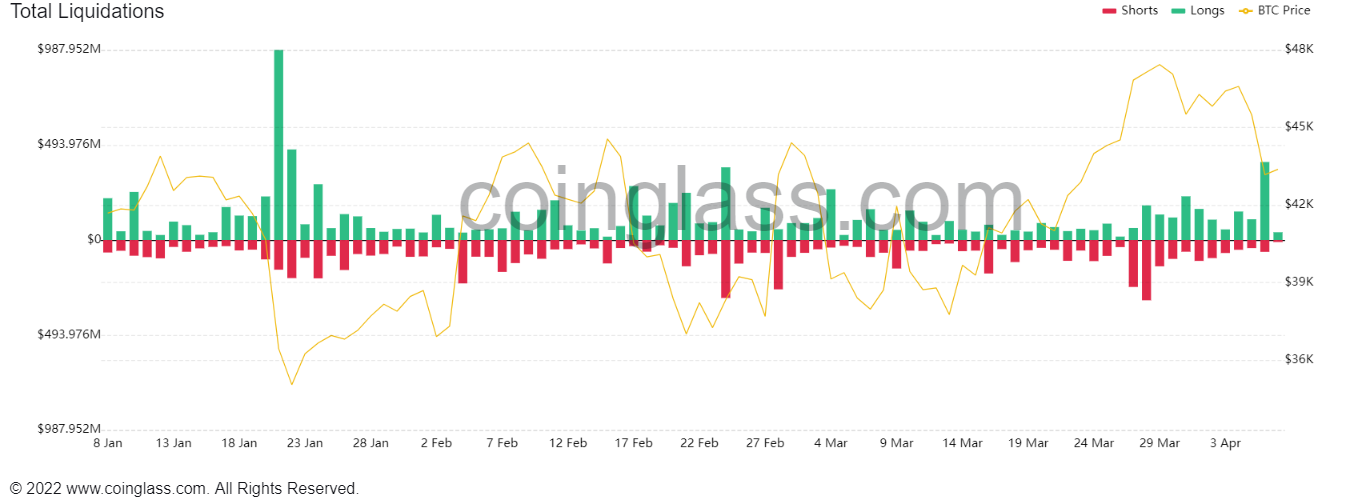
Wednesday saw over $400 million in liquidation losses. (Coinglass)
Liquidations occur when an exchange forcefully closes a trader’s leveraged position as a safety mechanism due to a partial or total loss of the trader’s initial margin. This happens primarily in futures trading, which only tracks asset prices, as opposed to spot trading, where traders own the actual assets.
Futures tracking Solana’s SOL and Dogecoin’s DOGE saw a combined $40 million in liquidation losses, the most among major cryptocurrencies outside of bitcoin and ether. Meanwhile, GMT tokens of the month-old crypto project StepN were an unusual entrant on the list with $9 million in recorded losses.
Both DOGE and GMT were among the top gainers in the past week. DOGE prices were buoyed amid speculation that Elon Musk’s appointment to the Twitter board would be a positive catalyst for Dogecoin’s growth, while Stepn gained popularity among traders for its unique step-to-earn approach.
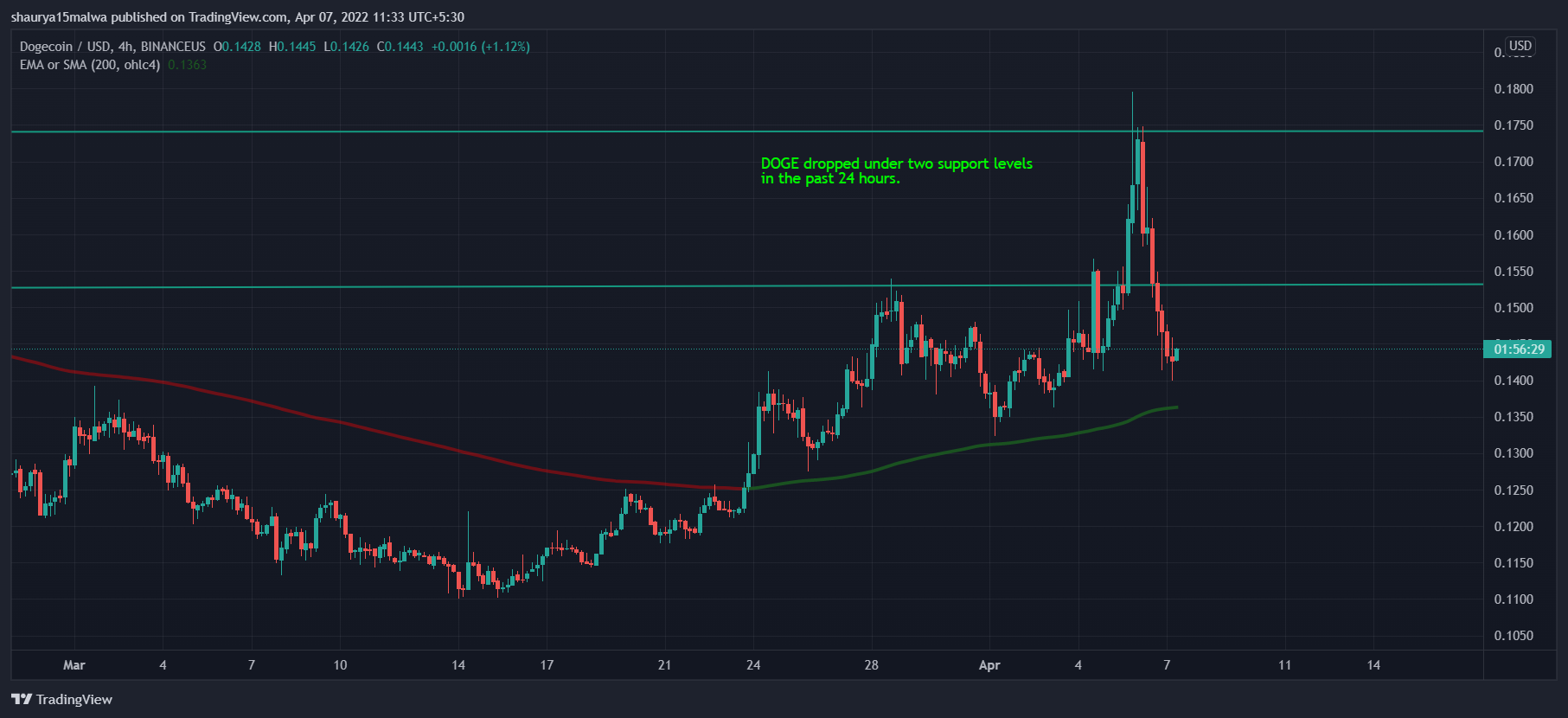
DOGE dropped steeply after a rise earlier this week. (TradingView)
Bitcoin futures racked up $92 million in losses, the most among all cryptocurrencies, followed by ether futures at $64 million. The losses continued in Asian hours on Thursday, with over $40 million in liquidations already recorded at writing time.
Data from tracking tool Coinglass show most liquidations took place on crypto exchange Binance, with over $133 million in losses. Traders on OKX and FTX saw the next highest losses with $100 million and $68 million respectively.
Some 83% of all traders were long, or betting on higher crypto prices, following a bitcoin drop to support at $45,000 on Wednesday. However, the asset has lost a further 5% since then and trades at $43,500 at writing time.
Author

CoinDesk Analysis Team
CoinDesk
CoinDesk is the media platform for the next generation of investors exploring how cryptocurrencies and digital assets are contributing to the evolution of the global financial system.