Bitcoin price dips to $61K but defends one of its most resilient macro uptrends ever
- Bitcoin price has retraced to $61K range, nearly 15% below its $73,777 all-time high recorded on March 14.
- After its ATH, BTC dipped 20%, marking deepest correction on a closing basis since FTX lows in November 2022.
- Amid a resilient macro uptrend, Bitcoin price consolidates in a falling wedge pattern.
- Former President Donald Trump says, "Biden doesn't even know what" crypto is, urging America’s pro-crypto community to vote for him.

Bitcoin (BTC) price is leaning to the south, with a price action characterized by lower highs. However, the big-picture outlook remains bullish. Tailwinds for BTC now sprout from US Election campaigns as well as reports that large holders continue to buy the dip.
Also Read: Bitcoin price drops, but holders with 100 to 1000 BTC continue to buy up
Daily digest market movers: Bitcoin bulls defends one of the most resilient macro uptrends ever
Since its all-time high on March 14 at $73,777, Bitcoin price has been unable to reclaim this level, with the price action thereafter characterized by lower highs. The lowest this dump has gone is a 23% fall to the May 2 intraday low after BTC bottomed out at $56,911.
Currently, Bitcoin price is about 20% below its all-time high, with Glassnode analysts observing that this “is the deepest correction on a closing basis since the FTX lows in [November] 2022.” Nevertheless, the big picture outlook for BTC remains bullish, with the “macro uptrend still passing as one of the most resilient in history, with comparatively shallow corrections thus far,” Glassnode notes.
Measured from the $73k ATH, #Bitcoin prices corrected by -20.3%, which is the deepest correction on a closing basis since the FTX lows in Nov-2022.
— glassnode (@glassnode) May 9, 2024
That said, this macro uptrend still appears to be one of the more resilient in history, with comparatively shallow corrections… pic.twitter.com/8WvCOGBV2R
Specifically, despite short-term fluctuations or market pressures, the overall long-term trend of increasing prices for Bitcoin remains intact. This resilience indicates that there is strong ongoing demand for Bitcoin and confidence in its future value. Investors are willing to hold onto their positions even during periods of volatility. It suggests that the market sees potential for continued growth in the value of Bitcoin over time.
Meanwhile, as US presidential election campaigns continue to heat up, former President Donald Trump is now pivoting on crypto and digital assets to attract voters from this burgeoning sector. In a recent statement, he said, “Biden doesn't even know what" crypto is, urging, “If you're in favor of crypto, you better vote for Trump.”
BREAKING: President Donald Trump says Biden doesn't even know what crypto is and if you support crypto you should vote for Trump.
— Donald J. Trump News (@DonaldTNews) May 9, 2024
What's your reaction?pic.twitter.com/12pkV6FxUF
Trump also committed to stopping the hostility toward crypto in the US, embracing the sector and announcing that he is accepting presidential campaign donations in cryptocurrency.
Bitcoin, altcoins, stablecoins FAQs
Bitcoin is the largest cryptocurrency by market capitalization, a virtual currency designed to serve as money. This form of payment cannot be controlled by any one person, group, or entity, which eliminates the need for third-party participation during financial transactions.
Altcoins are any cryptocurrency apart from Bitcoin, but some also regard Ethereum as a non-altcoin because it is from these two cryptocurrencies that forking happens. If this is true, then Litecoin is the first altcoin, forked from the Bitcoin protocol and, therefore, an “improved” version of it.
Stablecoins are cryptocurrencies designed to have a stable price, with their value backed by a reserve of the asset it represents. To achieve this, the value of any one stablecoin is pegged to a commodity or financial instrument, such as the US Dollar (USD), with its supply regulated by an algorithm or demand. The main goal of stablecoins is to provide an on/off-ramp for investors willing to trade and invest in cryptocurrencies. Stablecoins also allow investors to store value since cryptocurrencies, in general, are subject to volatility.
Bitcoin dominance is the ratio of Bitcoin's market capitalization to the total market capitalization of all cryptocurrencies combined. It provides a clear picture of Bitcoin’s interest among investors. A high BTC dominance typically happens before and during a bull run, in which investors resort to investing in relatively stable and high market capitalization cryptocurrency like Bitcoin. A drop in BTC dominance usually means that investors are moving their capital and/or profits to altcoins in a quest for higher returns, which usually triggers an explosion of altcoin rallies.
Technical analysis: Bitcoin price action consolidates in a falling wedge
Bitcoin price continues to consolidate within a falling wedge pattern, formed when the price consolidates between two converging trendlines that slope downward. As the price continues to move within this pattern, it usually indicates a temporary pause or retracement in a downtrend.
When the price breaks out above the upper trendline of the falling wedge pattern, it is often seen as a bullish signal. This breakout suggests that buying pressure is building up and that a potential trend reversal or uptrend could follow. Traders may interpret this breakout as a signal to go long or enter a buy position.
This is likely as Bitcoin price is also still holding in the upper section of the Bollinger Bands indicator, holding well above the centerline (a Simple Moving Average), which is trailing the price from below at $56,718. This shows bullish momentum is intact. Volatility is low given the proximity of the price to the SMA.
The immediate support for Bitcoin price is due to the Smooth Moving Average (SMMA) at $61,452. This support level holding adds to the upside potential for BTC.
The Relative Strength Index (RSI) has also managed a series of higher lows on the weekly time frame, which adds credence to the supposition that the macro uptrend remains very much intact.
As explained in a previous FXStreet publication, the profit target for the falling wedge pattern is a 20% move above breakout point to the area near $71,116. In a highly bullish case, Bitcoin price could extend to take back the $73,777 peak.
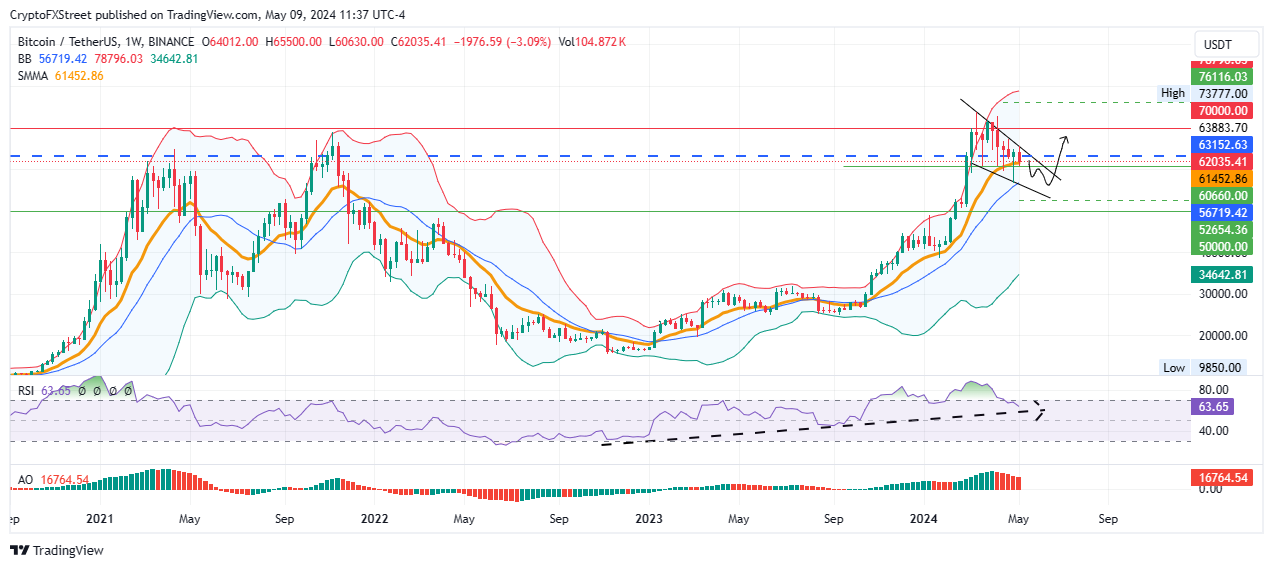
BTC/USDT 1-week chart
On the other hand, enhanced seller momentum could see the downtrend extend. A move below the centerline of the Bollinger indicator at $56,719 would encourage sell orders. The next logical target would be a retest of the previous liquidity pool below $60,660.
However, for the bullish thesis to be invalidated, the bears must shove BTC to break and close below 52,654 on the weekly time frame. This could see Bitcoin price provide another buying opportunity around the $50,000 psychological level.
Author

Lockridge Okoth
FXStreet
Lockridge is a believer in the transformative power of crypto and the blockchain industry.