Will tech lead a recovery on Wall Street after earnings?

After hitting a 15-year high in March of 2018, tech stocks have underperformed the broader market ahead of Q1 earnings season. Many large cap tech shares have pulled back after a robust run up versus the broader market. The ratio between the Technology Select Sector SPDR ETF (XLK) and the S&P 500 SPDR ETF (SPY) has dropped nearly 4% since mid-March but a combination of strong earnings and robust seasonals will likely drive tech shares higher.
The first quarter historically has been a solid quarter for the tech shares that make up the XLK. To determine the nature of how they perform, a seasonality test was run on the ratio of the XLK versus the SPY.
What is Seasonality?
Seasonality describes the performance of returns over a specific period of time. For example, you might assume that ahead of the kick-off of the summer driving season on Memorial Day, gasoline prices would move higher. You can also run a seasonality study of one security versus another to determine the strength of the returns and which generally outperforms during a specific period.
Chart showing relative performance of technology shares versus the S&P 500.
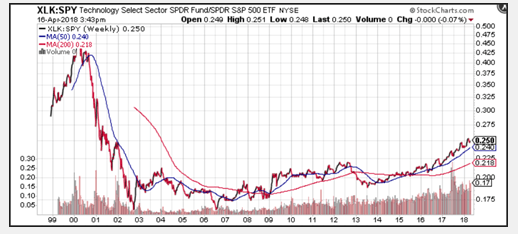
In looking at the relative performance of the XLK versus the SPY you can see that over the past 10-years the XLK has outperformed the S&P 500 index ETF 80% of the time, with an average outperformance of 1% during the month of May. Technology shares, represented by the XLK are higher 80% of the time for an average gain of 1.1%, while the SPY is up 80% of the time but for an average gain of a meager 0.1%.
The seasonal are even more convincing if you look at the past 5-years. During this period in the month of May, technology shares are up relative to the S&P 500 index 100% of the time for an average gain of 1.6%.
Why Have Technology Shares Pulled Back?
Technology shares have pulled back after hitting all-time highs in January along with the broader markets but have recently suffered given their strong outperformance over the last 12-months. As the markets face a deluge of concerns including trade tariffs, geo-political risks, and the risk that the White House will be stymied by a change of leadership in the House of Representatives, stocks have faced increased volatility. Higher volatility has increased the risk of holding higher beta stocks and has led to profit taking amongst some of the best performing technology shares. Investors are waiting not only to see earnings results but to see if guidance by technology companies has been hampered by the onset of volatility.
Summary
Over the past 5-weeks technology shares have underperformed the broader markets, ahead of earnings season. Historically technology shares have outperformed the broader markets in May following earnings, which can be analyzed using a seasonality study. Over the past 5-years, the XLK has outperformed the broader markets 100% of the time, notching up an average outperformance of 1.6%. Over the last 10-years the XLK has outperformed the SPY 80% of the time with an average outperformance of 1%. This would lead you to believe that technology shares are poised to outperform following earnings season.
The information and comments provided herein under no circumstances are to be considered an offer or solicitation to invest and nothing herein should be construed as investment advice. The information provided is believed to be accurate at the date the information is produced. Losses can exceed deposits.
Author

LCG Research team
London Capital Group
















