UK jobs report preview: GBP/USD set to react to figures that go with the Brexit mood
- The UK labor market is expected to remain once again.
- Top-tier economic data has been unable to keep up with Brexit developments.
- GBP/USD's reaction depends on the mood around Brexit talks.

Finding a job in the UK is more accessible than in the past and pay is rising – but that does not move the pound these days. The employment report is scheduled two days ahead of the critical EU Summit and 16 ahead of Brexit Day.
GBP/USD volatility has markedly risen – and that is good news for pound traders, who are looking for opportunities. Reactions to economic figures are unlikely to remain meager. However, volatility has risen due to Brexit, and headlines related to the UK's exit from the EU will also determine the magnitude of the move.
Wages in focus
Economists expect the Unemployment Rate for August to remain at the historic lows around 3.8% seen in July. More importantly, Average Earnings carry expectations for a deceleration – but to stay at high levels well above the inflation rate of 1.7% recorded in August.
With unemployment standing at historically low levels for a long time, economists expect salaries to rise. Higher pay may translation into higher inflation – causing the Bank of England to raise interest rates. In turn, higher rates push the currency higher. In case wage growth declines, so do expectations for inflation and higher rates – and the pound may follow.
Including bonuses, wage growth is projected to slow from 4% to 3.9%. Excluding bonuses – which is a better measure of salaries – a drop from 3.8% to 3.7% is on the cards.
Overall, wage growth has returned to pre-crisis levels:
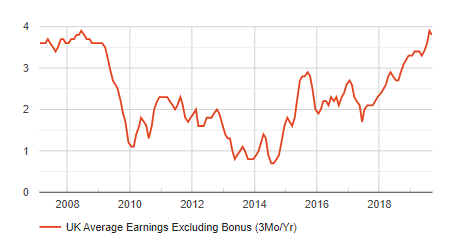
The change in earnings, excluding bonuses, is the most significant figure, yet a deviation of 0.1% from early projections would also be considered within expectations. An increase of 3.9% or more would be pound-positive, while a deceleration to 3.6% or below would weigh on sterling.
Should this figure come out within expectations, wages, including bonuses and the jobless rate, may come into play, but they may have a more muted impact on the pound.
Dependency on Brexit headlines
However, as mentioned earlier, the response depends on the market mood. An upbeat advance in pay will likely have a more significant positive effect if the UK and the EU are closer to a deal, and GBP/USD already enjoys an uptrend. If headlines are pessimistic, sterling may be unable to benefit from upbeat economic developments.
The same goes for a disappointing outcome. A substantial slowdown in wage growth may exacerbate cable's fall if headlines are pessimistic. However, if the market believes that a Brexit deal that can pass parliament is imminent – sterling will likely shrug off weak data.
Conclusion
The UK jobs report is a top-tier indicator that is set to move the pound. The reaction depends on the surprise going with the trend – and the direction depends on Brexit.
Author

Yohay Elam
FXStreet
Yohay is in Forex since 2008 when he founded Forex Crunch, a blog crafted in his free time that turned into a fully-fledged currency website later sold to Finixio.