The game of deal or no deal is still on.


Thanksgiving didn't disappoint the bulls.
As a bear, I was hoping this year would be different but of course, it wasn't. The odds of a Thanksgiving rally in the equity markets are high; light volume tends to favor melt-ups because the "buy and hold" investors are busy celebrating the holidays while the active traders (most of which are short) are biting their nails and collectively causing the same annual short squeeze they are suffering from.
The recent sell-off is being blamed on Trump's trade deal comments but in my view, the market was simply looking for a reason to sell. The indices were massively overbought and the last buyer appeared to be in (last week saw massive inflows into the stock market). Further, US corporations have altered their supply chains leaving the relationship between the US and China less critical than it was at the beginning of this skirmish. In short, whether we get a deal or no deal, might not even be material at this point.
It is also important to note that despite two days of hefty selling the S&P 500 is essentially back to where it was a few weeks ago (a time in which we all thought the market was lofty). President Trump was mocked when he referred to this sell-off as "peanuts" but so far that is all it has been.
Treasury Futures Markets
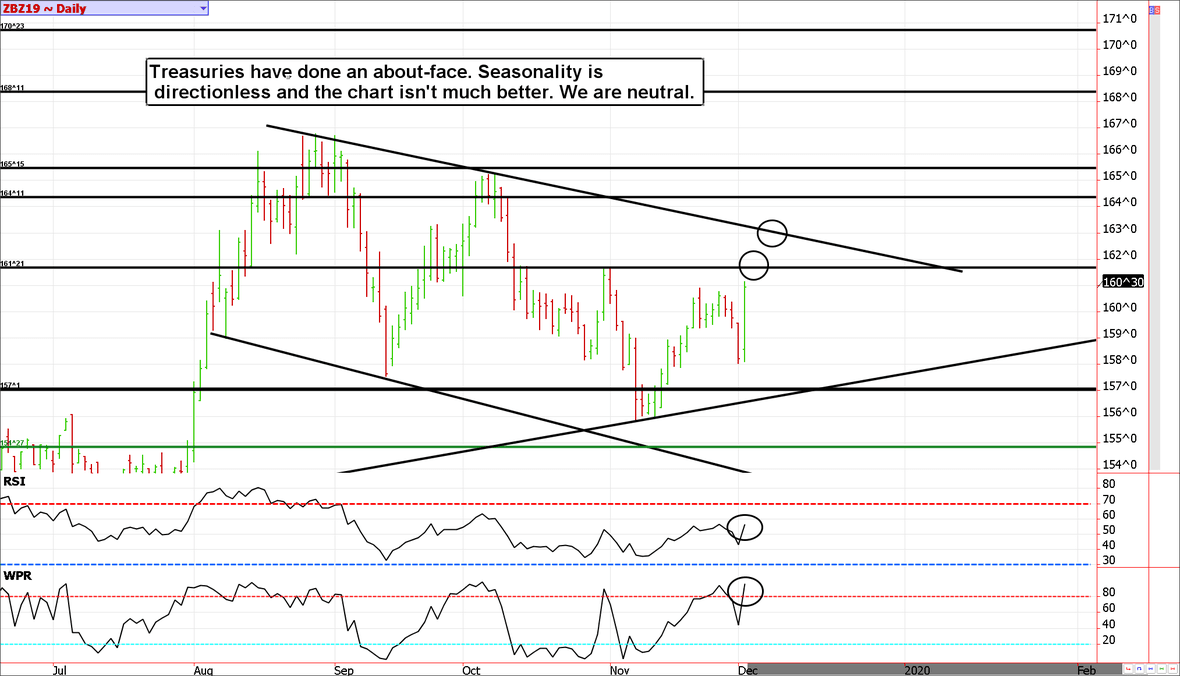
30-year Treasury Bond Futures
Flight to safety in Treasuries.
Treasuries appear to be benefiting from the stock market's losses as investors allocate away from risk and toward what they believe to be safer assets. Gold and sliver also went along for the ride. Yet, we aren't ready to jump on the bond bandwagon just yet. Treasury seasonals are mixed, at best, and the chart is unconvincing. At this time, we are neutral and have little insight to offer.
*YOU SHOULD BE TRADING THE MARCH CONTRACT.
Treasury futures market consensus:
We are neutral and waiting for the next clue.
Technical Support: ZB : 155'02 and 153'30 ZN: 130'14, 132'06, and 133'0
Technical Resistance: ZB: 161'15, 165'04, and 167'09 ZN: 128'04, 127'08, 126'06.
Stock Index Futures
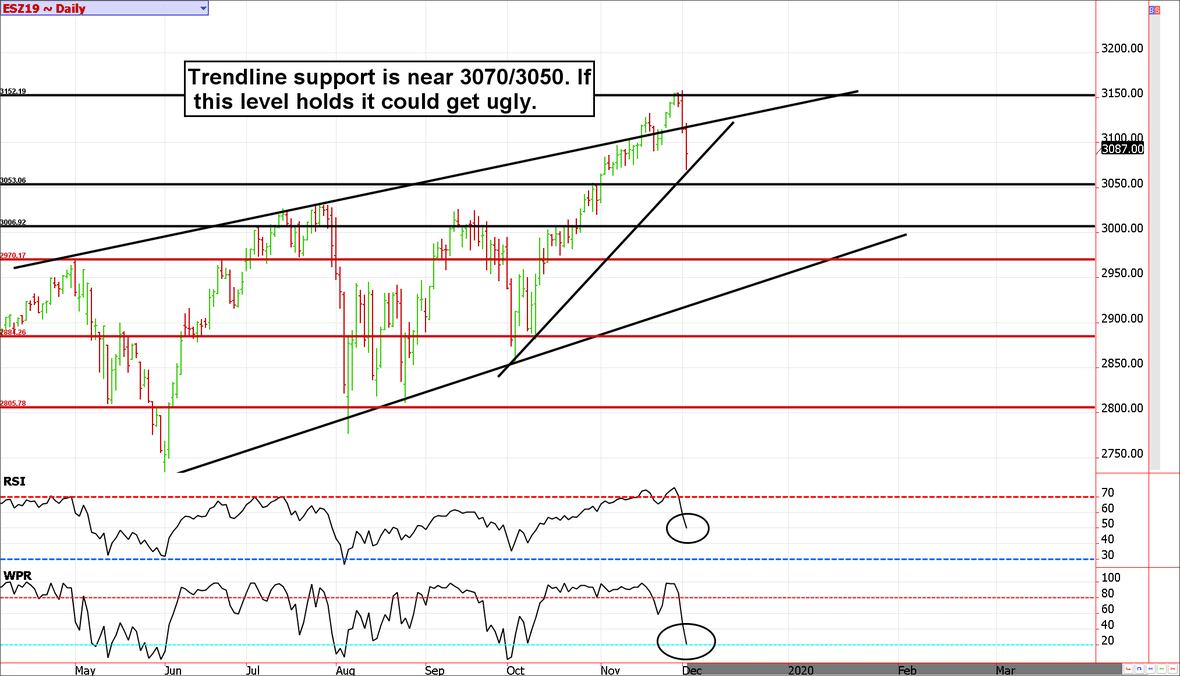
Shoulda, woulda, coulda...
As it turns out, 3150 was the magic number for the ES. We had acknowledged this level as a real possibility, but despite pinpointing it well in advance we had lost most of our conviction "up there" and failed to recommend adding to shorts (as was the original plan). Things could have been worse, though.
We are certain the Thanksgiving rally took its toll on the bears. Not only was it a painful and one-directional rally, but it also occurred in the midst of a shortened holiday trading week. This made for a difficult trading environment, opening the door for plenty of mistakes. We suspect quite a few bears missed the trade or were squeezed out before the move occurred and many of the bulls probably missed their chance to lock in profits.
Trendline support in the December contract will be 3070/3050; this is where things get interesting. A break and hold below could get (temporarily) ugly.
Stock index futures market consensus:
3150 was the magic number on the upside, the critical pivot area on the downside will be 3070/3050.
Technical Support: 3050, 3006, 2970, 2887 and 2805
Technical Resistance: 3150 and 3175
E-mini S&P Futures Day Trading Ideas
These are counter-trend entry ideas, the more distant the level the more reliable but the less likely to get filled
ES Day Trade Sell Levels: 3137, 3157, and 3173
ES Day Trade Buy Levels: 3062, 3019, 2994, 2977, 2955, and 2926
In other commodity futures and options markets...
September 12 - Roll the September Bloomberg Commodity Index into the December contract.
December 13 - Roll the December Bloomberg Commodity Index into March.
February 21 - Exit half of the Bloomberg Commodity Index futures position (we added on a dip in January).
June 14 - Roll BCI into the September contract and double the quantity (to dollar cost average).
July 25 - Go long the euro currency using a micro futures contract.
September 6th - Sell vertical spreads in December cattle using the 95 and 90 put.
September 11 - Buy March sugar 12.50 calls near 46 ticks.
September 16 - Exit the diagonal spread in hogs to lock in roughly $450 before transaction fees.
September 24 - Exit credit spread in December cattle to lock in about $350 per lot before transaction costs.
September 25 - Buy January orange juice 110 calls for about 2.50 ($375).
September 30 - Sell December silver 16.00 put and purchase the November 15.75 put for a net credit of 10 cents ($500) before commissions and fees.
October 3 - Sell March eurodollar (interest rate future) near 98.44.
October 3 - Sell December 10-year note 133 call and buy the November 135 call for a net credit of about 32 ticks or $500.
October 10 - Buy back silver 16 put to lock in gain on that leg of the trade near $330 per lot before transaction costs.
October 10 - Buy back 10- year note 133 call to lock in roughly $300 per lot on that leg of the trade.
October 16 - Offset British Pound future to lock in the gain near $1.2820ish. Most were essentially long from the $1.2200 level (after considering the rollover).
October 24 - Sell diagonal call spreads in live cattle (sell the February 128 call and buy the December 125 call for a net credit of about $470 before transaction costs.
October 28 - Exit March eurodollar future to lock in moderate gain ($375 to $450 per contract for most).
October 28 - Sell S&P 500 futures in a SMALL way using Micro E-mini or E-minis depending on account size and risk tolerance.
November 7th - Sell the February 127 put and buy the January 124 put in the ZN to collect about 33 ticks.
November 7th - Add to micro ES short future position (double the current quantity).
November 14th - take a quick profit on the ZN diagonal spread.
December 3 - Offset half of the short S&P positions.
Seasonality is already factored into current prices, any references to such does not indicate future market action.
There is substantial risk of loss in trading futures and options.
Author
Carley Garner
DeCarley Trading
Carley Garner is an experienced commodity broker with DeCarley Trading, a division of Zaner, in Las Vegas, Nevada. She is also the author of multiple books including, “Higher Probability Commodity Trading” and “A Trader's First Book on Commodities”.