Sector Snapshot: Home construction stocks look constructive, despite rising rates

"We're in a rising interest rate environment, haven't you heard?"
I've been reading variations of the Rising Interest Rate Environment™ argument for far longer than...well far longer than interest rates have actually been rising. Going all the way back to 2010, pundits have been warning that the Fed would have to hike interest rates dramatically to counteract the inflationary impact of all the Quantitative Easing "helicopter money." As the chart below shows, you'd really have to cross your eyes to see a Rising Interest Rate Environment™ in the benchmark 10-year Treasury bond:
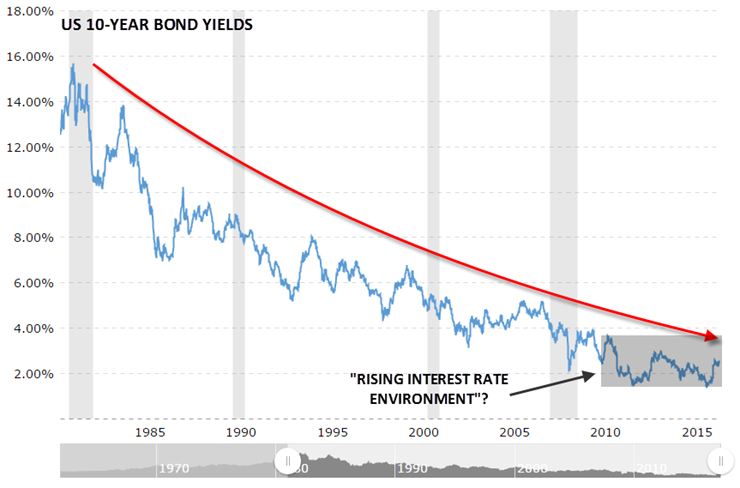
So color me skeptical when the pundit who's constantly been proven wrong over the last 7 years declares that this is the time that interest rates start to rise in earnest, for real. That said, you could certainly make an argument that we're finally seeing economic indicators like hourly wages and consumer confidence accelerate, at a time when the Fed is increasingly eager to build up some "dry powder" to combat the next recession whenever that may come.
Bringing this high-level macroeconomic discussion back to actionable investing ideas, if you truly believe we're entering the long-awaited Rising Interest Rate Environment™, one of your first thoughts would to avoid the stocks of homebuilders. After all, rising mortgage rates make buying a house more expensive, all else equal.
In this case too, the intuitive, conventional wisdom is apparently off-base.
As the chart below shows, US homebuilders have actually been rising impressively so far this year. Indeed, the Home Construction ETF (ITB) is actually the strongest industry that I track in my "Markets at a Glance" spreadsheet year to date. Perhaps even more surprisingly, the correlation between the homebuilder ETF and the 10-year treasury yield (which is also used to price mortgage rates) has turned positive since the election:
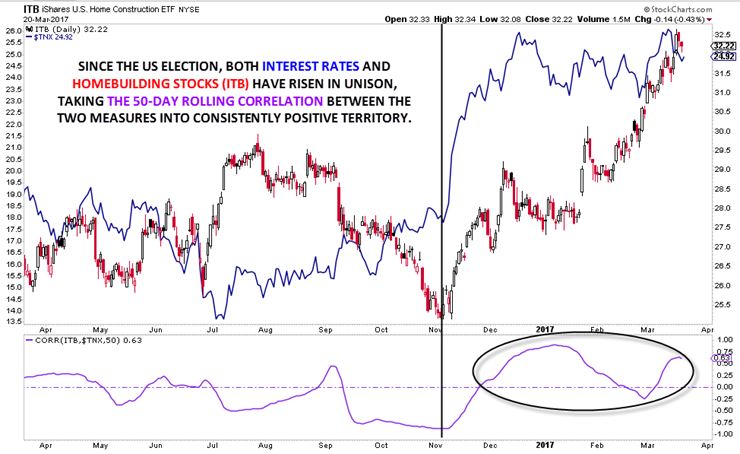
So what's happening here?
The most compelling explanation I've heard is that millennials, scarred by the slow economic recovery after the Great Recession and burdened by unprecedented student loan debt loads, have been postponing their initial home purchases. While they still have the "American Dream" of home ownership, they haven't felt a sense of urgency to act on that dream. The recent rise in interest rates has reminded those millennials that interest rates actually CAN rise, despite their experiences as adults so far, and has therefore pulled them off the sidelines. This rising demand for lower-end "starter homes" has had a knock-on benefit for the entire housing market by allowing the young families who were previously stuck in their starter homes to upgrade and so on.
Regardless of the fundamental/psychological explanation behind the move in homebuilder stocks, it's clear that the predicted "inverse correlation" with interest rates needs to be revisited. If we finally are entering the much-anticipated Rising Interest Rate Environment™, that doesn't necessarily mean that homebuilder stocks can't extend their gains.
Author
Matt Weller, CFA, CMT
Faraday Research
Matthew is a former Senior Market Analyst at Forex.com whose research is regularly quoted in The Wall Street Journal, Bloomberg and Reuters. Based in the US, Matthew provides live trading recommendations during US market hours, c