Mission Impossible: Tariffs Didn't Reduce the Trade Deficit (Deals Won't Either)


Trump is on an impossible mission. Tariffs will not reduce the trade deficit and will likely make matters worse.
To fully understand Trump's trade dilemma, consider the following chart.
Trump's Current Account and Trade Deficit Problem in One Picture

Identity
Government Saving + Private Saving = Exports - Imports
The identity is not debatable, but it is misunderstood.
Exports and imports are not just about trade. One must factor in capital, thus my annotation about foreign direct investment.
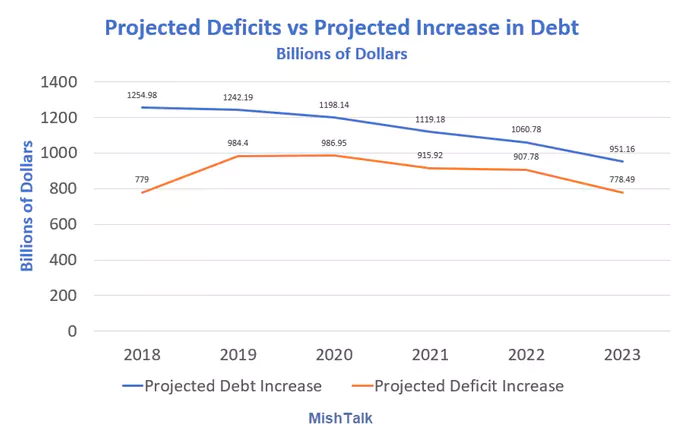
For the government "saving" component, pencil in deficits in excess of $1 trillion dollars for five years.
Projected Deficits vs Projected Increase in Debt
For more details, please see my post Projected US Budget Deficit Lie in Four Pictures.
The important point as relates to this article is the increase in debt is the true deficit.
This happens because the projected deficit does not include all of the amount owed to the Social Security Trust Fund. That amount is called off-budget. But when the calendar year rolls over, the difference magically appears on the balance sheet as actual debt.
Trump Tax Cuts
Regardless of what you think of them, the Trump tax cuts, unaccompanied by spending cuts dramatically increased deficits.
That money has to come from somewhere.
Tariffs Not the Answer

Tump's Tweet is absurd in theory and practice. The deficit has risen since Trump went on his "Tariff Man" binge.
Options
- Increased consumer saving (fewer consumer purchases)
- Increased business saving (lower capital spending)
- Increase in the trade deficit
- Increase in direct US Investment from abroad
Those are the options.
Capital Flows Dwarf Trade Flows
I bounced some ideas off Michael Pettis at China Financial Markets.
He responded "Capital flows have grown so much that investment flows wholly overwhelm trade flows. A s a result, one country’s trade imbalances with another can easily be the consequence of capital flows created by distortions originating elsewhere."
Current Account Balance vs Trade Balance

Thus the increased fiscal deficit does not guarantee an increased trade deficit.
Analyzing Mexico
Pettis added this important point: "Tariffs on foreign goods don't necessarily reduce the trade deficit. In fact they may actually increase them if they make foreigners more eager to invest in the US."
He explains why in Mexico’s Positive Impact on the U.S. Trade Balance.
Contrary to what one might first expect, Mexico’s role in global trade is actually beneficial to the United States. While restricting Mexican imports will reduce the American deficit with Mexico, it will increase the overall American deficit.
Nixon Closed the Gold Window
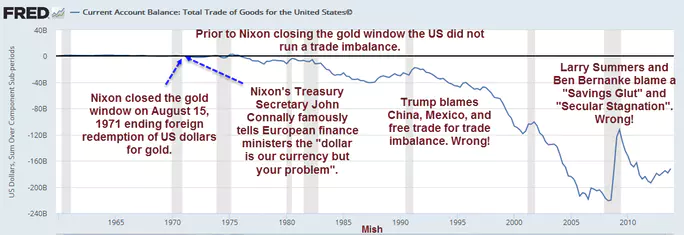
Note that these imbalances started after Nixon closed the gold window.
Pettis Comments on the Gold Window
I suspect that the ballooning of the inflows and the closing of the gold window may have been the consequence of the same processes.
My basic view of the relevant history is that at some point in the very late 1800s and early 1900s, advanced economies (mainly the UK but also Western Europe and even the US) had reached the stage economists had never considered, in which investment was no longer constrained by the scarcity of savings. Income levels were high, leading to plenty of available savings, and there was so much existing capital stock. John Hobson in the UK and Charles Arthur Conant in the US were probably the first to notice this and discuss the implications. But the destruction wrought by two world wars changed all of that by destroying savings (by destroying wealth) and creating new investment needs (by destroying infrastructure and manufacturing capacity). However by the late 1960s and early 1970s much of the advanced world had been substantially rebuilt, returning us to the condition of excess savings.
Excess Savings
I am not a subscriber to the excess saving theory. Rather, I believe that governments and central banks have so distorted money, it is difficult to know what the pool of real savings is.
In the traditional sense, savings = production - consumption. Printing money does not constitute saving, it constitutes distortions that have benefited the banks and wealthy at the expense of the middle class and poor.
That's a debate for another time.
Meanwhile, I greatly appreciate, as always, discussion from Michael Pettits. In my estimation, he is the world's leading authority on trade.
He will have a new book out shortly and I look forward to reviewing it.
Meanwhile, it is safe to conclude, Trump is on a mission impossible path that cannot possibly work, at least as he expects.
Recession, a Means to the Goal
Note the recession bars in the top image, then ponder my recent post: Trump Again Threatens Europe With Tariffs: Expect Instant Global Recession.
If Trump "succeeds" in reducing the trade deficit with his policies, he's highly likely to cause a global recession in the process.
Author
Mike “Mish” Shedlock's
Sitka Pacific Capital Management,Llc

















