Market struggling with risk appetite/aversion

Outlook:
When the payrolls number is released this morning at 8:30 am ET, we will have the expectations vs. the actual issue, but with two sets of expectations. We also get the usual second thoughts over the details—chiefly the participation rate and average wages. At a guess, discussion of this critical indicator will be cut short by talk about the US airstrike against Syria, which has more questions than answers so far.
It's not clear that the geopolitical situation will shift the economic Big Picture. Which is it, the pessimistic forecast of the 10-year yield at 2.25% or the other view, 2.60%? Which one you like, and how it affects equities, is going to be a big factor in the dollar's fate. Similarly, in the same hour you can read that oil is going back to $40 or up to $65, depending on which factors seem most influential. This, too, will affect the dollar through the supply chain through the inflation data to the Fed to yield curve. War generally lifts the oil price, but we don't actually have war. We have one incident.
We are not going to get answers soon and certainly not from payrolls, although it's interesting that the skilled labor shortage does seem to be real. We have yet to see wages respond, though. The shortage is "soft" and the wages are "hard."
Something else we are struggling with is risk appetite/aversion. Of the majors, dollar/yen is most influenced by the risk environment. North Korea provoking both China and the US by lobbing missiles into the sea presumably raises risk aversion, but in the absence of anything specifically scary, business does go on, including Japanese manager allocations to foreign markets. On the basis of rate differential leading to yield-seeking capital outflow, you'd expect the yen to be softening. Instead it has been firming since January, albeit not in a straight line.
In fact, we may have a double bottom with the March 27 low (110.08) not quite matched by the low on April 4 at 110.23. These were the lowest lows since last November. A double bottom is a positive pattern— for the dollar. But it's not developing, at least not yet, suggesting that it must be risk aversion holding it back, since it can't be a change in Japanese monetary policy.
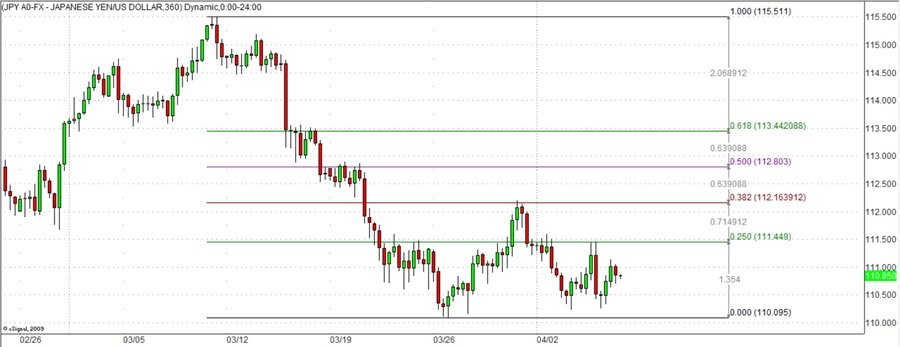
Let's assume the geopolitical situation doesn't worsen and may, perhaps, improve on the Trump-Xi talks yesterday and today. Trump is eager and even anxious to get a trade deal with the Chinese in order to satisfy his campaign promise. The appearance of smoother relations might be construed as a drop in riskiness, although technically Syria is an "ally" of China, so who knows? Once the dust settles, we "should" get a rise in the dollar/yen to the inverted neckline at about 112.16 and perhaps thence to the 62% retracement at 113.44. But we have been waiting for this trade for a long time now. Nobody can say if and when the dust will settle.
Going unnoticed amid the Syria event are a number of otherwise newsworthy items, including a top Trump advisor (National Economic Council director Cohn) calling for the breakup of the big banks. This puts Trump on the same page as Elizabeth Warren. Populism makes strange bedfellows. The idea is specialization in consumer lending vs. all the rest. Such a division is obviously sub-optimal and will reduce cross-sector flow efficiencies by a lot. But it's also punishment for not putting the mortgage jackasses in jail in 2009, which we still say is the single most powerful driving force behind the surge in populism in both political parties.
Also in the US, the intelligence committee chairman who provided a sideshow to distract attention from the FBI's investigation into Trump-Russia relations recused himself from the committee (two weeks late) and is under investigation by the ethics committee. This is named "falling on your sword." The Saudis are starting their bond sale roadshow on Sunday to raise $10 billion. And oh yes, Greece (remember Greece?) agreed to a raft of reforms that will allow the EU to fork over another tranche of cash (€6 billion of €86 on the table) so Greece can pay its debt maturing in July. The FT reports the reforms are not due until 2018 and 2019. Somehow this is supposed to satisfy the IMF and bring it back to the table but quite how that works is not clear. Also, BoE Gov Carney is supporting PM May in not singling out financial services as a special case in talks with the EU. The financial sector can takes its lumps along with farmers. Pretending the financial sector is not central won't fool the EU guys for a minute.
We expect a new deal between China and the US by the end of the day. It might—possibly—take the lead from payrolls and war.
Politics and War: Tr ump, and pr esumably Secy Tiller son, made a 180 degr ee about -face on Syria. For years the stance was "not in our self-interest to intervene" and now suddenly it's in the US "national security interest" to show some muscle. At the same time, Trump just put some 1000 US troops on the ground in Syria at greater risk.
Military analysts say Assad was deliberately provoking Trump, as hostiles are wont to do in a new president's first few months. Trump would rather be seen as "flexible" on a policy than wimpy. Besides, Tomahawks are so macho. Let's hope Chinese president Xi was suitably impressed, not by the decision but by whatever strategic and military expertise he could detect that lay behind the missile attack. In the end, the judgment thus far is that the attack was precisely the correct "proportional" response to a dictator gassing his own civilians.
The problem, of course, is nobody knows what happens or should happen next. Nothing has really changed. Assad remains in power—there is no regime change. There is no "Trump foreign policy," either. Congress demanded its right to declare war in the identical Obama episode but then refused to consider taking action. They won't get away with that this time. Senator McCain said, before the attack, he would make the entire Syrian air force inoperable. Sounds like a good second step. But that's one guy, not Congress.
Who will decide what happens next? Trump has no plan but he does have decent military advisors and nobody has more plans than the military. They have plans to make plans. Trump doesn't have to think; he just has to choose.
There is plenty to chew on. For one thing, Putin personally negotiated the Syrian government commitment to destroying chemical weapons—all of them. Does that mean Assad went behind Putin's back and if so, is he now embarrassed and chastened? What is Putin's next step? So far we have a statement that the US assault does "great damage to the US-Russia relationship" and the missile strikes "violate international law and constitute aggression against a sovereign state." Iran protested, too.
It seems like Russia is on the evil side of things in the Middle East, associating itself with Syria, Iran, and Hezbollah. We know it likely has a long game and right now that looks like pointing to US-Russia war. But that would be stupid. The US has far more military and economic power.
Trump is positioning the US as world leader and on the moral high ground. He said "No child of God" should suffer such horror." This is the first time anyone has ever heard Trump say the word "God." No one believes for a minute that Trump is ruled by a moral compass. And while the US response is proportionate according to the military rulebook, we can't stop worrying that the impulse to bully is just that—impulsiveness and bullying. Again, good thing the military is really good at planning. We shall see if planning trumps tweets.
And we want to know which prime ministers and presidents were told ahead of time. The UK, France and Germany, along with NATO, were notified by Defense Sec Mattis, but not, evidently, Turkey, Israel or the King of Jordan, whose chair in the White House is still warm. The State Dept, that would normally handle such notifications and consultations is empty and unmanned. The Russians were told through the hotline, but that's not the same thing as picking up the phone to Putin.
What is the legal basis for the US attack? It's not "shoot first and ask questions afterwards." Remember all that planning the military engages in. The US can't rely on the UN to authorize military action. The UN's hands are tied because it would take a Security Council resolution and that would need Russia and China. We don't even ask. Technically, the use of military force is illegal under international law except with Security Council blessing, in self-defense or upon invitation. The first and third excep-tions don't apply so that leaves self-defense.
In fact, it's Russia who was invited to manage military forces in Syria. According the Responsibility of States for Internationally Wrongful Acts of the International Law Commission, Article 20, "the princi-ple of intervention upon invitation can only stand as a legal basis if no actions taken by the invited state constitute a violation of pre-emptive norms of international law – otherwise, the principle is thereby nullified." In other words, Russia failed its duty and has violated this law, so its "intervention by invita-tion" loses its legal justification. And opens the door for the US "self defense" argument.
We heard more complicated (and confusing) justifications on TV last night and no doubt will hear plenty more in the days to come. On the home front, the hypocrisy is stunning. Technically, the presi-dent cannot declare war. That's Congress' job. The 1973 War Powers Resolution requires the president to "consult with Congress" before sending troops into combat. This time Trump did advise several top Congressmen, including Speaker Ryan, ahead of the missile attack. But he didn't ask for permission and didn't need to, because he can claim to be acting under a clause in the Resolution that allowed Bush to invade Iraq and Obama to bomb Libya. Obama asked Congress for a declaration of war against the Islamic State in 2015 but Congress declined. At a guess, Congress (and the voters) will become newly enamored of a macho president providing "leadership" and will give Trump anything he asks for. And if they don't, he will act anyway. A new stage in geopolitics has begun. Start praying for American generals.
| Currency | Spot | Current Position | Signal Date | Signal Strength | Signal Rate | Gain/Loss |
| USD/JPY | 110.64 | SHORT USD | 03/21/17 | STRONG | 112.51 | 1.66% |
| GBP/USD | 1.2432 | SHORT GBP | 04/07/17 | NEW*WEAK | 1.2432 | 0.00% |
| EUR/USD | 1.0638 | SHORT EURO | 04/07/17 | NEW*WEAK | 1.0638 | 0.00% |
| EUR/JPY | 117.71 | SHORT EURO | 03/28/17 | STRONG | 120.19 | 2.06% |
| EUR/GBP | 0.8557 | LONG EURO | 03/02/17 | WEAK | 0.8575 | -0.21% |
| USD/CHF | 1.0052 | LONG USD | 04/07/17 | NEW*STRONG | 1.0052 | 0.00% |
| USD/CAD | 1.3388 | LONG CAD | 04/06/17 | WEAK | 1.3425 | -0.28% |
| NZD/USD | 0.6968 | LONG NZD | 03/28/17 | WEAK | 0.7022 | -0.77% |
| AUD/USD | 0.7528 | SHORT AUD | 03/28/17 | WEAK | 0.7607 | 1.04% |
| AUD/JPY | 83.74 | SHORT AUD | 03/22/17 | STRONG | 85.20 | 2.25% |
| USD/MXN | 18.7440 | SHORT USD | 01/31/17 | WEAK | 20.8108 | 9.93% |
This is an excerpt from “The Rockefeller Morning Briefing,” which is far larger (about 10 pages). The Briefing has been published every day for over 25 years and represents experienced analysis and insight. The report offers deep background and is not intended to guide FX trading. Rockefeller produces other reports (in spot and futures) for trading purposes.
To get a two-week trial of the full reports plus traders advice for only $3.95. Click here!
Author
Barbara Rockefeller
Rockefeller Treasury Services, Inc.
Experience Before founding Rockefeller Treasury, Barbara worked at Citibank and other banks as a risk manager, new product developer (Cititrend), FX trader, advisor and loan officer. Miss Rockefeller is engaged to perform FX-relat

















