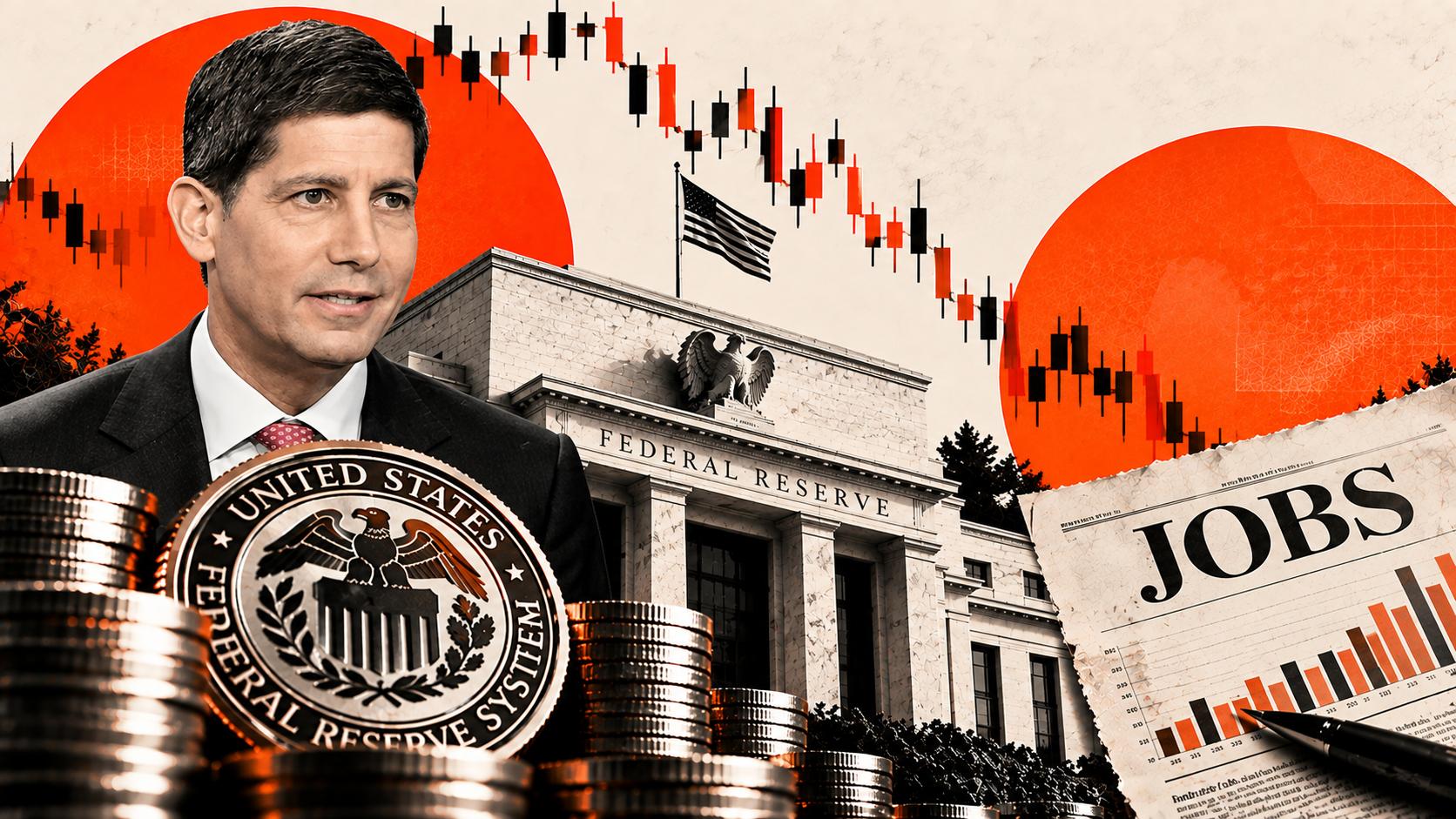
US Dollar Weekly Forecast: US NFP and CPI grab all the attention
- The US Dollar closed the week with gains after two drops in a row.
- The ‘Warsh trade’ has been supporting the Greenback’s recovery.
- The Fed is expected to ease by almost 58 basis points by year-end.

Finally, the recent steep leg lower in the US Dollar (USD) has found some respite.
Indeed, the US Dollar Index (DXY) has managed to regain some composure and put further distance from the yearly lows near 95.50 recorded in late January, reaching the boundaries of the 98.00 yardstick toward the end of the week.
Meanwhile, the improvement in the index has come in tandem with the investors’ assessment of what a Federal Reserve (Fed) under Kevin Warsh might look like. Market participants continue to factor in a couple of interest rate reductions in the future, but the likelihood of a more aggressive easing appears unlikely, at least for now.
In the US money market, Treasury yields faded part of the weekly pullback on Friday, but they could not help closing the week in the red across various maturity periods.
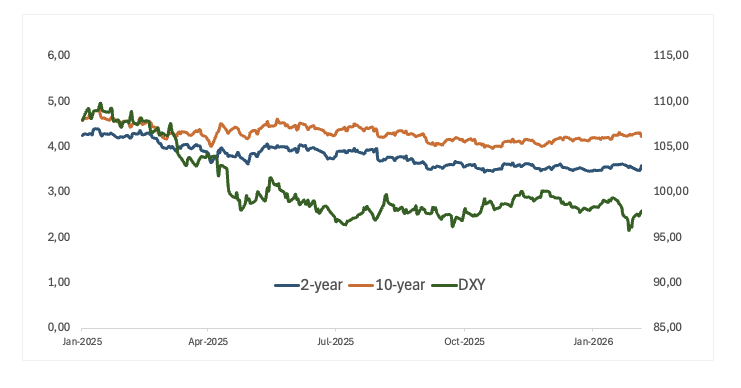
Fed stays on hold as confidence edges higher
The Federal Reserve left rates unchanged at its January meeting, holding the fed funds target range at 3.50%-3.75%, in line with expectations. The tone of the statement was marginally more upbeat, with policymakers pointing to solid growth and dropping earlier references to rising downside risks to employment.
Chair Jerome Powell said the current policy stance is still good, pointing out signs that the labour market is stabilising and that service inflation is still going down. Powell said the recent rise in inflation has mostly been caused by tariffs on goods. The Fed expects this to peak around the middle of the year.
Powell reiterated that policy decisions will remain meeting by meeting. He stressed that further rate hikes are not the base case and suggested that risks to both sides of the Federal Reserve’s dual mandate have eased.
Mixed Fed signals underline uncertainty over easing
Fed speakers this week highlighted a policy debate that remains very much alive. Some voting members are openly leaning towards sizeable rate cuts, while others are still pushing back, worried that inflation progress could stall. For markets, the takeaway is not just about timing but about how wide the gap remains inside the Committee:
Stephen Miran (Board of Governors, voter) continued to argue for aggressive easing. He said he was looking for more than a full percentage point of rate cuts over the course of the year, underlining his view that policy remains too restrictive. His comments followed President Donald Trump’s announcement that former Fed official Kevin Warsh would be his pick to lead the central bank, adding political context to the remarks.
Tom Barkin (Richmond Fed, non-voter) took a more measured stance. He said the rate cuts delivered so far have helped ensure the labour market while the Fed works through what he described as the last mile in bringing inflation back to 2%. Looking ahead, he said he expects the economy to remain resilient into 2026, supported by potential deregulation, tax cuts and continued confidence from firms about demand.
Lisa Cook (Board of Governors, voter) struck a distinctly cautious tone. She said she is more concerned about stalled progress on inflation than about a weakening labour market, signalling she would not back further rate cuts until price pressures, particularly those linked to last year’s tariffs, begin to ease more clearly.
Mary Daly (San Francisco Fed, non-voter) focused on risks beneath the surface of the labour market. While she said businesses remain cautiously optimistic, she noted that households are far less confident, aware that the current low-hiring, low-firing environment could quickly turn into one with fewer job openings and more layoffs.
All in all
This week’s comments reinforce that policy direction is still up for debate. With voting members divided between aggressive easing and inflation caution, expectations for rapid rate cuts remain vulnerable to pushback from within the Fed.
Markets price cuts, the Fed sees work still to do
The latest US inflation data came in exactly as expected. In December, both headline and core Consumer Price Index inflation rose at a steady pace. Headline inflation held at 2.7% YoY, while the core measure remained at 2.6% over the past twelve months.
Overall, the figures reinforced the disinflation narrative and encouraged market speculation that the Fed could begin cutting rates again in the coming months. That said, the outlook remains uncertain. The impact of US tariffs on household costs is still unclear, and several Fed officials have stressed that inflation remains too high and above the 2% objective.
Dollar shorts trimmed, but bearish bias lingers
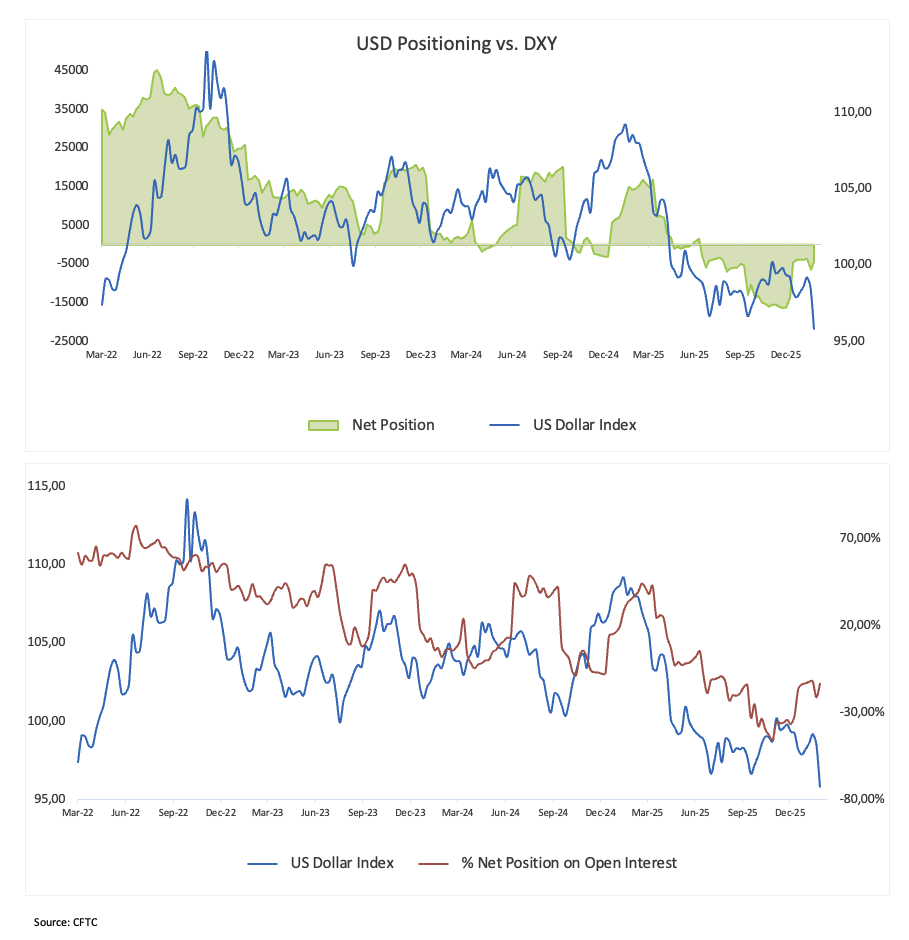
According to the Commodity Futures Trading Commission, non-commercial traders reduced their net short positions in the US Dollar to two-week lows around 4.4K contracts. In addition, open interest rose to nearly 31.8K contracts, reversing two weekly drops in a row.
Given the already bearish setup, it is likely that the market has priced in much of the negative news. The increase in open interest suggests fresh participants are entering the market, even if overall sentiment toward the Dollar remains cautious.
What’s next for the US Dollar
Attention now turns to the US labour market. Next week’s Nonfarm Payrolls report is expected to be the main market driver toward the end of the week, alongside the release of fresh US inflation data from the Consumer Price Index.
Markets will also stay alert to any new remarks from Fed officials following last week’s policy meeting, with investors keen to assess how firmly policymakers are pushing back against expectations of near-term rate cuts.
Technical landscape
The US Dollar Index (DXY) seems to have met an important resistance zone near the 98.00 mark, or monthly highs.
Once the index clears this region, it could attempt a test of the 98.50-98.70 band, where the interim 55-day and 100-day SMAs and the more relevant 200-day SMA all converge. North of here emerges the 2026 ceiling at 99.49 (January 15).
On the downside, immediate contention comes at the 2026 bottom at 95.56 (January 27) prior to the February 2022 floor at 95.13 and the 2022 base at 94.62 (January 14).
Furthermore, momentum indicators keep favouring extra pullbacks. Indeed, the Relative Strength Index (RSI) recedes to around the 47 region, while the Average Directional Index (ADX) above 29 suggests that a firm trend remains in place for now.
-1770400746516-1770400746517.png)
Bottom line
Much of the recent recovery in the Greenback appears to be Fed-driven, almost exclusively following President Trump’s appointment of Kevin Warsh as Jerome Powell’s successor. Moving forward, investors are expected to closely follow results from US hard data.
That said, the labour market remains the key focus for the Fed. Policymakers are watching closely for any clear signs of weakening, but inflation is still very much part of the equation. Price pressures remain uncomfortably high, and if progress on disinflation starts to stall, expectations for early or aggressive rate cuts could quickly be pared back.
Against that, the Fed would likely stick with a more cautious policy stance and, over time, make the case for a firmer buck, political noise aside.
Inflation FAQs
Inflation measures the rise in the price of a representative basket of goods and services. Headline inflation is usually expressed as a percentage change on a month-on-month (MoM) and year-on-year (YoY) basis. Core inflation excludes more volatile elements such as food and fuel which can fluctuate because of geopolitical and seasonal factors. Core inflation is the figure economists focus on and is the level targeted by central banks, which are mandated to keep inflation at a manageable level, usually around 2%.
The Consumer Price Index (CPI) measures the change in prices of a basket of goods and services over a period of time. It is usually expressed as a percentage change on a month-on-month (MoM) and year-on-year (YoY) basis. Core CPI is the figure targeted by central banks as it excludes volatile food and fuel inputs. When Core CPI rises above 2% it usually results in higher interest rates and vice versa when it falls below 2%. Since higher interest rates are positive for a currency, higher inflation usually results in a stronger currency. The opposite is true when inflation falls.
Although it may seem counter-intuitive, high inflation in a country pushes up the value of its currency and vice versa for lower inflation. This is because the central bank will normally raise interest rates to combat the higher inflation, which attract more global capital inflows from investors looking for a lucrative place to park their money.
Formerly, Gold was the asset investors turned to in times of high inflation because it preserved its value, and whilst investors will often still buy Gold for its safe-haven properties in times of extreme market turmoil, this is not the case most of the time. This is because when inflation is high, central banks will put up interest rates to combat it. Higher interest rates are negative for Gold because they increase the opportunity-cost of holding Gold vis-a-vis an interest-bearing asset or placing the money in a cash deposit account. On the flipside, lower inflation tends to be positive for Gold as it brings interest rates down, making the bright metal a more viable investment alternative.
Author

Pablo Piovano
FXStreet
Born and bred in Argentina, Pablo has been carrying on with his passion for FX markets and trading since his first college years.