|

How to play gold tricky spot?

Gold prices have risen last week but failed to close above $1,800. Silver prices followed the gold price trend and closed the week at $24.299 (Spot Silver). A weekly close above $24.30 in spot silver was a bullish signal, as mentioned in the previous article. Silver has simply puzzled market participants with just one cent. Both metals are approaching a critical level where a large significant move in either direction is likely. This critical juncture is referred to as the gold tricky spot.

The name “tricky spot” comes from the fact that prices frequently deceive investors with excessive volatility and large moves. When the price trades at tricky spot, determining the next course of action is a difficult task. The trading during this environment and controlling the risk is a very difficult task.

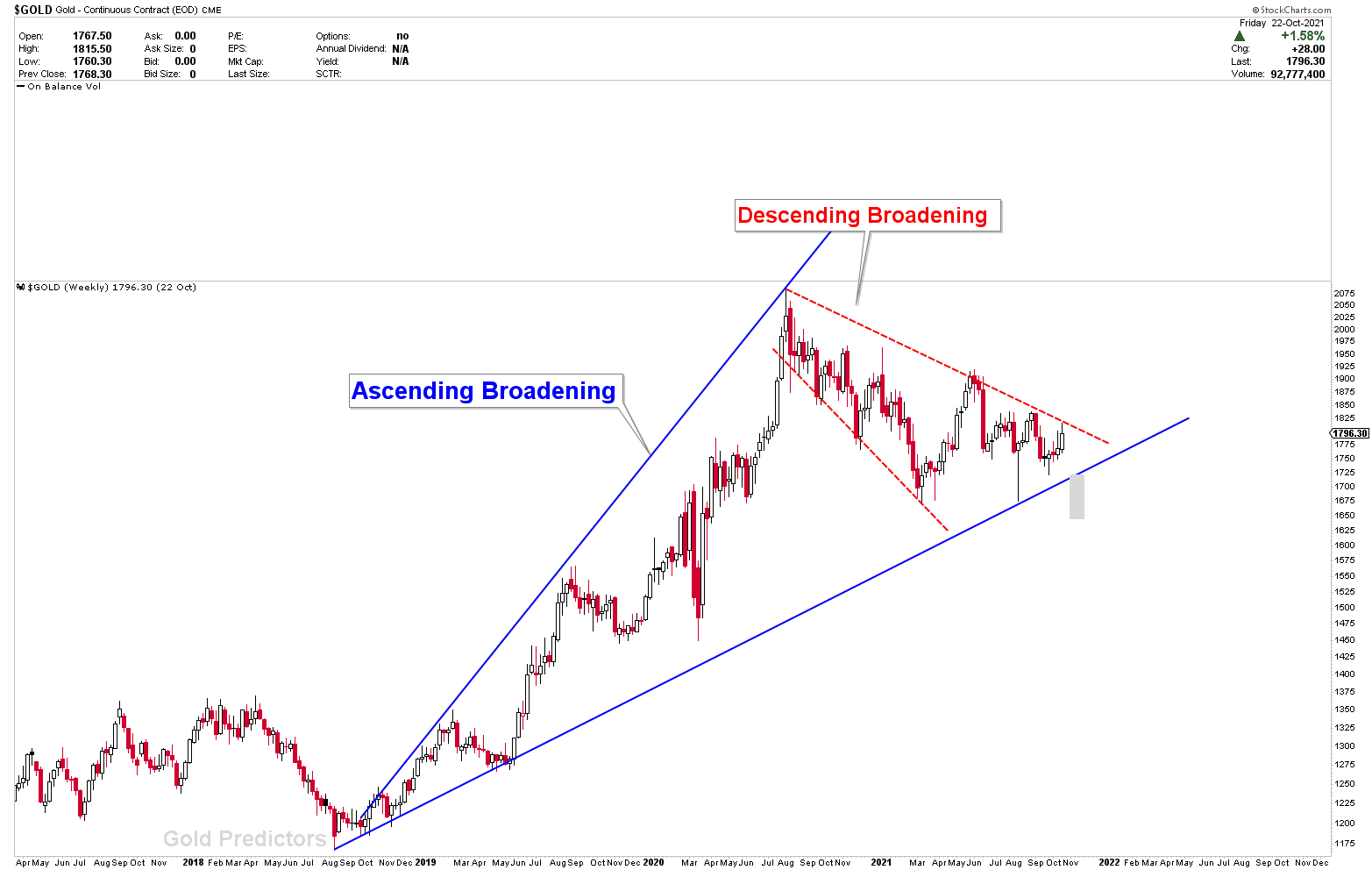
The chart below depicts a major pattern in the gold market, indicating that the next big move in either direction is about to happen soon. The chart depicts the formation of ascending broadening patterns where the price has been stuck for several months. Now, the recent drop in gold markets has produced descending broadening patterns, which are bullish price patterns if broken upside. The gold market is now on the verge of descending broadening, where the next big move must occur. As expected, the US dollar index fell last week. A move below the last week’s low will cause the index to fall even further in the near future. If this happens, gold and silver may skyrocket to hit the important resistance juncture. The US dollar index is currently trading sideways with big ranges.
Gold

Unlock exclusive gold and silver trading signals and updates that most investors don’t see. Join our free newsletter now!

Author

Muhammad Umair, PhD

Muhammad Umair, PhD

Gold Predictors

Muhammad Umair is a financial markets analyst and investor who focuses on the forex and precious metals markets.


More from Muhammad Umair, PhD
Share:

Editor's Picks

AUD/USD turns south toward 0.6900 as USD firms up

AUD/USD sees fresh selling and drops toward 0.6900 in late Asian trading on Monday, as renewed US Dollar strength weighs on the pair amid lingering Middle East and Russia-Ukraine geopolitical tensions. Focus remains on Oil prices, Treasury bond yields, and RBA expectations for fresh trading impetus in the major.

USD/JPY retakes 158.00 amid hawkish BoJ bets, firmer USD

USD/JPY erases losses and retakes 158.00 in the Asian session on Monday, trading within a one-week-old range. Geopolitical uncertainty continues to underpin the US Dollar, despite fading Fed rate hike hopes, supporting the pair's rebound. However, further upside could be capped by hawkish BoJ expectations and looming intervention risks that could support the Japanese Yen.

Gold trades flat as stronger US Dollar offsets easing Fed rate-hike bets

Gold trades little changed on Monday after giving back most of its early gains. The metal remains caught between easing Fed interest-rate hike bets and a stronger US Dollar (USD), while US Treasury yields also remain elevated near multi-year highs.

Crypto Today: Bitcoin rally slows while Ethereum and XRP extend recovery amid slowing ETF inflows

Bitcoin is narrowly consolidating while trading above $86,000 at the time of writing on Monday. Altcoins, on the other hand, show a positive outlook, with Ethereum edging higher above $2,700 while Ripple steadies above $1.52.

Eurozone inflation just hit 3.8%, its highest in three years. This chart shows why the ECB can’t simply hike its way out

The ECB would normally have a relatively straightforward answer to inflation running almost twice its target: raise interest rates. But these are not normal circumstances. This time, the bond market is already doing part of the tightening for it, leaving the ECB facing an increasingly difficult dilemma.

Eurozone inflation just hit 3.8%, its highest in three years. This chart shows why the ECB can’t simply hike its way out

The ECB would normally have a relatively straightforward answer to inflation running almost twice its target: raise interest rates. But these are not normal circumstances. This time, the bond market is already doing part of the tightening for it, leaving the ECB facing an increasingly difficult dilemma.














