Home Prices’ Rapid Decline Warns of Recession Ahead

I’m heading back to Australia for a six-city tour – Auckland, Perth, Adelaide, Melbourne, Sydney, and Brisbane – from April 24 to May 3. Usually, I only go once a year. This latest will be my third visit in 14 months.
One of the reasons I’m going back is that home prices down under are falling sharply in leading cities like Sydney and Melbourne. In fact, according to local media, the country could see the world’s worst house price fall in 2019. What’s particularly troubling is that this is happening without the anchor of a recession. It’s just a bubble beginning to burst from extreme overvaluations and tightening credit.
That happened in the U.S. starting in early 2006. Do you remember that?
Real estate prices began falling slowly and the home construction index was already down 60% before stocks peaked in October 2007 and the economy hit recession in January 2008. Then home price started falling rapidly.
Well, similar trends in home building here in the U.S., since late 2017, warn of a recession in 2020, with a stock peak just ahead of that. In Australia the decline started in early to mid-2017.
In 2018, home prices decelerated to near-zero growth. They’re not declining like in Australia, but they are slowing fast. Look at this chart for a sample of the fastest slowing cities.
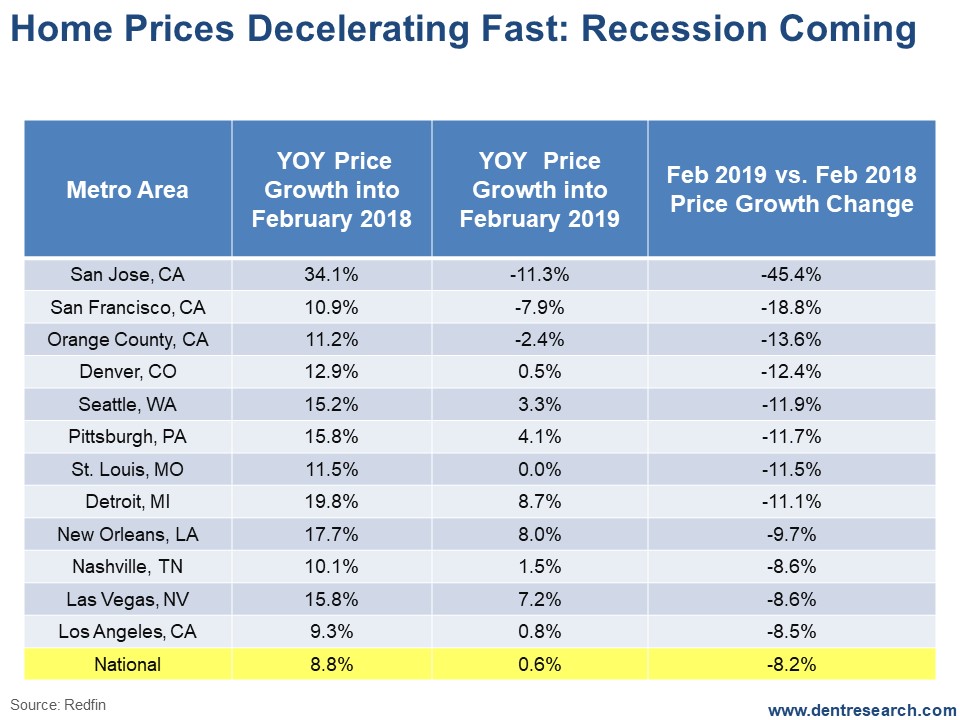
It’s not surprising that the fastest rates of deceleration are in San Jose/Silicon Valley. Year-over-year gains into February 2018 were 34.1% compared to -11.3% into February 2019. That’s a net slowdown of 45.4%.
Out of the top 73 U.S. cities, only 12 saw minor gains into February 2019 over 2018.
This is the beginning of the end for real estate.
Real estate takes longer to sell and freezes up faster than stocks, so caution is warranted now.
Stocks are still likely to run harder than ever into late 2019 or very early 2020. After that, expect a recession, and ultimately a depression to set in.
Author

Harry S. Dent, MBA
Dent Research
Harry S. Dent Jr. studied economics in college in the ’70s, but found it vague and inconclusive. He became so disillusioned by the state of his chosen profession that he turned his back on it.