Home-Country Bias Part II


Last week, I introduced you to the concept of home-country bias – a phenomenon that routinely leads investors to over-allocate to domestic stocks.
Americans prefer to invest in U.S. stocks because, psychologically, it feels like the right thing to do.
But it’s not!
U.S. stocks outperform foreign stocks only half the time, roughly. So, following the logic, a portfolio that is always concentrated in U.S. stocks is guaranteed to underperform about half the time.
My message last week was a stern warning aimed at U.S. investors.
Don’t get complacent!
Don’t extrapolate the past into the future… assuming U.S. stocks will outperform for the next 10 years, just because they have for the last 10 years.
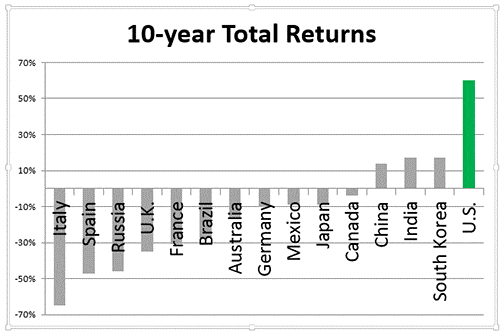
Take a look at this chart, which shows 10-year total returns of the top 15 global economies.
Anything jump out at you?
U.S. stocks have trounced foreign markets for the last decade. We know this.
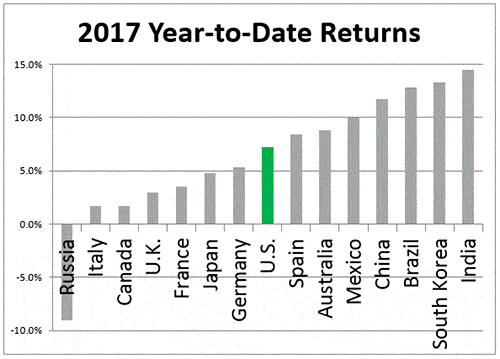
Now, take a look at this chart, which shows 2017 year-to-date returns…
What jumps out at you this time?
Anyone who assumed U.S. stocks would outperform in 2017 has so far been disappointed. A number of foreign stock markets have proven to be better bets.
But again, buying foreign stocks is something most investors don’t feel comfortable doing. Tying up your hard-earned capital in foreign stock plays feels riskier. But in reality, it isn’t.
You see, I’m not a proponent of buying foreign stocks and holding them indefinitely.
Instead, I use a forward-looking algorithm to identify pockets of outperformance opportunity in foreign stock markets – “sweet spots,” if you will.
I use the Cycle 9 Alert system that I developed over five years ago.
To truly understand the power of these foreign market “sweet spots,” I’ve run some analysis that shows the annualized return of foreign markets.
I looked at the annualized return of foreign stocks while in a Cycle 9 “sweet spot.” And I’ve compared that to their annualized return the rest of the time – we’ll call it their “sour spot.”
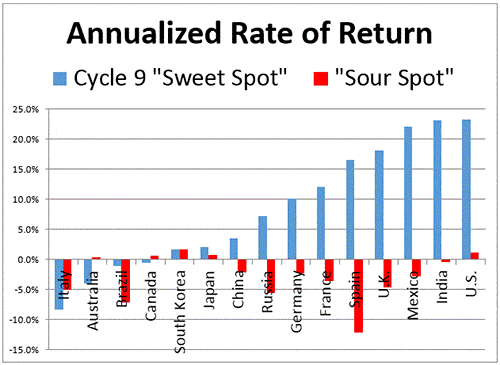
As you can see, foreign stock markets perform significantly better during Cycle 9 sweet spots… and much worse the rest of the time.
The average annualized “sweet spot” return comes in at a healthy 8.4%. Whereas the average “sour spot” return is negative 2.7%. And this leads to an average outperformance of 11% per year.
Of course, these foreign market “sweet spots” are so powerful that they only come about occasionally – less than once a year, on average. And they only last a short period of time – around three months.
All told, my Cycle 9 Alert algorithm gives us the chance to make highly-targeted and highly-profitable bets on foreign markets – but only when the time is right.
By investing in foreign stock markets just 19% of the time – only during their sweet spots – we can, essentially, turn negative investor returns into positive trader returns.
One example of this strategy in action is my recent recommendation to buy European stocks.
On March 7, I told my Cycle 9 Alert readers to buy a specific investment, related to European stocks.
Since then, European stocks are up 3.5% in just two weeks (145% annualized)… while the Dow Jones Industrial Average is down about 1%.
The specific investment I recommended has already gained more than 25% in less than 15 days. And I’m expecting bigger profits to come our way over the next two to three months – so there’s still time to act on this foreign market opportunity.
Whatever you do – don’t be lazy… and don’t call it “patriotism.” Buying U.S. stocks may feel comfortable, but ignoring foreign market opportunities nearly guarantees you’ll trail the pack half the time.
Author
Dent Research Team of Analysts
Dent Research