Gold Weekly Forecast: XAU/USD recovery loses momentum at 200-day SMA, $1,800 support under threat
- XAU/USD struggled to make a decisive move in either direction this week.
- Near-term technical outlook suggests that sellers remain in control.
- Additional losses are likely with a daily close below $1,800.

The XAU/USD pair started the week on a firm footing and climbed to a weekly high of $1,855 on Wednesday supported by the broad-based selling pressure surrounding the greenback. However, with the USD regaining its strength in the second half of the week, XAU/USD came under heavy bearish pressure, lost nearly 1% on Thursday and extended its slide on Friday. Following a rebound in the late American session ahead of the weekend, the pair closed the week with little changed near $1,820.
What happened last week
In the absence of significant macroeconomic data releases and fundamental developments, the sharp decline witnessed in the US Treasury bond yields weighed on the USD and allowed XAU/USD to gain traction during the first half of the week. Reflecting the greenback’s poor performance, the US Dollar Index lost more than 0.5% and touched a fresh two week low of 90.25 on Wednesday. The relatively cautious market mood and a rebound seen in the 10-year US T-bond yield helped the USD limit its losses and forced XAU/USD to reverse its direction on Thursday.
The data published from the US showed on Tuesday that the NFIB Business Optimism Index in January declined to 95 from 95.9 in December. On Wednesday, the inflation report revealed that the Core Consumer Price Index (CPI) in January fell to 1.4% on a yearly basis from 1.6% and came in lower than the market expectation of 1.5%. This reading reaffirmed the view that the US Federal Reserve is likely to preserve its dovish stance with consumer prices struggling to pick up.
While speaking at an event on Wednesday, FOMC Chairman Jerome Powell reiterated that the Fed remains committed to providing support to the economy. Powell noted that they will not look to tighten the policy solely in response to an improving labor market and reiterated that the policy rate will be kept near-zero until they reach employment and inflation goals.
On Thursday, the US Department of Labor in its weekly report said that Initial Jobless Claims declined to 793,000 in the week ending February from 812,000. Although this reading came in worse than analysts’ estimate of 757,000, it received little to no reaction from market participants.
Finally, the University of Michigan's Consumer Sentiment Index dropped to 76.2 (preliminary) in February from 79 in January and fell short of the market expectation of 80.8, capping USD's gains on Friday.
Next week
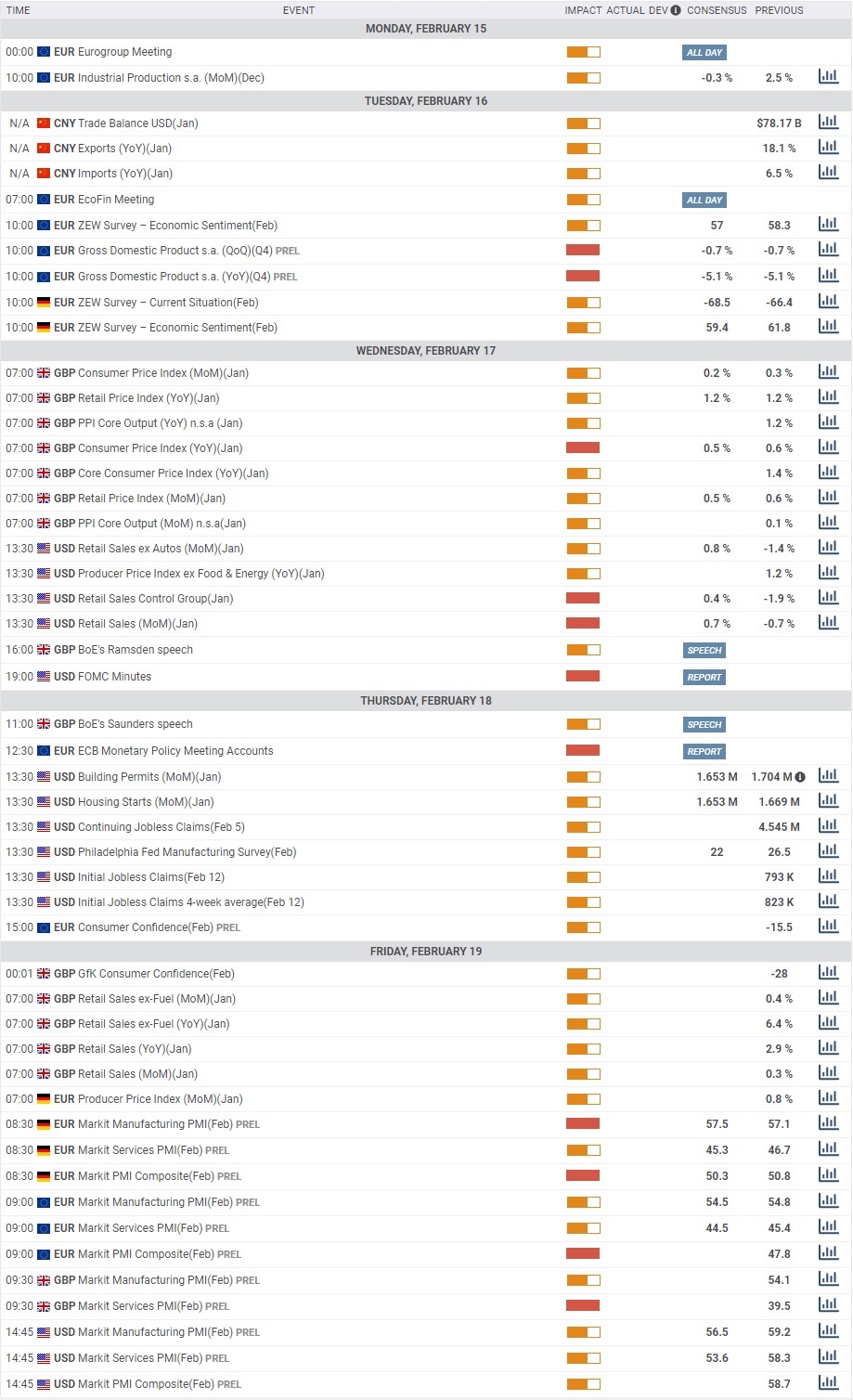
There won’t be any significant macroeconomic data releases next Monday and the USD’s market valuation is likely to continue to impact XAU/USD’s movements at the start of the week.
On Tuesday, the ZEW Survey - Economic Sentiment reports for the euro area and Germany will be watched closely by investors alongside the fourth-quarter Gross Domestic Product (GDP) figures for the eurozone. If these data point out to further weakness in the euro area economy, the greenback could start attracting investors and weigh on XAU/USD.
On Wednesday, January Retail Sales data will be featured in the US economic docket. The market consensus points out to a 0.7% increase following December’s 0.7% contraction. A better-than-expected print could help the USD outperform its rivals. Later in the day, the FOMC will release the minutes of its February meeting.
On Friday, the IHS Markit will publish its preliminary Manufacturing and Services PMI reports for Germany, the euro area, the UK and the US.
Gold technical outlook
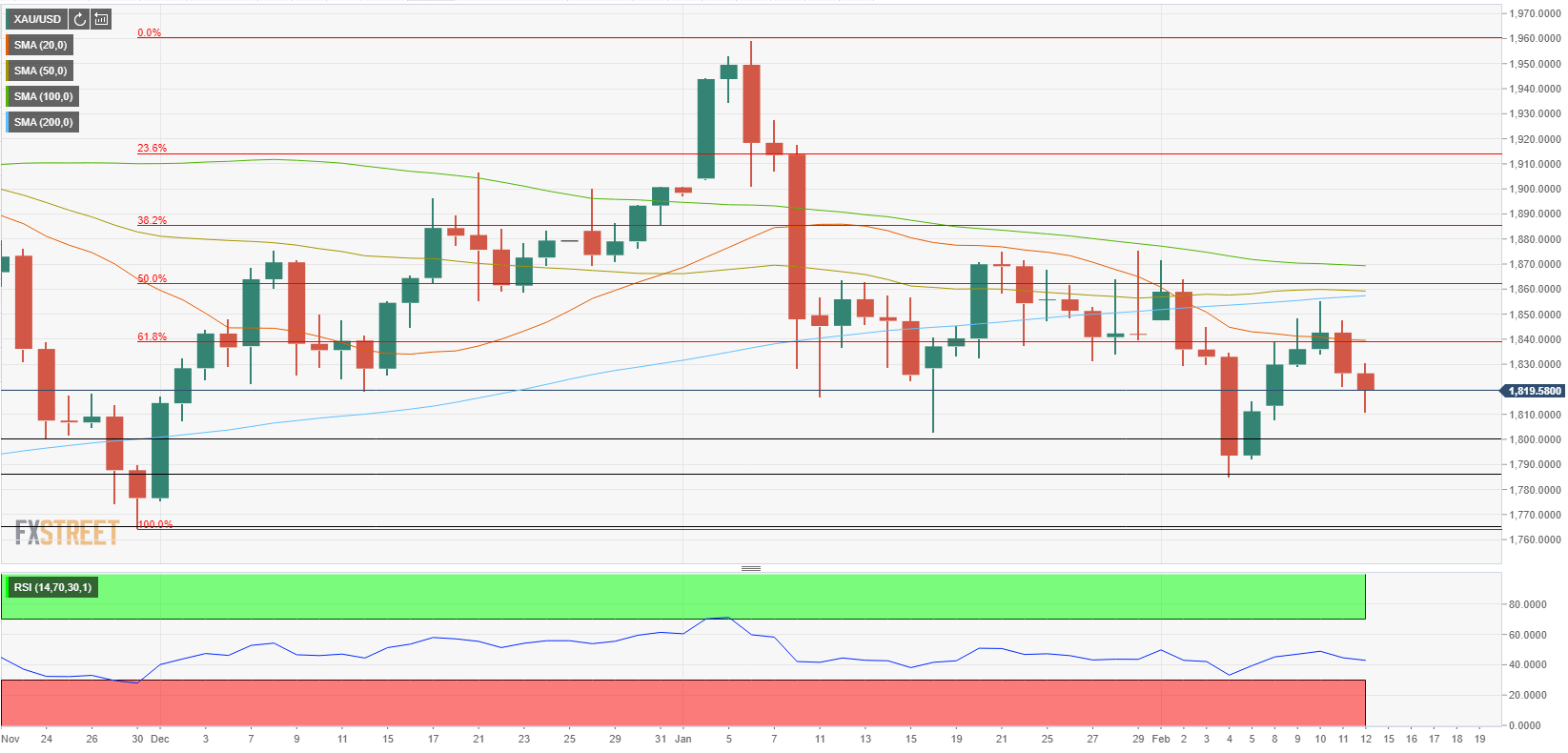
The Relative Strength Index (RSI) indicator on the daily chart edges lower toward 40, suggesting that buyers struggle to dominate gold's price action. Additionally, the four-day rebound witnessed earlier in the month lost its momentum near the 200-day SMA and XAU/USD closed below that key level for the eighth straight trading day on Friday.
On the downside, $1,800 (psychological level) could be seen as the first support. A daily close below that level could open the door for additional losses toward $1,785 (Feb. 4 low) ahead of $1,765 (Nov. 30 low/starting point of December rally).
The initial resistance aligns at $1,845 (Fibonacci 61.8% retracement of the latest uptrend/20-day SMA). Even if gold manages to clear that hurdle, buyers could remain hesitant to return unless XAU/USD breaks above $1,855 (200-day SMA). Finally, the 100-day SMA around $1,870 is likely to act as the next dynamic resistance.
Gold sentiment poll
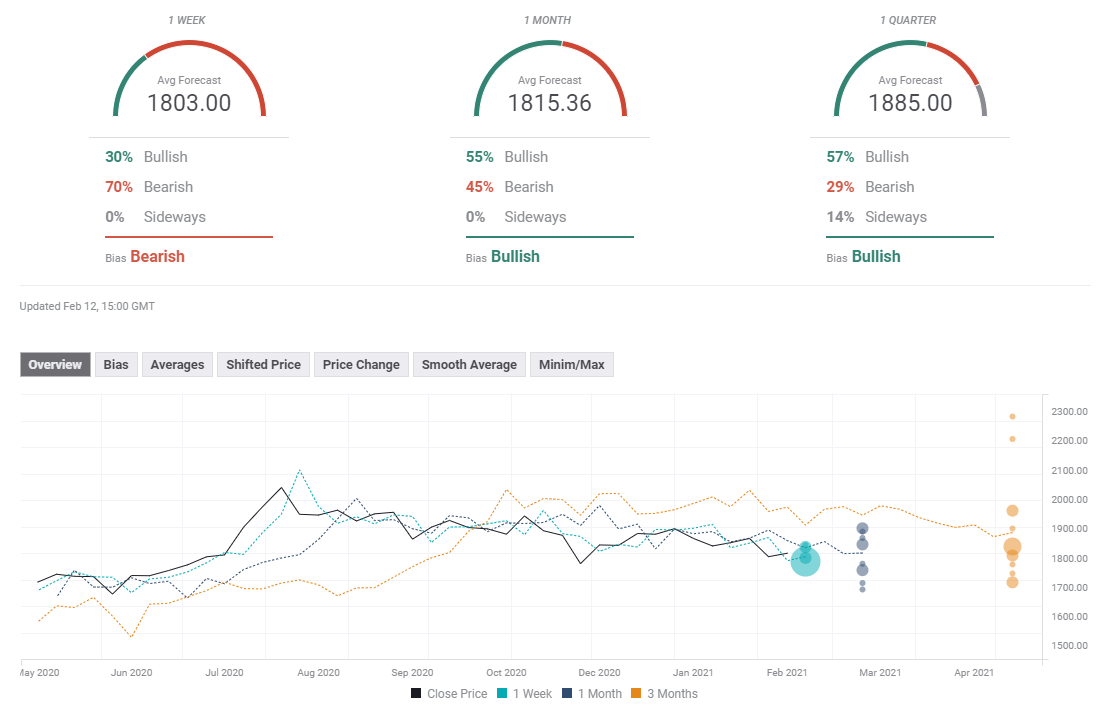
Gold's short-term outlook stays bearish according to the latest FXStreet Forecast Poll, which shows that the average price target on a one-week view currently stands at $1,803. Although 55% of experts remain bullish on a one-month view, the average target of $1,815 suggests that gains are likely to be limited.
Author

Eren Sengezer
FXStreet
As an economist at heart, Eren Sengezer specializes in the assessment of the short-term and long-term impacts of macroeconomic data, central bank policies and political developments on financial assets.