Gold Price Forecast: XAU/USD turns south before testing 200-day SMA, tests $1,820
- XAU/USD came under strong bearish pressure in early American session.
- Next critical support for gold aligns at $1,800.
- Rising US Treasury bond yields and risk aversion weigh on gold.

The XAU/USD pair closed the fourth straight trading day in the positive territory but lost its bullish momentum before testing the critical 200-day SMA. With gold losing interest in the risk-averse market environment on Tuesday, the pair turned south and was last seen losing 0.72% on a daily basis at $1,823.
The sharp decline witnessed in major global equity indexes confirms the negative shift in market mood. Earlier in the day, Japan's Nikkei 225 Index lost more than 3% and major European equity indexes are currently down between 2.4% and 2.9%. Additionally, the S&P 500 Index is losing more than 1% after the opening bell.
In the meantime, the benchmark 10-year US Treasury bond yield, which has been showing a strong inverse correlation with gold prices lately, is up more than 1% in the early American session.
Earlier in the day, the data from the US revealed that the NFIB Business Optimism Index improved modestly to 99.8 in April from 98.2. Nevertheless, this reading was largely ignored by market participants.
Gold technical outlook
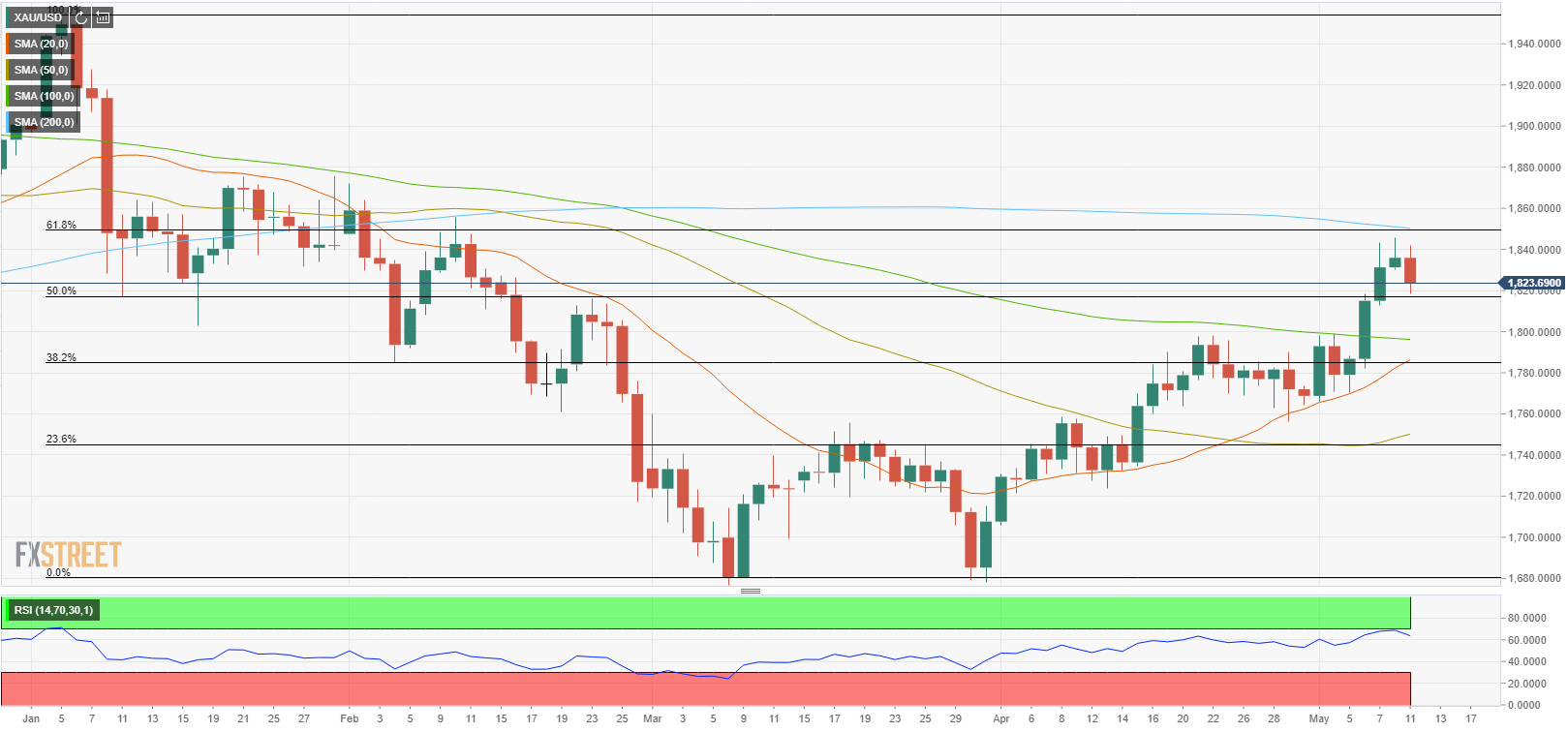
Currently, gold is trading near $1,820 (Fibonacci 50% retracement of the January-March downtrend) and additional losses could be witnessed if the next four-hour candle opens below that level. The next significant support is located at $1,800 (psychological level, 100-day SMA).
Meanwhile, the Relative Strength Index (RSI) indicator on the daily chart, which rose into the overbought territory near 70 on Monday, retreated to 60, suggesting that buyers are struggling to remain in control of the action.
On the upside, key resistance remains at $1,850 (Fibonacci 61.8% retracement level, 200-day SMA). Only a daily close above that level could open the door for another leg higher. The next hurdle could be seen at $1,860 (static level).
Author

Eren Sengezer
FXStreet
As an economist at heart, Eren Sengezer specializes in the assessment of the short-term and long-term impacts of macroeconomic data, central bank policies and political developments on financial assets.