Gold Price Forecast: XAU/USD buyers refuse to give up amid bullish technicals, ahead of US data
- Gold price holds the previous rebound near $2,170 ahead of key US data.
- US Dollar keeps losses amid weak US Treasury yields, mixed risk sentiment.
- Gold price looks to regain upside traction amid a bullish daily technical setup.

Gold price is treading water near $2,170 early Tuesday, consolidating the previous rebound to the $2,181 level. The US Dollar (USD) licks its wounds, market sentiment appears mixed and US Treasury bond yields fail to sustain Monday’s upswing.
Gold price looks to US data for fresh direction
Continued efforts by the Chinese authorities to the Yuan and the ongoing recovery in the Japanese Yen keep the downbeat tone intact around the US Dollar, helping Gold price stay afloat. The People’s Bank of China (PBOC) set the USD/CNY reference rate weaker-than-expected for the second day in a row while the Yen continues to draw support from the verbal intervention from Japanese officials, especially after USD/JPY touched the year-to-date (YTD) high of 151.86 on Friday.
Further, markets are resorting to profit-taking on the US Dollar longs after late last week’s solid recovery, gearing up for the all-important US Federal Reserve’s (Fed) preferred inflation measure, the Core Personal Consumption Expenditures (PCE) Price Index, which could help seal in a June interest rate cut. The Core PCE inflation is seen steady at 2.8% YoY in February while on a monthly basis, the gauge is likely to inch lower to 0.3% in the same period.
Recent comments from Fed officials indicated their concerns regarding sticky inflation and were read by markets as slightly hawkish. In response, the US Treasury bond yields rebounded firmly but the US Dollar failed to find any inspiration, as markets are wagering nearly 72% probability of a June rate cut.
The upswing in the US Treasury bond yields negated the weakness in the US Dollar, capping the upside attempts in the Gold price. However, resurfacing geopolitical tensions between Russia and Ukraine continue to underpin the traditional safe-haven Gold price. Russia attacked Ukraine's capital Kyiv with hypersonic missiles on Monday morning, US Ambassador Bridget Brink said on the X social network,” per Reuters.
Looking ahead, traders await the releases of the mid-tier US Durable Goods Orders and CB Consumer Confidence data later on Tuesday for fresh cues on the Fed rate cuts, keeping the US Dollar and Gold price on edge. A rebound in the US Durable Goods Orders data could offer temporary relief to the US Dollar at the expense of the Gold price. However, uncertainty over the timing and the scope of Fed rate cuts could remain a headwind for the Greenback, lending support to the bright metal.
Gold price technical analysis: Daily chart
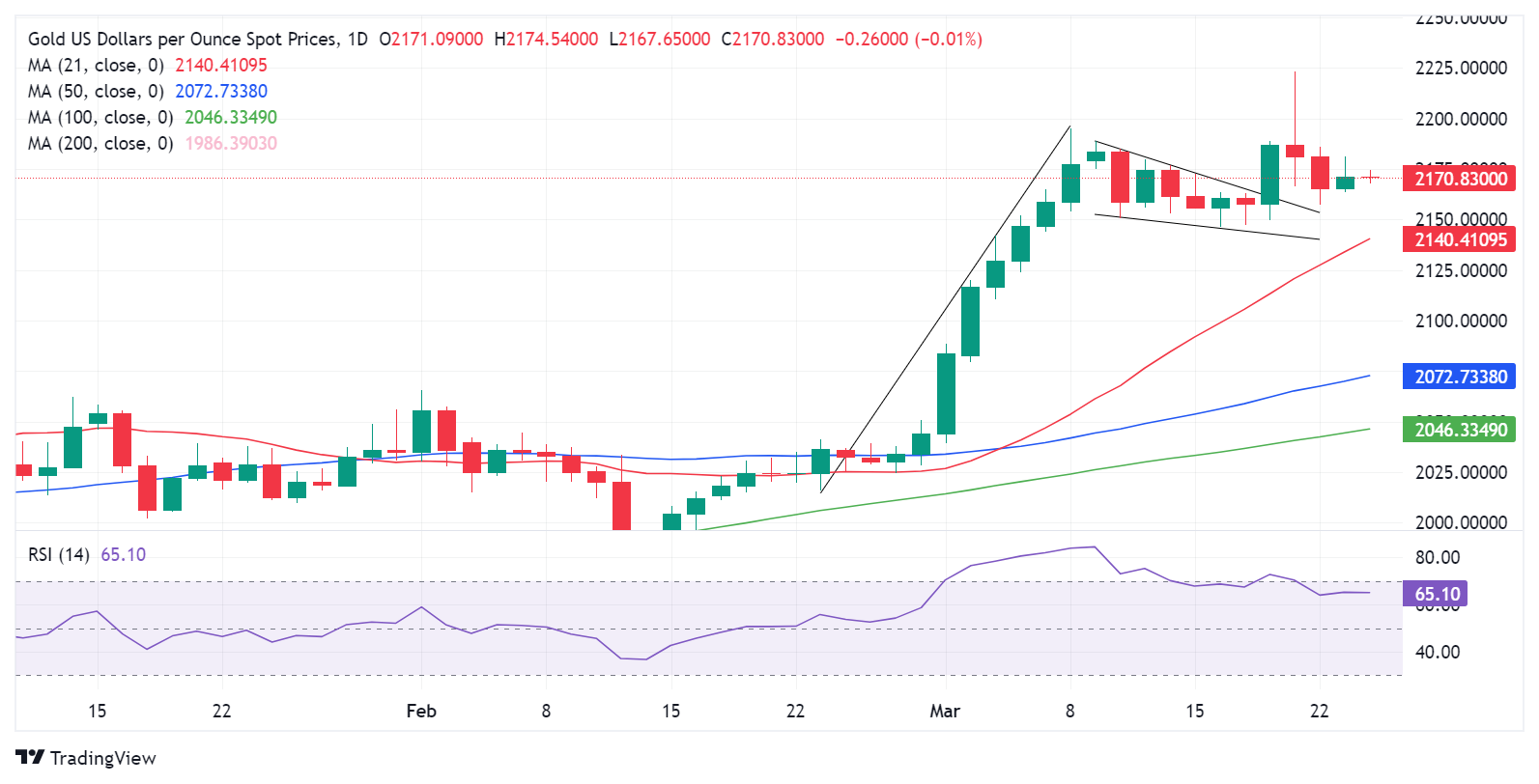
The short-term technical outlook for Gold price remains more or less the same.
With a Bull Flag in play, Gold price remains on track to test the measured target at $2,251 on a sustained move higher.
Before that barrier, Gold price needs to recapture the $2,200 threshold and the record high at $2,223.
The 14-day Relative Strength Index (RSI), holds well within the positive territory, pointing to more upside risks.
On the flip side, immediate support is seen at Friday’s low of $2,157, below which the Bull Flag resistance at $2,151 will be challenged.
A sustained move below the latter will put the Bull Flag support of $2,140 at risk. At that level, the bullish 21-day Simple Moving Average (SMA) emerges.
Gold FAQs
Gold has played a key role in human’s history as it has been widely used as a store of value and medium of exchange. Currently, apart from its shine and usage for jewelry, the precious metal is widely seen as a safe-haven asset, meaning that it is considered a good investment during turbulent times. Gold is also widely seen as a hedge against inflation and against depreciating currencies as it doesn’t rely on any specific issuer or government.
Central banks are the biggest Gold holders. In their aim to support their currencies in turbulent times, central banks tend to diversify their reserves and buy Gold to improve the perceived strength of the economy and the currency. High Gold reserves can be a source of trust for a country’s solvency. Central banks added 1,136 tonnes of Gold worth around $70 billion to their reserves in 2022, according to data from the World Gold Council. This is the highest yearly purchase since records began. Central banks from emerging economies such as China, India and Turkey are quickly increasing their Gold reserves.
Gold has an inverse correlation with the US Dollar and US Treasuries, which are both major reserve and safe-haven assets. When the Dollar depreciates, Gold tends to rise, enabling investors and central banks to diversify their assets in turbulent times. Gold is also inversely correlated with risk assets. A rally in the stock market tends to weaken Gold price, while sell-offs in riskier markets tend to favor the precious metal.
The price can move due to a wide range of factors. Geopolitical instability or fears of a deep recession can quickly make Gold price escalate due to its safe-haven status. As a yield-less asset, Gold tends to rise with lower interest rates, while higher cost of money usually weighs down on the yellow metal. Still, most moves depend on how the US Dollar (USD) behaves as the asset is priced in dollars (XAU/USD). A strong Dollar tends to keep the price of Gold controlled, whereas a weaker Dollar is likely to push Gold prices up.
Author

Dhwani Mehta
FXStreet
Residing in Mumbai (India), Dhwani is a Senior Analyst and Manager of the Asian session at FXStreet. She has over 10 years of experience in analyzing and covering the global financial markets, with specialization in Forex and commodities markets.