GBP/USD Weekly Forecast: Sterling seen locked between 1.4000-1.4250
- After lower than exected US Non-Farm Payrolls, the GBP/USD is seen trading higher, but still below its key 200-period Simple Moving Average of 1.4250.
- The UK manufacturing output data headline the week ahead together with US inflation data and the FOMC meeting minutes.

The GBP/USD traded little change on the upside during the first week of April opening last week at 1.4035 and ending some 70 pips higher after oscillating in 1.3964-1.4106 range during the Easter holidays shortened week.
While the economic data published during the first week of April were somewhat disappointing for the UK and Sterling, the main topic haunting the financial markets was the ongoing trade wars between the US and China. The retaliatory actions of China implementing tariffs worth $50 billion on imported cars, chemicals, soya and the aircraft from the US weighed on the US Dollar at the beginning of last week bringing its value against Sterling up to 1.4097 on Tuesday. Market worries about the escalation of the trade war between the US and China overshadowed the headline macroeconomic report of last week, the US employment report for March.
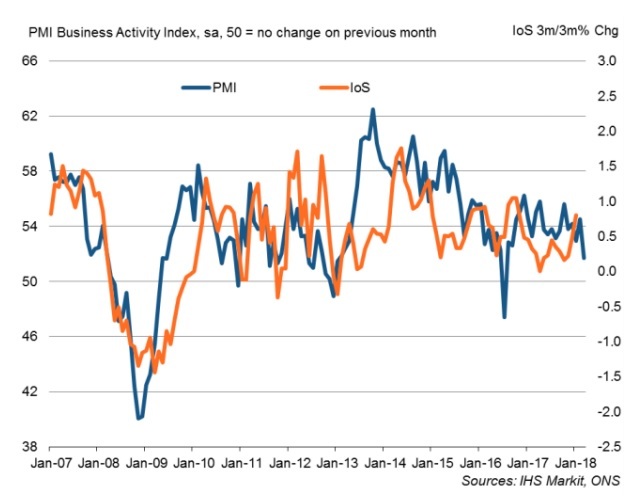
From the fundamental point of view, Sterling is poised for weakening given the recent slowdown in the economic indicators including forward-looking PMI surveys published last week. While the UK manufacturing PMI marked slight month-to-month increase with PMI rising to 55.1 in March from a downwardly revised reading of 55.0 in February on Tuesday, the construction PMI slumped to negative territory in March with headline PMI falling to 47.0 level indicating economic contraction. The UK services PMI fell to the lowest level in 20-months of 51.7 in March missing the forecast of 54.0 reading.
Correlation of the UK services PMI and the Index of services from ONS
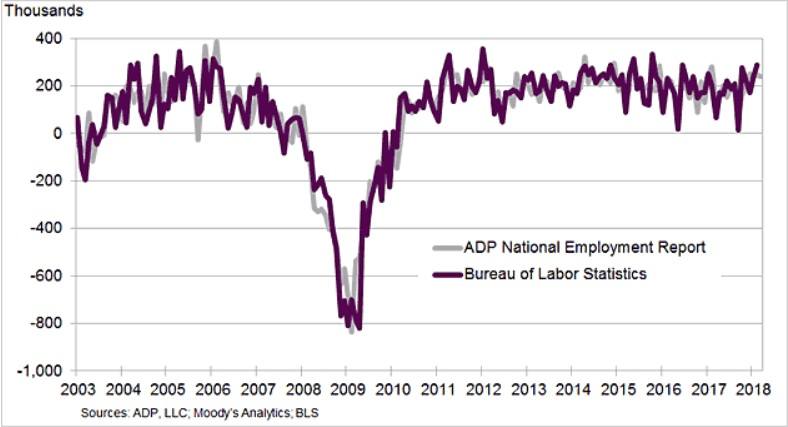
The US Non-Farm Payroll report disappointed regarding headline job creation with 103K new jobs added in the US economy in March compared to 190K expected by the market. Subsequently, the US unemployment rate also dwelled at the unchanged level of 4.1% instead of falling lower to 4.0% as expected by the market. The Labor Department’s labor market report was a disappointment especially given the fact that the forerunner of the government's labor market report was published on Wednesday with ADP private employment report showing 241K new jobs were added in the US in March, beating the analyst's forecast.
Historical correlation of ADP private employment and Labor Department’s NFP
GBP/USD 1-hour chart
Technical analysis
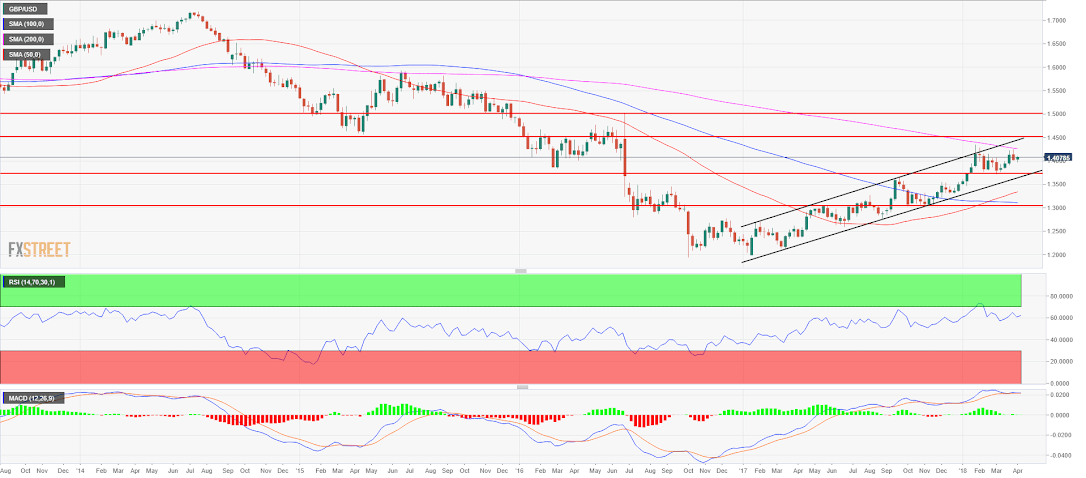
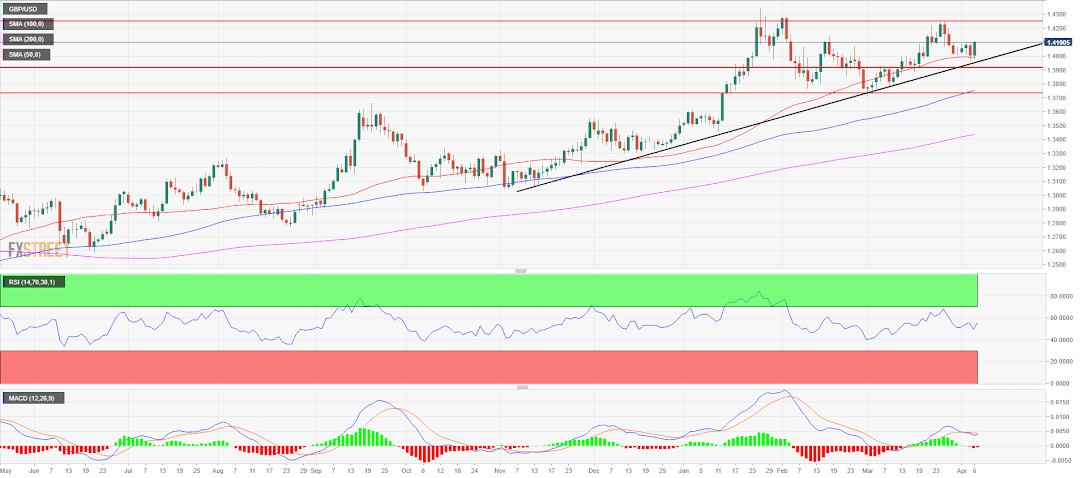
The GBP/USD is trading in a bull channel on the weekly chart. The currency pair is trading above its 50 and 100-week simple moving average (SMA). In mid-February, the 50-period SMA crossed above the 100-period SMA, which is called a golden cross and interpreted as a strong bullish signal by technical analysts. However, the GBP/USD is still trading below its key 200-period SMA at 1.4250 which is acting as dynamic resistance. A clear break above the level would be seen as bullish and can open the gates to the 1.45 psychological level and 1.50 swing high in the coming weeks. On the flip side, the main weekly supports are seen at 1.37 swing low and at the 1.30 figure, previous swing low and support base. The weekly Relative Strength Index (RSI) is above 60 and the Moving Average Convergence/Divergence (MACD) is displaying a slow upward momentum.
GBP/USD weekly chart
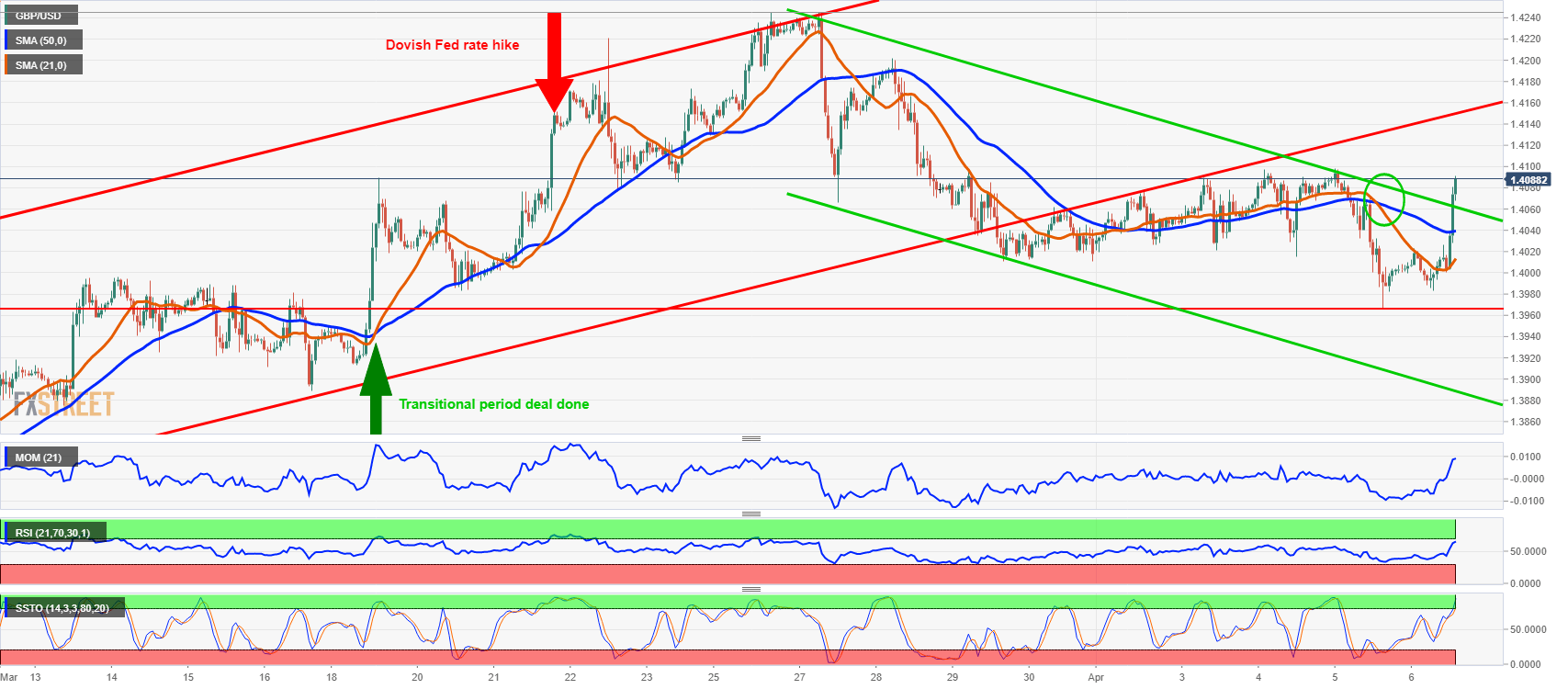
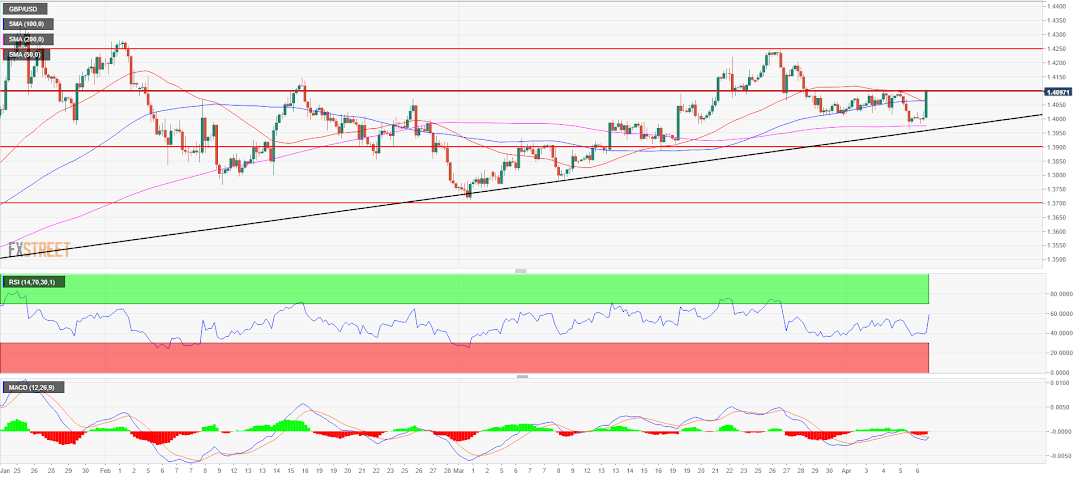
The GBP/USD rebounded from the 1.4000 handle after the worse-than-expected US Non-Farm Payroll report and found support at the 50-period simple moving average on the daily time frame. Immediate resistance is the 1.41 level which is the top of the range of the last week of trading. A clear break above the level can lead to the next resistance at 1.4245 swing high; followed by 1.4346 high of 2018. On the flip side, immediate support is seen at the 1.40 level. A clear break below the level and the 50-period simple moving average along with the ascending trendline can open the gates to 1.39 swing low, followed by 1.37 swing low established on March, 1. The daily RSI is above 50 while the MACD is gaining some mild bullish momentum.
GBP/USD daily chart
The picture on the 4-hour chart further confirms the analysis made on the daily time frame. The GBP/USD found support at the 200-period simple moving average on the 4-hour chart and has broken above both the 50 and 100-period simple moving average. The bulls took the lead at the 1.4000 support and are testing the 1.41 resistance. The RSI is trading in positive territory close to the 60 level while the MACD indicator is slowly turning bullish, indicating potential continuation upward.
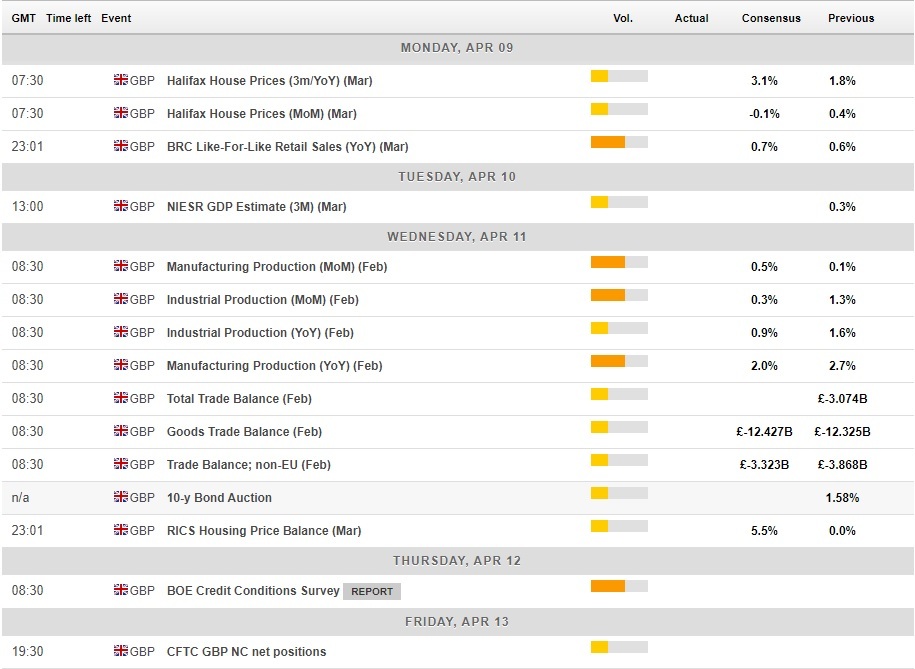
The UK economic calendar is light during the second week of April with the Industrial production and the UK manufacturing output data headlining the week ahead.
While manufacturing output is expected to rise 0.5% over the month in February after increasing 0.1% in the previous month, total index of production is forecast to increase only by 0.3% m/m after being boosted by mining and querying in January when the index of production rose 1.3% m/m. Over the year, the manufacturing output is expected to decelerate to 2.0% y/y while industrial production is expected to rise only by 0.9% y/y.
The UK economic calendar for April 9-13
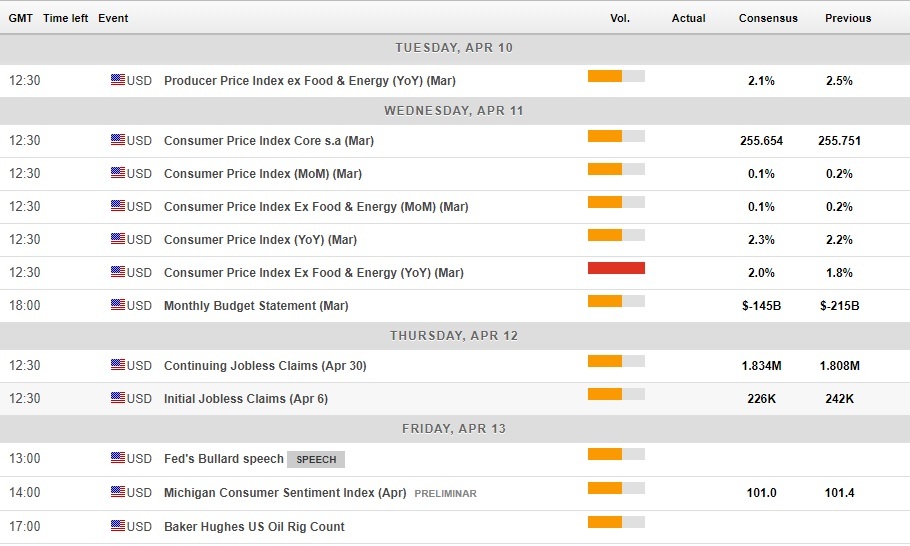
In the US the second week of April will be headlined by the US inflation data for March. The Consumer Price Index (CPI) excluding food and energy is expected to rise 2.0% over the year in March, up from 1.8% reading for February.The headline CPI is forecast to have accelerated to 2.3% over the year after printing 2.2% increase in the previous month. Wednesday’s action will be complemented by FOMC meeting minutes disclosing details of discussion among Fed policymakers during the last meeting in March that saw policy rates lifted by 25 basis points.
Concerning the US labor market, weekly initial jobless claims are seen rising 226K during the week ending April 8.
On Friday next week, the Michigan consumer sentiment is expected to confirm slight deterioration to 101.0 in April after 101.4 in March.
There are three Fed speakers scheduled for next week with Thursday speech from Minneapolis Federal Reserve Bank President Neel Kashkari opening. On Friday St. Louis Federal Reserve Bank President James Bullard is due to speak at the Washington University's Calhoun Lecture Series in St. Louis followed by Dallas Federal Reserve Bank President Robert Kaplan participating in a moderated luncheon at the Odessa Chamber of Commerce in Texas.
The US economic calendar for April 9-13
Forecast for next week
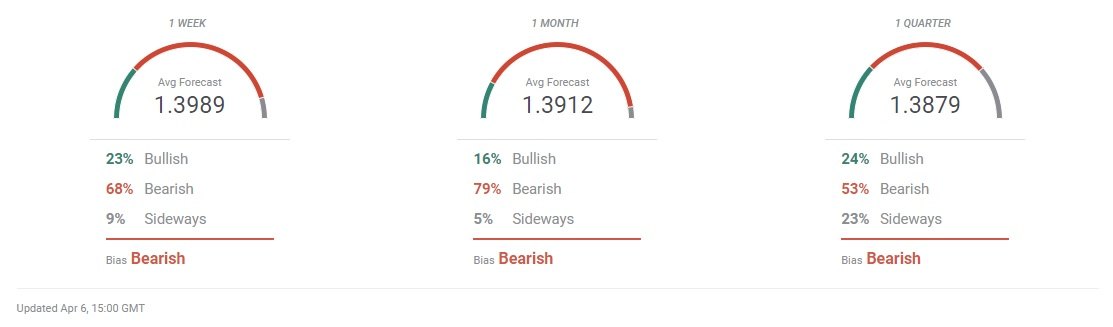
Analysts and economists participating in FXStreet Forecast Poll turned overly bearish once again for GBP/USD. The median prediction for GBP/USD for next week is 1.3989, about 100 pips lower from current spot value about 2-hours after the US Non-Farm Payroll data were out and the US President Trump once again heated the trade wars topic.
Bets in the latest FXStreet Forecast Poll are turning Bearish with 69% of participants in the FXStreet Forecast Poll predict Bearish trend to prevail in the upcoming week while 23% anticipate Bullish trend in a week ahead and 9% see sideways trend.
For the 1-month and 3-months prediction, the FXStreet Forecast Poll also turned Sterling negative Bearish predictions dominating. While 79% of participants expect a Bearish trend to prevail in 1-month time from now, only 53% predicted Bearish trend to dominate in 3-months time.
Predictions for GBP/USD actually cluster for all three prediction horizons to a narrow range around 1.3900 big figure.
FXStreet Forecast Poll
Author

Mario Blascak, PhD
Independent Analyst
Dr. Mário Blaščák worked in professional finance and banking for 15 years before moving to journalism. While working for Austrian and German banks, he specialized in covering markets and macroeconomics.