GBP/USD Forecast: Next hurdle for Pound Sterling aligns at 1.2360
- GBP/USD went into a consolidation phase near 1.2300.
- The pair could encounter stiff resistance at 1.2360.
- Monthly Core CPI in the US is forecast to rise 0.3% in September.

GBP/USD struggled to preserve its bullish momentum early Thursday and went into a consolidation phase at around 1.2300. In the second half of the day, September inflation data from the US could influence the US Dollar's (USD) valuation and drive the pair's action.
The UK's real Gross Domestic Product (GDP) expanded by 0.2% on a monthly basis in August, the UK's Office for National Statistics reported early Thursday. This reading followed the 0.6% contraction (revised from 0.5%) recorded in July and matched the market expectation. Other data from the UK revealed that Manufacturing Production and Industrial Production declined by 0.8% and 0.7% in the same period, respectively. Although the immediate market reaction to these figures was muted, they seem to be making it difficult for the Pound Sterling to continue to gather strength.
Pound Sterling price this week
The table below shows the percentage change of Pound Sterling (GBP) against listed major currencies this week. Pound Sterling was the strongest against the US Dollar.
| USD | EUR | GBP | CAD | AUD | JPY | NZD | CHF | |
| USD | -0.55% | -0.75% | -0.56% | -0.71% | -0.04% | -0.56% | -0.93% | |
| EUR | 0.53% | -0.19% | -0.01% | -0.16% | 0.52% | -0.02% | -0.37% | |
| GBP | 0.74% | 0.18% | 0.19% | 0.00% | 0.71% | 0.19% | -0.18% | |
| CAD | 0.54% | -0.03% | -0.21% | -0.16% | 0.50% | -0.02% | -0.38% | |
| AUD | 0.71% | 0.20% | 0.00% | 0.20% | 0.71% | 0.17% | -0.17% | |
| JPY | 0.02% | -0.54% | -0.71% | -0.52% | -0.76% | -0.58% | -0.90% | |
| NZD | 0.58% | 0.04% | -0.19% | 0.03% | -0.17% | 0.56% | -0.35% | |
| CHF | 0.90% | 0.38% | 0.18% | 0.37% | 0.17% | 0.87% | 0.37% |
The heat map shows percentage changes of major currencies against each other. The base currency is picked from the left column, while the quote currency is picked from the top row. For example, if you pick the Euro from the left column and move along the horizontal line to the Japanese Yen, the percentage change displayed in the box will represent EUR (base)/JPY (quote).
September Consumer Price Index (CPI) data will be featured in the US economic docket alongside the weekly Initial Jobless Claims. The monthly Core CPI, which strips volatile energy and food prices, is forecast to rise 0.3%.
Dovish comments from Federal Reserve (Fed) officials this week forced the USD to weaken against its rivals. Investors price in a 72% probability of the US central bank leaving its policy rate unchanged in 2023. In case the Core CPI comes in at around 0.5%, markets could reassess the Fed's rate outlook and help the USD regain its traction. On the flip side, risk flows are likely to continue to dominate the market action on a soft print and allow GBP/USD to continue to build on its weekly gains.
GBP/USD Technical Analysis
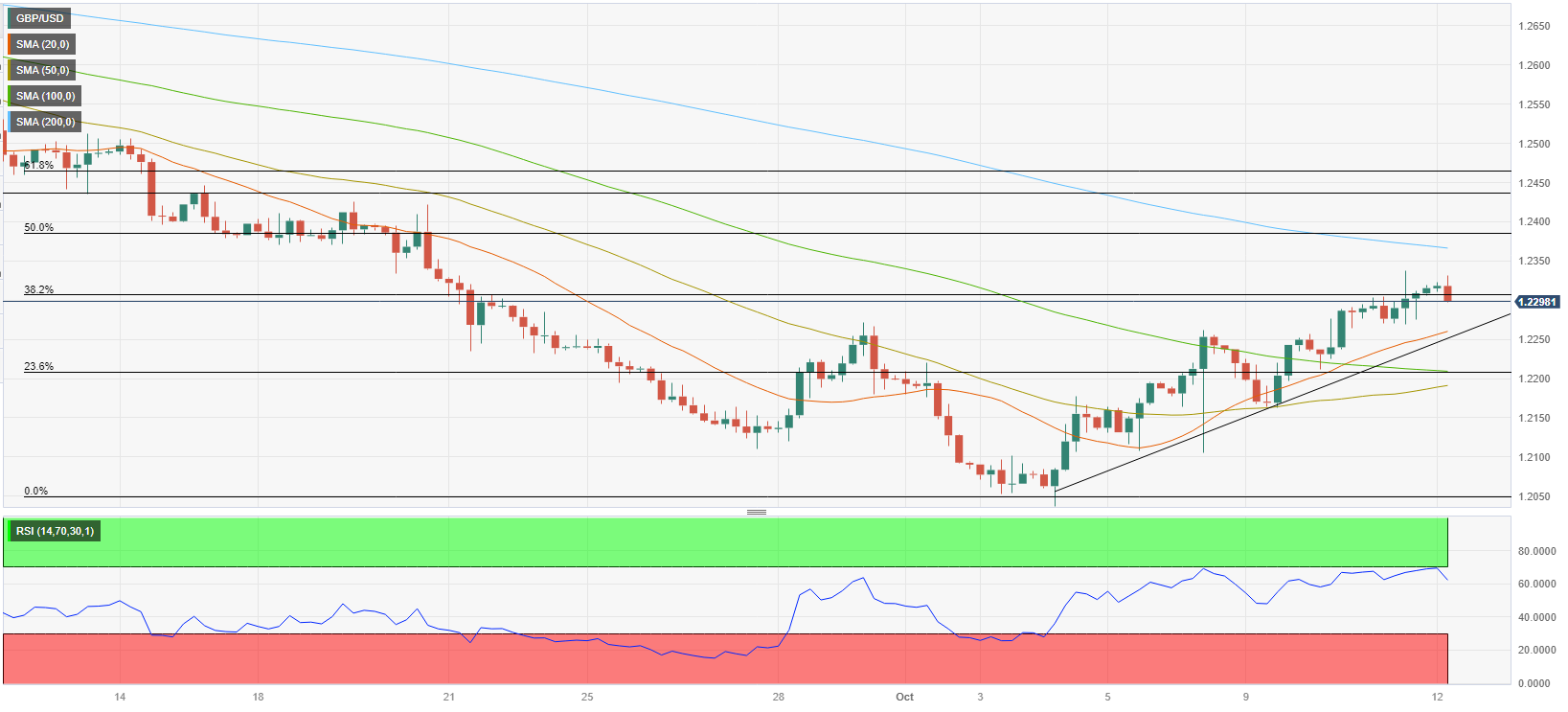
1.2300 (Fibonacci 38.2% retracement of the latest downtrend) aligns as immediate support before 1.2250, where the ascending trend line and the 20-period Simple Moving Average (SMA) on the 4-hour chart meet. If GBP/USD falls below the latter and confirm it as resistance, 1.2200 (Fibonacci 23.6% retracement, 100-period SMA) could be set as the next bearish target.
On the upside, 1.2360 (200-period SMA) aligns as important resistance before 1.2400 (Fibonacci 50% retracement and 1.2440 (static level).
Author

Eren Sengezer
FXStreet
As an economist at heart, Eren Sengezer specializes in the assessment of the short-term and long-term impacts of macroeconomic data, central bank policies and political developments on financial assets.