EUR/USD analysis: US-China trade truce, indecision over EU's top jobs prompt fresh selling
- The USD gets a boost as investors scale back aggressive Fed rate cut bets.
- Indecision over the EU's top jobs further weighs on the shared currency.
- Traders now eye Euro-zone/US manufacturing PMIs for a fresh impetus.

The EUR/USD pair continued with its two-way price action on Friday and ended nearly unchanged for the third consecutive session, forming a Doji candlestick chart pattern on the weekly chart. The shared currency initially gained some traction and climbed to the 1.1400 neighbourhood following the release of flash Euro-zone consumer inflation figures, showing that the core CPI accelerated to 1.1% yearly rate in June as compared to 1.0% expected.
The uptick, however, lacked any strong bullish conviction, rather started losing steam in the wake of stronger-than-expected US personal income data, which registered a growth of 0.5% as compared to 0.3% expected. Adding to this, the US personal spending increased for the third month in a row in May, which coupled with an upward revision of the previous month's reading suggested that the US economy is still on solid grounds.
The data seemed to have forced investors to scale back their expectations for a 50bps Fed rate cut move in July, which extended some support to the US Dollar and kept a lid on any strong follow-through move for the major. On the trade-related front, the US and China reached a trade truce over the weekend and eased trade war fears, further dampening prospects for any aggressive Fed policy easing in the immediate near future.
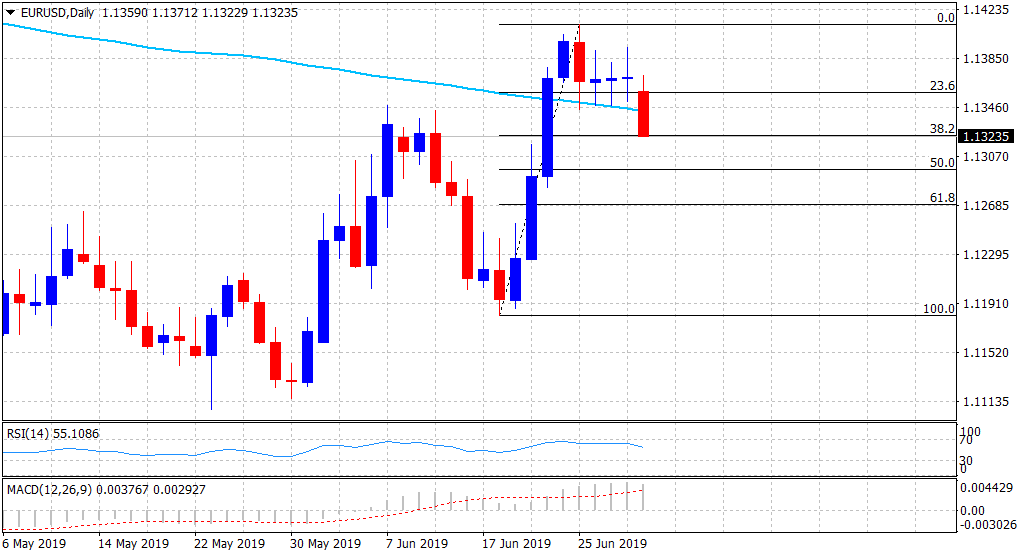
The latest positive development to restart trade talks prompted some follow-through USD short-covering move at the start of a new trading week and turned out to be one of the key factors exerting some downward pressure on the major. The pair finally broke through the very important 200-day SMA and was further weighed down by the fact that the European Union (EU) leaders failed to reach a consensus over who should get the EU's top jobs, including a successor to Commission chief Jean-Claude Juncker.
Moving ahead, Monday's release of the final Euro-zone manufacturing PMI prints and the US ISM manufacturing PMI - due later during the early North-American session, will now be looked upon for some short-term trading impetus. Meanwhile, this week's key focus will remain on the closely watched US monthly jobs report - popularly known as NFP, which is scheduled to be released on Friday and influence the near-term USD price dynamics.
From a technical perspective, the pair inability to capitalize on the recent positive move and failure to defend a popular moving average now points to the emergence of some fresh selling pressure. A subsequent weakness below the 1.1325-20 region - a support marked by 38.2% Fibo. level of the 1.1181-1.1412 recent up-move, will reinforce the bearish expectations and turn the pair vulnerable to accelerate the slide further towards the 1.1300 round figure mark en-route the 1.1275-70 support area (61.8% Fibo. level).
On the flip side, the 1.1350-55 region now becomes immediate strong resistance, above which the pair is likely to make a fresh attempt towards conquering the 1.1400 handle. A follow-through buying will now set the stage for an extension of the recent positive momentum towards challenging March monthly swing highs, around the 1.1445-50 region ahead of the key 1.1500 psychological mark.
Author

Haresh Menghani
FXStreet
Haresh Menghani is a detail-oriented professional with 10+ years of extensive experience in analysing the global financial markets.