Canada still faces risks, despite signs of NAFTA progress

Canada’s foreign affairs minister may be upbeat on recent NAFTA trade talks, but there are growing risks that an agreement just between the US and Mexico could leave Canada out in the cold
Canada's NAFTA difficulties
Chrystia Freeland, Canada's Foreign Affairs Minister, has made it clear that the US and Canada can move quickly to finalise NAFTA trade talks and that her country hasn't been left on the sidelines. Talks between the US and Mexico are said to be close to an agreement on a new auto deal but Canada hasn't been at the negotiating table for the past few weeks. When formal discussions do resume, clearly they won't be easy not least because of Donald Trump's earlier threats to walk away from NAFTA which he's regarded as being unfair to US manufacturers.
On tariffs, one potential solution being discussed by the Canadian government is duty relief and drawback programmes, where they’ll seek to give some comfort to their powerful automotive industry from retaliatory US steel and aluminium tariffs by protecting them from rising costs. Such protection will be made available to Canadian exporters who can show they’re facing import duties on their supplies. Nonetheless, Canada still remains on Trump’s hit list for future tariff’s, namely on auto imports, which could soon dent the Bank of Canada's optimistic outlook. The positive impact of such duty relief would quickly be diminished should Trump’s threats become reality.
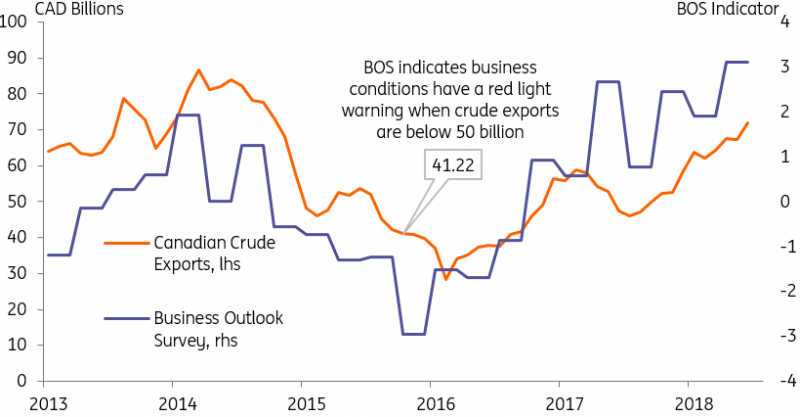
Canadian oil exports v Business outlook survey
Rising oil prices: How long will they last?
Oil prices are another factor which could dampen Canada’s outlook. In 2017, Canada was the fourth largest exporter of crude oil in the world with a total value worth $54 USD billion. Fluctuations in oil prices are always a threat to the economy. The price of crude is steadily increasing, they're now above $70 USD per barrel, but this may not be sustained.
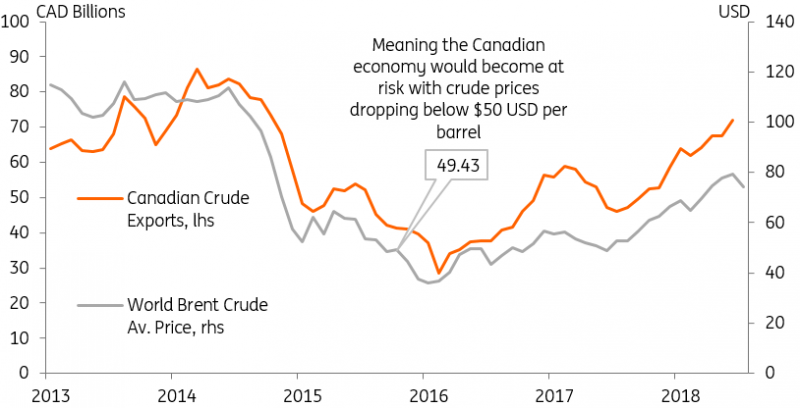
A boost in production is expected to come from the OPEC+ agreement; our commodities team is projecting a potential increase of around 1.5MMbbls/d in supply over the next few months. There’s also talk of Trump tapping into America's emergency oil stockpile with the intention to control rising gasoline prices, something which may not sit in the Republicans' favour at the upcoming US mid-terms in November. An escalation of the global trade war partnered with expansions of oil supply will weigh heavily on the oil market; we forecast the price of Brent crude to be on a downward turn towards $65 USD per barrel. But the extent of this decline shouldn't be too much of a threat to Canada unless prices drop below US$50 per barrel.
Canadian oil exports and price of Brent crude
We are optimistic about Canada’s future but risks still linger
The fight between upward inflationary pressures, strong growth performance and the hostility surrounding US trading policies didn’t seem to interfere with the Bank of Canada’s decision on Wednesday 11 July when policy rates were hiked a further 25bp to 1.5%. That said, the Canadian dollar was resistant to such a seemingly positive CAD move, weakening to one of its lowest levels, surpassing 1.32 post the July rate hike. Our FX team believes that the risks from any negative talk on a trilateral Nafta agreement will keep USD/CAD above 1.30 – and we’d need to see positive NAFTA news, or a surge in the stability of the US trading environment, in order to see a USD/CAD move below 1.30.
There's no doubt Canada’s economy is doing well as the country continues to reap the rewards of an exceptionally powerful US economy. June’s inflation reading saw the biggest year-on-year increase (+2.5%) in 6 years and May’s GDP release also came in above our expectations (+0.5%MoM), both suggesting any signs of damage from US trade tensions is limited. It also points to the BoC hiking rates again in 4Q18. The BoC prides itself on making data-dependent decisions so no further rate hikes this year would be extremely dovish, although any further escalations in trade tensions or a breakdown in NAFTA talks are key risks.
Read the original article here - Canada still faces risks, despite signs of NAFTA progress
Author
James Knightley
ING Economic and Financial Analysis
James Knightley is the Chief International Economist in London. He joined the firm in 1998 and has been covering G7 and Western European economies. He studied economics at Durham University, UK.