AUD/USD Weekly Forecast: Bleeding set to continue amid Fed’s hawkishness
- Central banks' imbalances are meant to push AUD/USD even lower in the upcoming weeks.
- A hawkish Fed and solid US growth figures put stocks on the back-foot.
- AUD/USD trades at fresh multi-month lows and could extend its slump towards 0.6770.

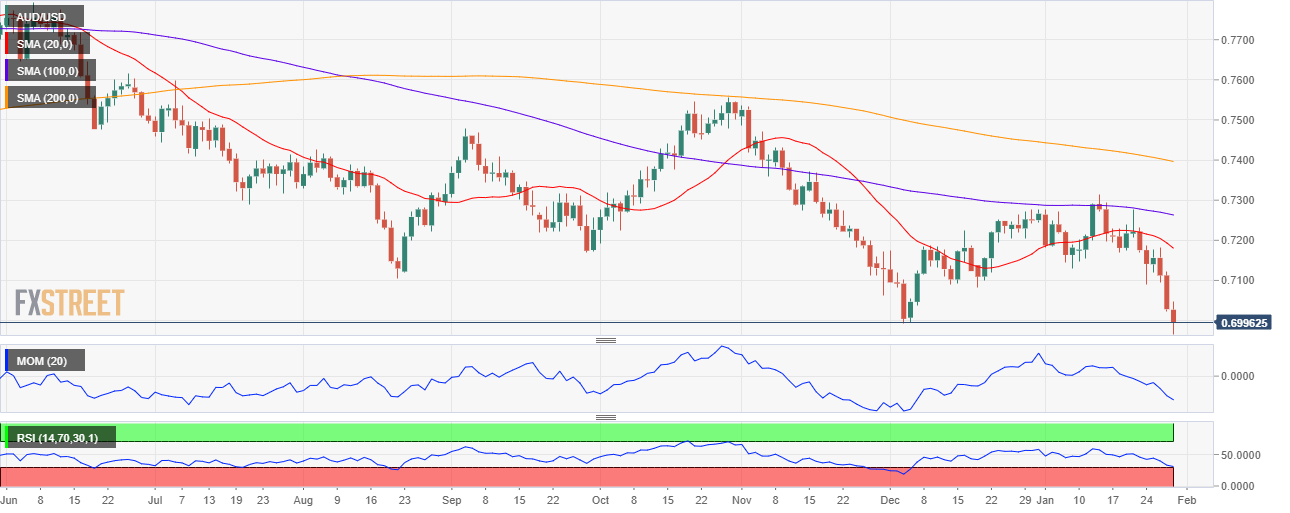
The AUD/USD pair plummeted to 0.6966, its lowest since July 2020, trading below the 0.7000 figure. The pair collapsed on renewed greenback's demand following the US Federal Reserve's latest announcement on monetary policy, much more aggressive than previously anticipated.
The perfect storm for AUD/USD
Heating inflation has put US policymakers in motion back in November, but ever since, each monetary policy meeting brings a more hawkish stance. This time, Fed's Chair Jerome Powell pretty much pre-announced a rate hike in March and left doors open for rate hikes in every upcoming meeting. The market is currently anticipating at least four hikes for 2022 and the reduction of the balance sheet afterwards.
He noted that the decision was taken amid substantial economic growth and a marked improvement in the labour market. On inflation, Powell expressed his concerns that it would keep rising but also cleared his determination to combat it.
The decision boosted the greenback while sending stocks into the dark side, a perfect scenario for AUD/USD depreciation. Wall Street is set to close in the red for a fourth consecutive week, as investors fear skyrocketing borrowing costs.
Plummeting gold prices also weighed on the pair as the bright metal collapsed. The bright metal hit $1,853.83 a troy ounce mid-week, now trading at its lowest since mid-December, at around $1,780 a troy ounce.
US first-tier data provided additional support to the American currency, as the country grew at an annualized pace of 6.9% in the last quarter of 2021, according to the Gross Domestic Product preliminary estimate. The December Personal Consumption Expenditures Price Index rose to 5.8% YoY, below the 6.1% expected, although still signalling continued inflationary pressures. The core reading jumped to 4.9% above the 4.8% forecast. However, there were some disappointing numbers, as Durable Goods Orders fell by 0.9% in December, while the preliminary estimates of the January Markit PMIs showed a contraction in businesses activity.
On the other hand, Australian data released these days was tepid, adding fuel to the fire. The preliminary estimates of the January Commonwealth Bank PMIs missed expectations, with the services index down to 45. December NAB's Business Confidence plunged to -12, while the Q4 Consumer Price Index surged to 3.5% YoY. Finally, the December Westpac Leading Index printed at -0.03%, well below the previous 0.12%.
Busy week ahead
The upcoming week will be a busy one, starting with China publishing the January official NBS PMIs and ending with the US Nonfarm Payrolls report.
Australia will release through the week the January AIG Performance of Manufacturing Index, December Retail Sales, Q4 NAB's Business Confidence, and the December Retail Sale. The Reserve Bank of Australia will have a monetary policy meeting next Tuesday, although the central bank is expected to maintain its current policy on hold.
The US macroeconomic calendar includes the January ISM official PMIs and the December employment report, expected to show that the US added 238K new jobs in the month. The Unemployment Rate is expected to remain steady at 3.9%.

AUD/USD technical outlook
The AUD/USD pair is poised to extend its decline, according to technical readings. The weekly chart shows that a bearish 200 SMA provided resistance, with the pair plummeting after being unable to advance beyond it. The 20 SMA, in the meantime, accelerated its slump and is crossing below the 100 SMA, both above the longer one. Meanwhile, technical indicators head firmly lower within negative levels.
In the daily chart, the bearish case is also clear, as the pair is developing below firmly bearish moving averages as technical indicators approached oversold readings, maintaining their downward slopes. The next relevant support level is 0.6920, with a break below it exposing 0.6770. Sellers will likely re-appear on approaches to the 0.7100 figure, although beyond the latter, a corrective advance could continue towards the 0.7170/0.7210 region.
AUD/USD sentiment poll
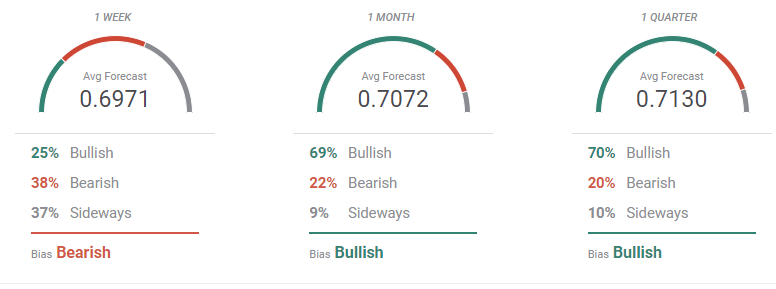
The FXStreet Forecast Poll shows that the pair could extend its decline in the near term, as bears led with 38% of the polled experts. The sentiment makes a sharp U-turn afterwards, as buyers are 69% in the monthly view and 70% in the quarterly perspective. The pair is seen recovering, although gains seem limited, as the pair is seen averaging 0.7130.
The Overview chart, on the other hand, shows that moving averages maintain their bearish slopes, as the pair is seen as low as 0.6600 in the upcoming weeks, although not higher than 0.7300. In the quarterly perspective, most targets accumulate between 0.71 and 0.73, although the range of possible targets extends for over 1,000 pips.
Related Forecasts:
Gold Weekly Forecast: XAU/USD poised for further losses on Fed's hawkish stance
EUR/USD Weekly Forecast: ECB's decision and Nonfarm Payrolls take centre stage
GBP/USD Weekly Forecast: Sterling sinking set to continue on high BOE expectations, low NFP ones
Author

Valeria Bednarik
FXStreet
Valeria Bednarik was born and lives in Buenos Aires, Argentina. Her passion for math and numbers pushed her into studying economics in her younger years.