EUR/USD Weekly Forecast: ECB’s decision and Nonfarm Payrolls take center stage
- The US Federal Reserve anticipated an aggressive monetary policy tightening for 2022.
- The European Central Bank is likely to maintain its wait-and-see stance.
- EUR/USD is technically bearish and could reach the 1.1000 figure in the near term.

The EUR/USD pair trades near the 1.1100 figure, at levels that were last seen in May 2020. The American dollar advanced ever since the week started but soared following the US Federal Reserve monetary policy announcement.
An aggressive Fed boosts the greenback
The US central bank kept rates and tapering unchanged as expected, reiterating that pandemic-related financial support will end in March. However, Chair Jerome Powell provided plenty of hawkish signals within his press conference. He hinted at a March liftoff, adding that he would not rule out a hike in every meeting this year.
On the balance sheet reduction, he gave no specific dates, as the Committee is still discussing how to do it, although it is certain that it will start sometime later in the year. Back in December, policymakers were considering reducing its bond holdings by not replacing bonds that mature, instead of ending purchases, quite an aggressive approach to the issue.
The decision came as inflation continues to rise in the world's largest economy, currently standing at 7% YoY, a multi-decade high. Powell noted that high inflation poses a threat to the job market, which continues progressing towards Fed's target. A tighter monetary policy should curb price pressures in an economy that is healthy enough to deal with higher rates. If the Federal Reserve effectively reduces Treasuries buying, yields will go up and make borrowing costs even more expensive.
As an immediate reaction to the news, Wall Street fell, with major indexes posting losses for a fourth consecutive week. The ongoing slump is not yet of concern, but Powell & Co may have to slow its tightening pace if panic selling hits stocks.
But overall, financial markets took it well. The yield on the 10-year US Treasury note peaked at 1.86% following the Fed's announcement, pulling back afterwards to end the week at around 1.79%.
Substantial growth coupled with persistent price pressures
US data released this week was mixed, although the greenback got an additional boost from the Q4 Gross Domestic Product figure, as it showed that the country grew at an annualized pace of 6.9% in the last quarter of 2021. The US published the December Personal Consumption Expenditures Price Index on Friday, which rose to 5.8% YoY, below the 6.1% expected, although still signalling continued inflationary pressures. The core reading jumped to 4.9% above the 4.8% forecast.
Other than that, Markit published the preliminary estimates for its January PMIs. US figures were quite disappointing, as the Services index contracted from 57.6 to 50.9, while the manufacturing one was down to 55 from 57.7 previously. Additionally, Durable Goods Orders unexpectedly fell 0.9% MoM in December, while the January Michigan Consumer Sentiment Index was downwardly revised to 67.2.
Markit also released the preliminary estimates of the Union's PMIs. German figures were upbeat, but generally speaking, the expansion in the services sector was tepid across the region, while the manufacturing sector picked up strongly.
The January German IFO survey showed that the Business Climate improved to 95.7, although the assessment of the current situation shrank to 96.1. The February GFK Consumer Confidence Survey printed at -6.7, better than the -7.8 expected. Finally, the Q4 GDP in the country printed at -0.7% QoQ, worse than the -0.3% expected. The EU only published the January Economic Sentiment Indicator, which shrank to 112.7 from 113.8 in the previous month.
Busy week ahead with the ECB and NFP
The upcoming week will start with the EU publishing the preliminary estimate of its Q4 GDP, foreseen at 0.3% QoQ, and Germany releasing the preliminary estimates of January inflation figures. The country will publish December Retail Sales and January unemployment figures on Tuesday when the US will release the official ISM Manufacturing PMI.
Later in the week, the EU will offer its latest inflation figures and December Retail Sales, while the ECB will have a monetary policy meeting on Thursday. The central bank is widely anticipated to maintain its current policy unchanged, alongside the cautious approach to future changes.
By the end of the week, the focus will be on US employment figures, as the country will release the Nonfarm December Payrolls report, expected to show that the US added 238K new jobs in the month. The Unemployment Rate is expected to remain steady at 3.9%.

EUR/USD technical outlook
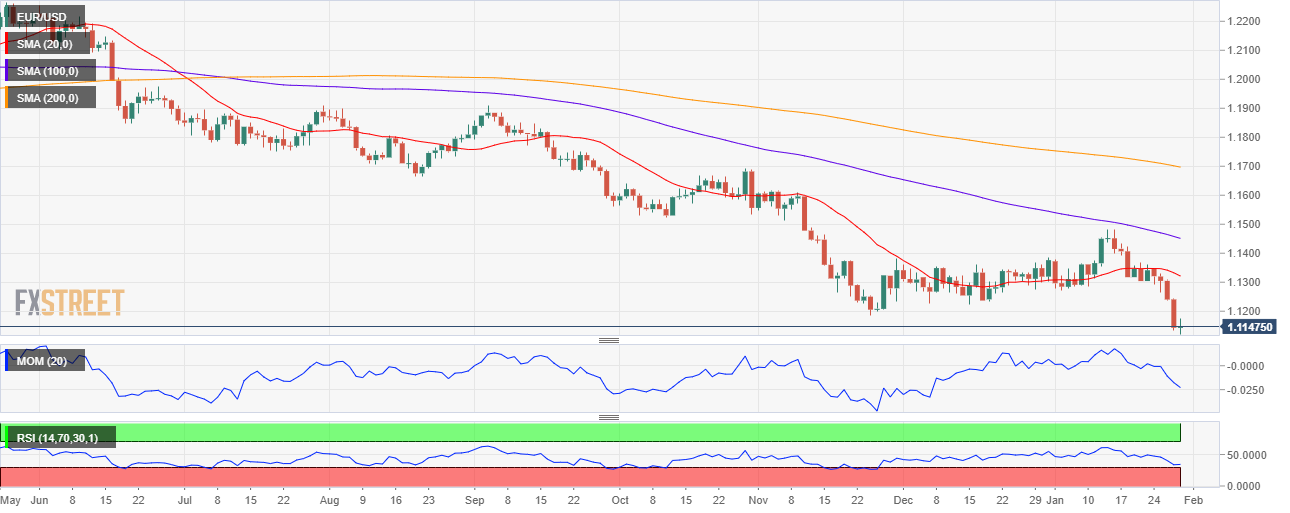
The EUR/USD pair bottomed at 1.1120 and trades nearby, heading into the close. The weekly chart shows that the pair has resumed its decline and is poised to fall further, as technical indicators head firmly south near oversold readings. Meanwhile, the 20 SMA has crossed below the 100 and 200 SMAs, maintaining a strongly bearish slope well above the current level.
The daily chart shows that the pair reached oversold readings. Technical indicators have stabilized in extreme levels amid Friday's limited intraday range, while the pair develops far below bearish moving averages. The pair may correct higher before posting a new leg lower, but selling interest will likely be aligned in the 1.1185/1.1220 price zone. If it managed to break above this resistance area, the pair could approach 1.1300. On the other hand, a break below the 1.1100 figure should lead to a test of the critical 1.1000 psychological level.
EUR/USD sentiment poll
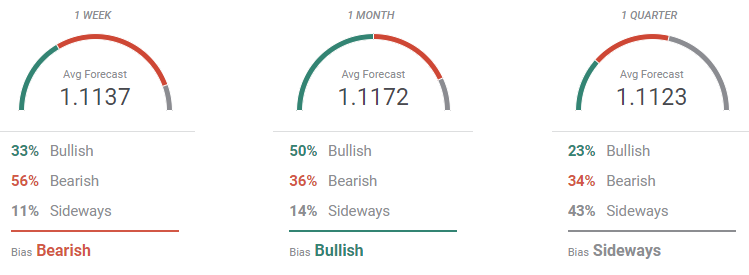
The FXStreet Forecast Poll shows that those betting on lower lows are a majority in the near term, with most targets accumulating between 1.10 and 1.11. The spread of possible targets widens in the monthly view but shrinks again in the quarterly perspective. On average, the pair is seen around the current level in the three time-frame under study, although bulls are a majority in the monthly perspective, with 50% of the polled experts looking for an upward corrective advance.
The Overview chart shows that the 1.1400 region has become a long-term resistance area also that a fall sub-1.1000 has become more likely, with multiple analysts betting for an extension towards 1.0800. All the three moving averages maintain firmly bearish slopes.
Related Forecasts:
Gold Weekly Forecast: XAU/USD poised for further losses on Fed's hawkish stance
GBP/USD Weekly Forecast: Sterling sinking set to continue on high BOE expectations, low NFP ones
Author

Valeria Bednarik
FXStreet
Valeria Bednarik was born and lives in Buenos Aires, Argentina. Her passion for math and numbers pushed her into studying economics in her younger years.