|

WTI Price Analysis: Oversold RSI can stop bears targeting 61.8% Fibonacci

  • WTI seesaws near 15-week low flashed the previous day.
  • Oversold RSI could repeat patterns registered from early-January 2019.
  • $57.35/25 becomes the key resistance confluence.

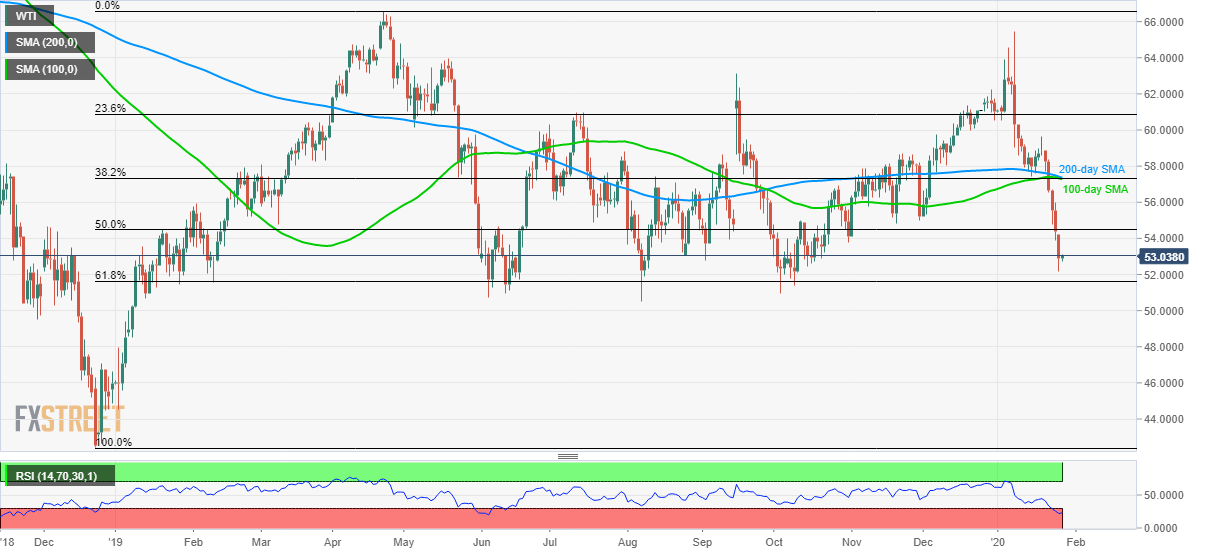
WTI bears catch a breath as the quote flashes $53.00 during the initial trading session on Tuesday. The energy benchmark recently dropped to the lowest since October and is declining towards 61.8% Fibonacci retracement of its upside from December 2018 to April 2019.

Even so, overbought conditions of RSI can help repeat the bounces off $51.60 key Fibonacci level, if not then $50.00 could try disappointing the sellers.

In a case where the black gold continues to linger beneath $50.00, high marked on December 26, 2018, near $47.00 will be in the spotlight.

On the flip side, a 50% Fibonacci retracement level of $54.50 could please the short-term buyers during the pullback.

However, a confluence of 100 and 200-day SMA, as well as 38.2% Fibonacci retracement, will cap the rise around $57.25/35, if not then a fresh run-up towards $60.00 could be expected.

WTI daily chart
Trend: Pullback expected

Additional important levels

Overview
Today last price52.88
Today Daily Change-0.02
Today Daily Change %-0.04%
Today daily open52.9
 
Trends
Daily SMA2058.95
Daily SMA5058.88
Daily SMA10057.32
Daily SMA20057.49
 
Levels
Previous Daily High54.21
Previous Daily Low52.16
Previous Weekly High59.65
Previous Weekly Low53.86
Previous Monthly High62.38
Previous Monthly Low55.41
Daily Fibonacci 38.2%52.94
Daily Fibonacci 61.8%53.43
Daily Pivot Point S151.96
Daily Pivot Point S251.03
Daily Pivot Point S349.91
Daily Pivot Point R154.02
Daily Pivot Point R255.15
Daily Pivot Point R356.08

Author

Anil Panchal

Anil Panchal

FXStreet

Anil Panchal has nearly 15 years of experience in tracking financial markets. With a keen interest in macroeconomics, Anil aptly tracks global news/updates and stays well-informed about the global financial moves and their implications.


More from Anil Panchal
Share:

Editor's Picks

EUR/USD retreats below 1.1800 as EU-US trade relations sour

EUR/USD loses its traction and retreats below 1.1800 following the earlier climb. The data from Germany highlighted a modest improvement in business sentiment in February but failed to help the Euro as investors assess the US-EU trade relations following Trump's global tariff hike announcement.

GBP/USD rises toward 1.3550 as tariff confusion slams USD

GBP/USD extends the advance toward 1.3550 on Monday. The US Dollar faces intense selling pressure as tariff uncertainty lingers following US President Trump's latest announcement. Traders will take more cues from the broader market sentiment and central bank talks. 

Gold climbs above $5,100 on broad USD weakness

Gold sticks to its bullish bias near the monthly above $5,100 on Monday. Renewed trade-war fears, along with rising geopolitical tensions in the Middle East, turn out to be key factors that underpin the safe-haven precious metal and validate the constructive outlook.

Cardano braces for impact as US tariff storm brews

Cardano is down 4% at press time on Monday, entering its third consecutive day of decline. Bearish bias in Cardano’s derivatives market positional buildup aligns with rising pressure on the broader cryptocurrencymarket amid US President Donald Trump's reassessment of global tariffs and domestic conflict with the US Supreme Court. 

Supreme Court nixes tariffs, Trump teases 15% global tariff

On February 20th, the Supreme Court ruled that Trump’s global tariffs under IEEPA authority were unconstitutional, effectively nullifying the framework. However, the relief was short-lived. Within hours, Trump floated a 15% blanket tariff under an alternative legal authority.

Top Crypto Losers: Zcash, Pump.fun, and LayerZero extended losses as Bitcoin loses $65,000

The cryptocurrency market starts the week in panic mode, with altcoins Zcash, Pump.fun, and LayerZero. Bitcoin falls below $65,000 as the US President Donald Trump regroups amid renewed trade policy risks.