USD/JPY Price Forecast: Bullish bias builds above 155.00 support
- USD/JPY holds above the 100-day SMA, maintaining a constructive bias.
- Immediate resistance stands at the 50-day SMA near 156.00.
- Momentum improves as RSI reclaims the 50 mark, while ATR indicates volatility remains elevated.

USD/JPY trades on the front foot on Tuesday as the Japanese Yen (JPY) weakens broadly after reports that Japan’s Prime Minister Sanae Takaichi signaled caution over further Bank of Japan (BoJ) rate hikes during a meeting with Governor Kazuo Ueda last week. However, the pair is struggling to extend gains as the US Dollar (USD) eases from its intraday highs.
At the time of writing, USD/JPY trades around 155.70 after hitting a daily high of 156.28, up nearly 0.64%.
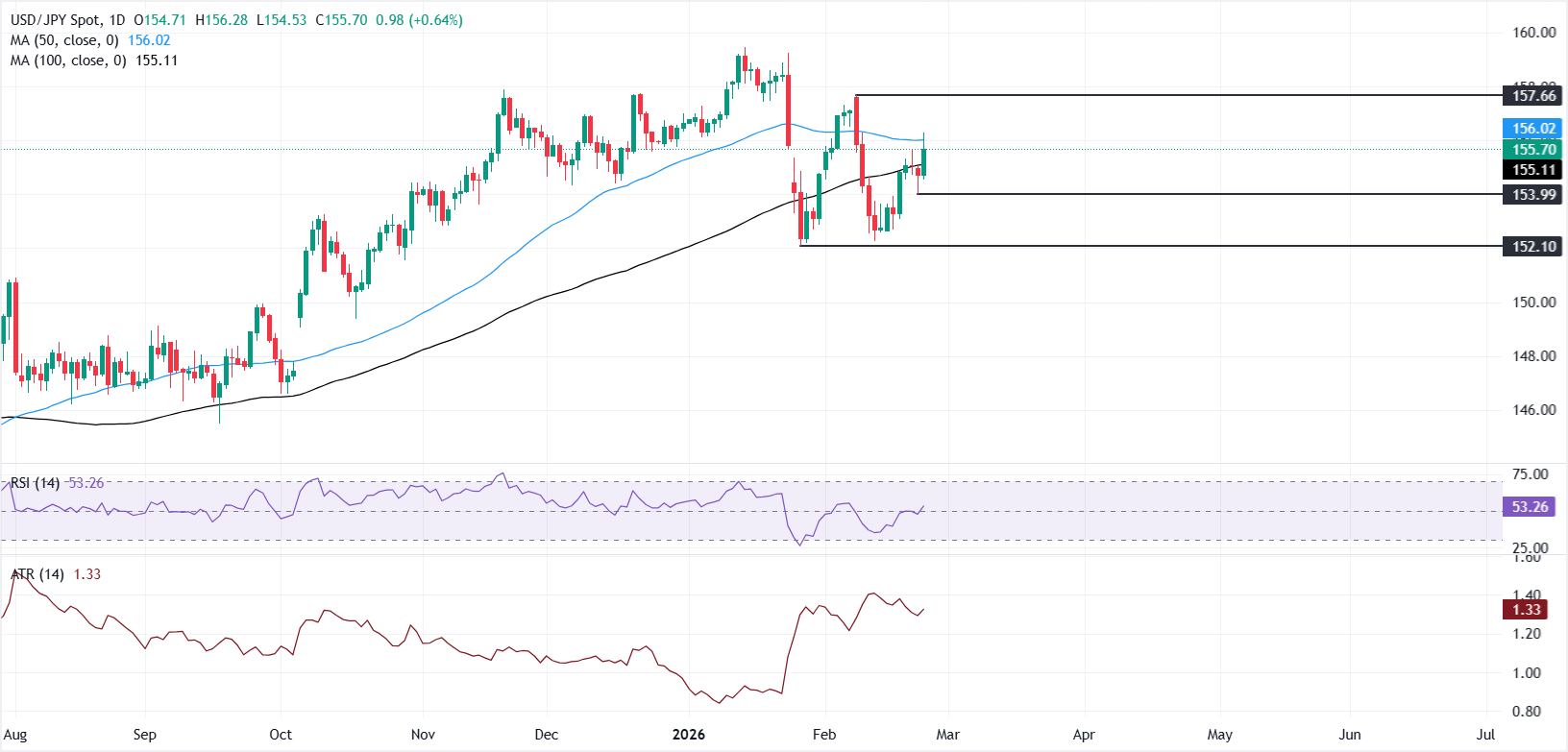
From a technical perspective, the daily chart suggests a neutral to mildly bullish near-term outlook. Price action has climbed back above the 100-day SMA near 155.10, while the 50-day SMA around 156.00 is now acting as immediate resistance, capping further upside attempts.
Momentum indicators show early signs of stabilization. The Relative Strength Index (RSI) has recovered toward 53 after approaching oversold territory earlier this month, signaling improving bullish momentum.
Meanwhile, the Average True Range (ATR) near 1.30 reflects elevated but steady volatility, favoring gradual trend continuation rather than an abrupt reversal as long as underlying support levels hold.
On the downside, immediate support is seen at the 100-day SMA around 155.10. A break below this level would expose the 154.00 region as the next key support.
Below 154.00, the 152.00 zone becomes pivotal, as a decisive move beneath that area would invalidate the emerging bullish bias and shift focus back toward a deeper corrective phase.
On the upside, a sustained move above the 50-day SMA could open the door toward the 157.00-157.50 region, where the recent swing highs cap the upside.
Japanese Yen FAQs
The Japanese Yen (JPY) is one of the world’s most traded currencies. Its value is broadly determined by the performance of the Japanese economy, but more specifically by the Bank of Japan’s policy, the differential between Japanese and US bond yields, or risk sentiment among traders, among other factors.
One of the Bank of Japan’s mandates is currency control, so its moves are key for the Yen. The BoJ has directly intervened in currency markets sometimes, generally to lower the value of the Yen, although it refrains from doing it often due to political concerns of its main trading partners. The BoJ ultra-loose monetary policy between 2013 and 2024 caused the Yen to depreciate against its main currency peers due to an increasing policy divergence between the Bank of Japan and other main central banks. More recently, the gradually unwinding of this ultra-loose policy has given some support to the Yen.
Over the last decade, the BoJ’s stance of sticking to ultra-loose monetary policy has led to a widening policy divergence with other central banks, particularly with the US Federal Reserve. This supported a widening of the differential between the 10-year US and Japanese bonds, which favored the US Dollar against the Japanese Yen. The BoJ decision in 2024 to gradually abandon the ultra-loose policy, coupled with interest-rate cuts in other major central banks, is narrowing this differential.
The Japanese Yen is often seen as a safe-haven investment. This means that in times of market stress, investors are more likely to put their money in the Japanese currency due to its supposed reliability and stability. Turbulent times are likely to strengthen the Yen’s value against other currencies seen as more risky to invest in.
Author

Vishal Chaturvedi
FXStreet
I am a macro-focused research analyst with over four years of experience covering forex and commodities market. I enjoy breaking down complex economic trends and turning them into clear, actionable insights that help traders stay ahead of the curve.