|

WTI Price Analysis: Oil hits 2.5-year high, weekly chart shows a bullish breakout

WTI extends previous week's gain, clocks fresh 13-month high. 

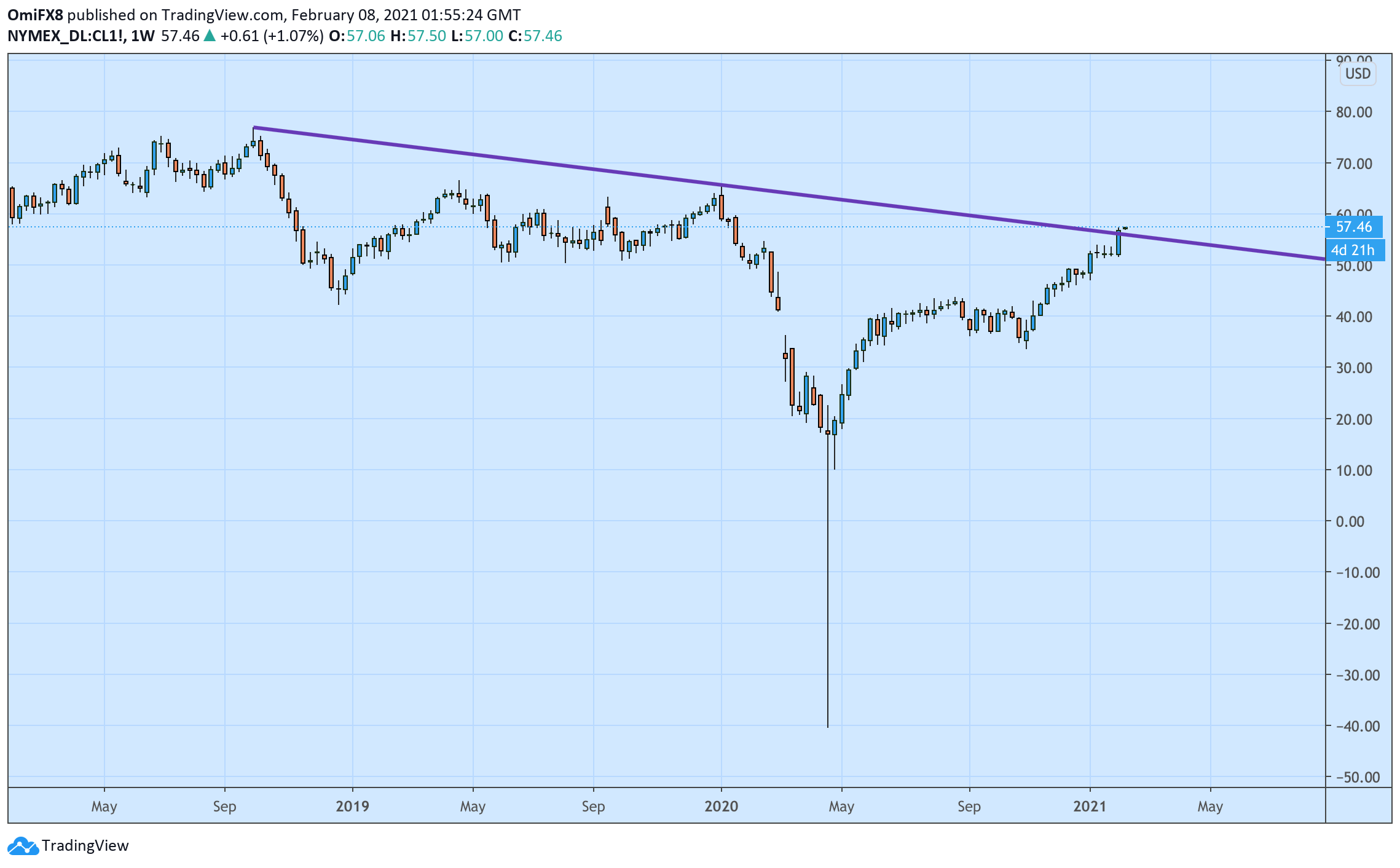
Oil has violated a 2-1/2-year-long bearish trendline. 

West Texas Intermediate (WTI) crude, a North American oil benchmark, rose to $57.50 on Monday – the highest level since January 2020. 

Prices jumped nearly 9% last week – the biggest single-week gain since October 2020 – confirming an upside break of the trendline falling from October 2018 and January 2020 highs. 

The breakout has exposed resistances at $60 (psychological level) and $65.65 (lower high created in January 2020). 

However, a pullback may be seen before a continued rally, as the daily and weekly chart Relative Strength Indices are hovering above 70.00, indicating overbought conditions. 

The ascending 10-day Simple Moving Average, currently at $54.64, is a key support to watch out for in the short-term. 

Weekly chart
Trend: Bullish

Technical levels

WTI

Overview
Today last price57.35
Today Daily Change0.48
Today Daily Change %0.84
Today daily open56.87
 
Trends
Daily SMA2053.33
Daily SMA5049.95
Daily SMA10045.19
Daily SMA20041.71
 
Levels
Previous Daily High57.17
Previous Daily Low56.21
Previous Weekly High57.17
Previous Weekly Low51.6
Previous Monthly High53.94
Previous Monthly Low47.26
Daily Fibonacci 38.2%56.8
Daily Fibonacci 61.8%56.57
Daily Pivot Point S156.33
Daily Pivot Point S255.79
Daily Pivot Point S355.37
Daily Pivot Point R157.29
Daily Pivot Point R257.7
Daily Pivot Point R358.24

Author

Omkar Godbole

Omkar Godbole

FXStreet Contributor

Omkar Godbole, editor and analyst, joined FXStreet after four years as a research analyst at several Indian brokerage companies.


More from Omkar Godbole
Share:

Editor's Picks

AUD/USD keeps range near mid-0.7100s as USD bulls await US CPI

AUD/USD steadies near mid-0.7100s in the Asian session on Friday, stalling the previous day's sharp decline to an over one-week low. The August PPI report reaffirmed Fed rate-hike bets and boosted the US Dollar on Thursday, which weighed heavily on the pair. However, hawkish RBA expectations limited losses for the Aussie as USD bulls now await the release of the US consumer inflation figures before placing fresh bets.

USD/JPY holds lower ground toward 154.00; looks to US CPI

USD/JPY holds lower ground toward 154.00 in the Asian session on Friday after hot Japanese PPI data bolster a more hawkish BoJ repricing and provide fresh impetus to the Japanese Yen. However, the downside appears capped as the US Dollar preserves overnight gains ahead of the latest US consumer inflation data.

Gold moves away from one-week low, climbs above $4,450 as USD edges lower ahead of CPI

Gold builds on its modest intraday recovery from the $4,300 neighborhood, or a one-and-a-half-week low, touched earlier this Friday, and climbs above $4,350 heading into the European session. The upside potential, however, seems limited as traders opt to wait for the release of US consumer inflation figures before placing directional bets.

Cardano approaches critical support as correction risks grow
Cardano (ADA) recovers slightly, trading at $0.206 at the time of writing on Friday, inches above the critical support zone after losing more than 6% so far this week. Weakening derivatives data and fading bullish momentum suggest a bearish near-term outlook, with a decisive close below the support zone potentially triggering a deeper correction for ADA.
US core CPI data set to ease in August as markets reprice Fed September rate decision

The US Bureau of Labor Statistics will publish the August Consumer Price Index data on Friday. The report is expected to show a small decline in annual core inflation. Any divergence from analysts’ estimates could influence the Federal Reserve’s policy outlook and impact the US Dollar’s valuation.

Venezuela’s 65-billion-barrel Oil deal could reshape America’s inflation fight
The United States (US) has secured unprecedented access to part of Venezuela’s vast Oil reserves. The timing is particularly significant as the war with Iran is disrupting Middle Eastern supplies, keeping energy prices elevated and reviving concerns about inflation.