|

WTI is gaining for the fifth-straight week, eye $74.00 heading into the weekend

  • Western Texas Intermediate printed a  two-month high at 73.90
  • Oil companies with installations in the Gulf of Mexico turn to Iraq and Canadian oil.
  • The crude oil rally was capped by China’s first sale of crude of its reserves.

Western Texas Intermediate (WTI) crude oil is climbing for the fourth day in a row, surging almost 1%, trading at $73.86 at the time of writing. 

The market sentiment is downbeat. Major global equity indices closed with losses, except for the Japanese Nikkei and Topix, which reported gains of 2.06% and 2.31%. Meanwhile, as the New York session advances, the S&P 500, the Dow Jones, and the Nasdaq record losses between 0.01% and 0.25%.

Meanwhile, the US Dollar Index, which influences the price in commodities stills up some 0.17%, at 93.25.

WTI reached two-month highs at $73.90

The surge in oil prices is due to low inventories in the US, which are near a three-year low, and rising natural gas prices impacting customers who may be forced to switch to oil. Further, no new lockdowns in Europe and robust recovery in China mobility lift the prospects for upside.

In the Gulf of Mexico, crude oil companies that have not been able to re-establish operations turn to Iraq and Canadian oil to meet the market demands. 

Nevertheless, the rally was capped by China’s first sale of crude from its strategic petroleum reserves in its attempt to curb inflation in raw material prices.

WTI Price Forecast: Technical outlook

Daily chart

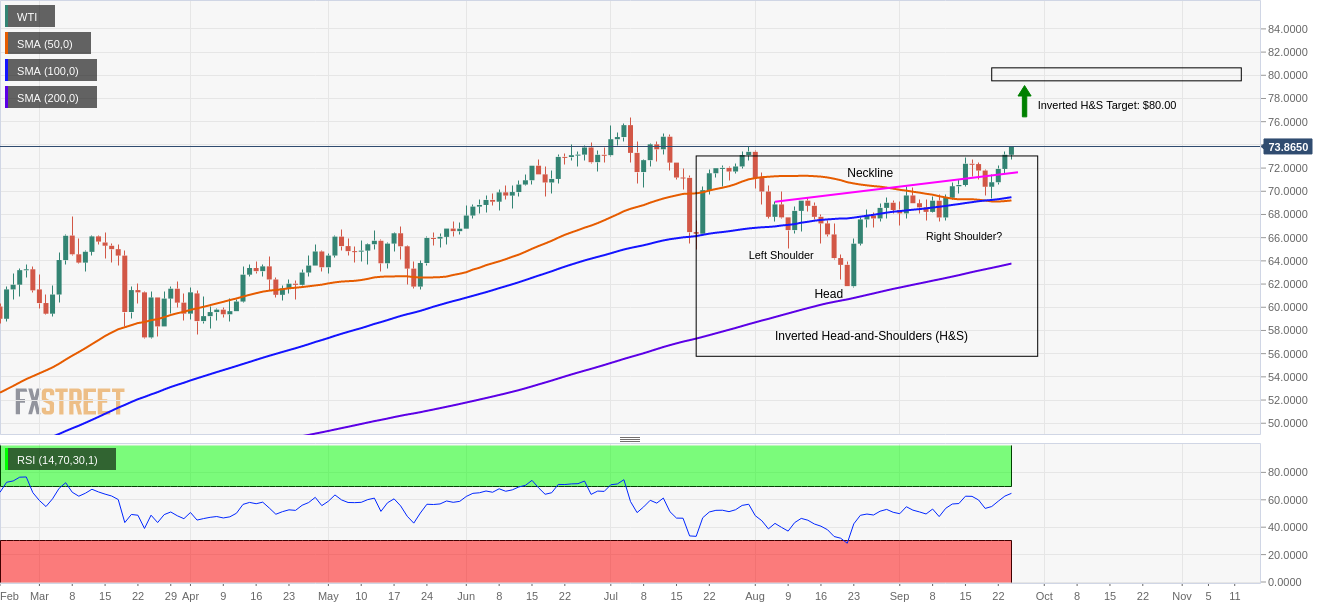
WTI is trading above the neckline of an inverted head-and-shoulders pattern that has bullish implications. A daily close above the July 30 high at $73.88 could propel the black gold towards the inverted head-and-shoulders target of $80.00. But on its way up, it will find the July 13 high at $74.95, followed by $76.00. A decisive break of that level would expose the inverted head-and-shoulders target of $80.00

The Relative Strength Index is at 65, aiming higher, towards oversold levels, but it has room for some upside.
 

Author

Christian Borjon Valencia

Markets analyst, news editor, and trading instructor with over 14 years of experience across FX, commodities, US equity indices, and global macro markets.


More from Christian Borjon Valencia
Share:

Editor's Picks

AUD/USD bulls regain control above 0.6950 amid USD retreat

AUD/USD regains traction and extends the previous day's bounce from the weekly low, aiming for 0.7000 in Asia on Friday. The overnight pullback in US bond yields keeps the US Dollar below an 18-month high, which in turn offers some support to the pair. Meanwhile, hawkish RBA expectations also keep the major underpinned.

USD/JPY holds gains near 158.00 after Japan's weak Household Spending data

USD/JPY clings to gains around 158.00 after data showed on Friday that Japan's Household Spending fell for the ninth straight month, undermining the Japanese Yen. Meanwhile, the US Dollar remains depressed as the overnight fall in US bond yields counters a hawkish Fed and geopolitical uncertainties, could cap any downside in the pair.

Gold remains range-bound below $4,200

Gold has given up some ground after an initial bullish attempt to reach weekly highs, returning to below the $4,200 mark per troy ounce on Friday. The US Dollar’s strong upside momentum, combined with rising US Treasury yields across the curve, seems to keep further gains in the yellow metal under scrutiny.

Has Bitcoin really escaped the macro forces it was built to fight?
Over 17 years ago, Satoshi Nakamoto designed Bitcoin (BTC) on the back of a global financial crisis as an alternative to the global monetary system outside the control of central banks, governments and traditional intermediaries. This raises a key question: has Bitcoin really become independent of the macroeconomic forces it was built to challenge?
The Euro is not the sick man of Europe. France's bond market is
EUR/USD remains under pressure, near the 17-month low of 1.1161 reached on Monday. The pair has lost more than 7% since its yearly peak, as concerns over France's public finances increasingly weigh on the single currency. But behind the weakness of the Euro (EUR), the problem does not necessarily lie with the European economy as a whole.
Has Bitcoin really escaped the macro forces it was built to fight?
Over 17 years ago, Satoshi Nakamoto designed Bitcoin (BTC) on the back of a global financial crisis as an alternative to the global monetary system outside the control of central banks, governments and traditional intermediaries. This raises a key question: has Bitcoin really become independent of the macroeconomic forces it was built to challenge?














