USD/THB mildly down as markets asses US job report
- Market sentiment is skewing towards a potential test of the Dollar’s downside this week.
- Last week’s soft NFP report from April continues to weigh on the USD.
- Fed officials hold to Powell’s speech, lack of progress in inflation but that cuts will eventually come.

On Monday, the USD/THB is trading lower on Monday as the USD remains weak following Friday’s weak Nonfarm Payrolls report. Several Federal Reserve (Fed) officials were on the wires, but didn’t provide additional guidance on the Fed’s stance other than the one provided in last week’s decision. The bank remains data-dependant awaiting to gain more confidence to start cutting.
That being said, markets adjusted their expectations on the Fed and now foresee higher chances of the first cut in July and September, which may add pressure to the Dollar in the near term. These factors, along with a lack of major data releases this week for markets to digest, create an ambiance of uncertainty for the US currency, which may push the market towards a Dollar downside test this week.
USD/THB technical analysis
On the daily chart, the Relative Strength Index (RSI) reveals a tendency towards the negative zone, with the latest reading just above 50. This hints at a potential bearish cycle in the absence of a strong buying push. The Moving Average Convergence Divergence (MACD) shows rising red bars, indicating a gradual increase in negative momentum.
USD/THB daily chart
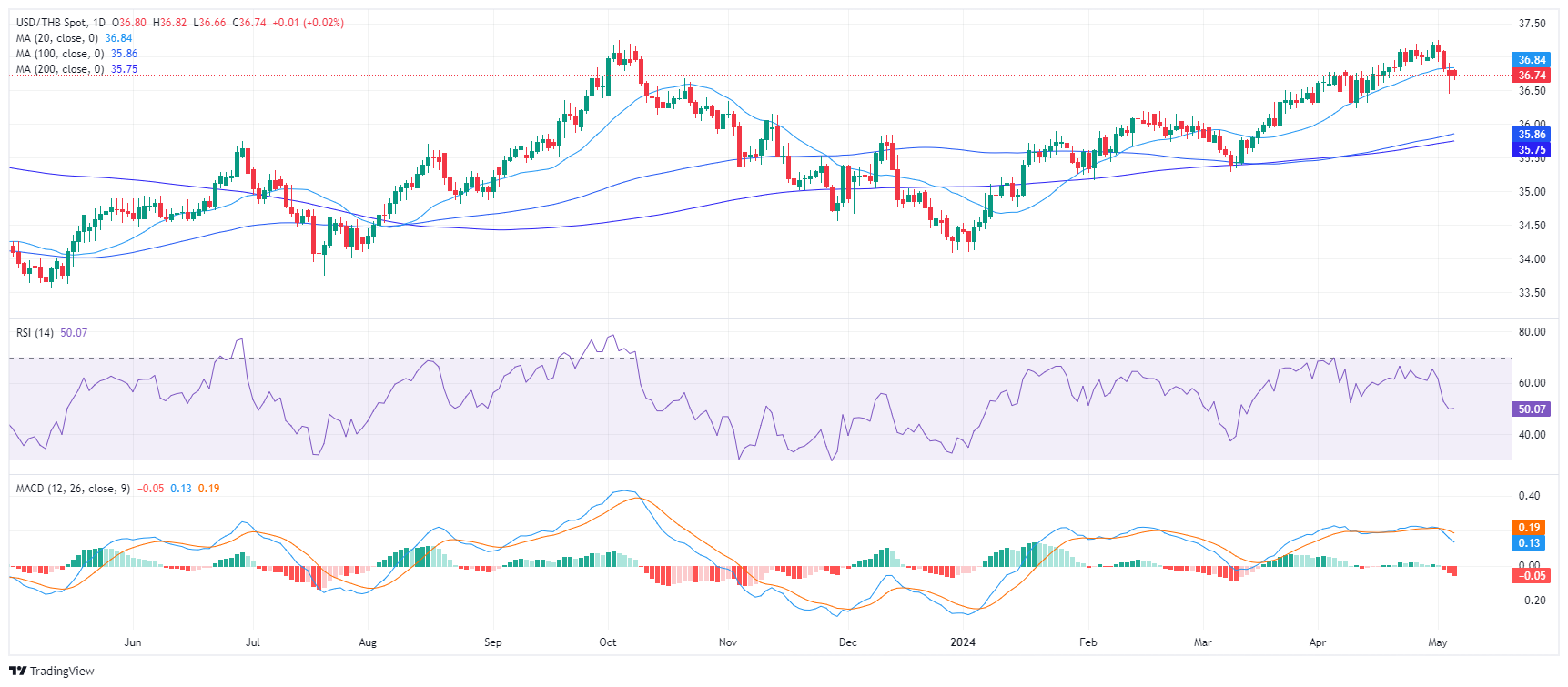
In an overview of the broader performance, the USD/THB is currently exhibiting significant long-term strength. The pair is positioned above both the 100 and 200-day Simple Moving Average (SMA), suggesting a resilient upward trend. On the shorter horizon, the pair remains below the 20-day SMA, which may signify that in the short term, the bear might take the lead. So the daily indicators and the pair’s position below the 20-day SMA may suggest that further downside may be on the horizon.
Author

Patricio Martín
FXStreet
Patricio is an economist from Argentina passionate about global finance and understanding the daily movements of the markets.