|

USD/THB continues losing ground on soft USD data

  • The USD/THB declined to 36.20 on Thursday with sharp losses seen during the European session.
  • Signs of US economic slowdown are unveiled, as Initial Jobless Claims surpassed expectations and the Philadelphia Fed Manufacturing Survey came in soft.
  • Given the soft US economic data, the likelihood of the Fed cutting sooner rather than later has increased.

The USD/THB pair is trading weaker on Thursday with 0.35% losses at around 36.20. Soft Initial Jobless Claims and a reduction in the Philadelphia Fed Manufacturing Survey following the lower-than-expected Consumer Price Index (CPI) seem to be driving the USD downwards on rising dovish bets on the Federal Reserve (Fed).

The Initial Jobless Claims for the week ending May 3, touched a high of 222K, outdoing forecasts and marking an upward revision of the previous week's figures which stood at 232K. Continued economic softness may mount pressure on the Federal Reserve (Fed), to cut rates earlier. However, markets continue to see the easing starting in September but if data continues to outperform, the Fed might consider a cut in July.

USD/THB technical analysis

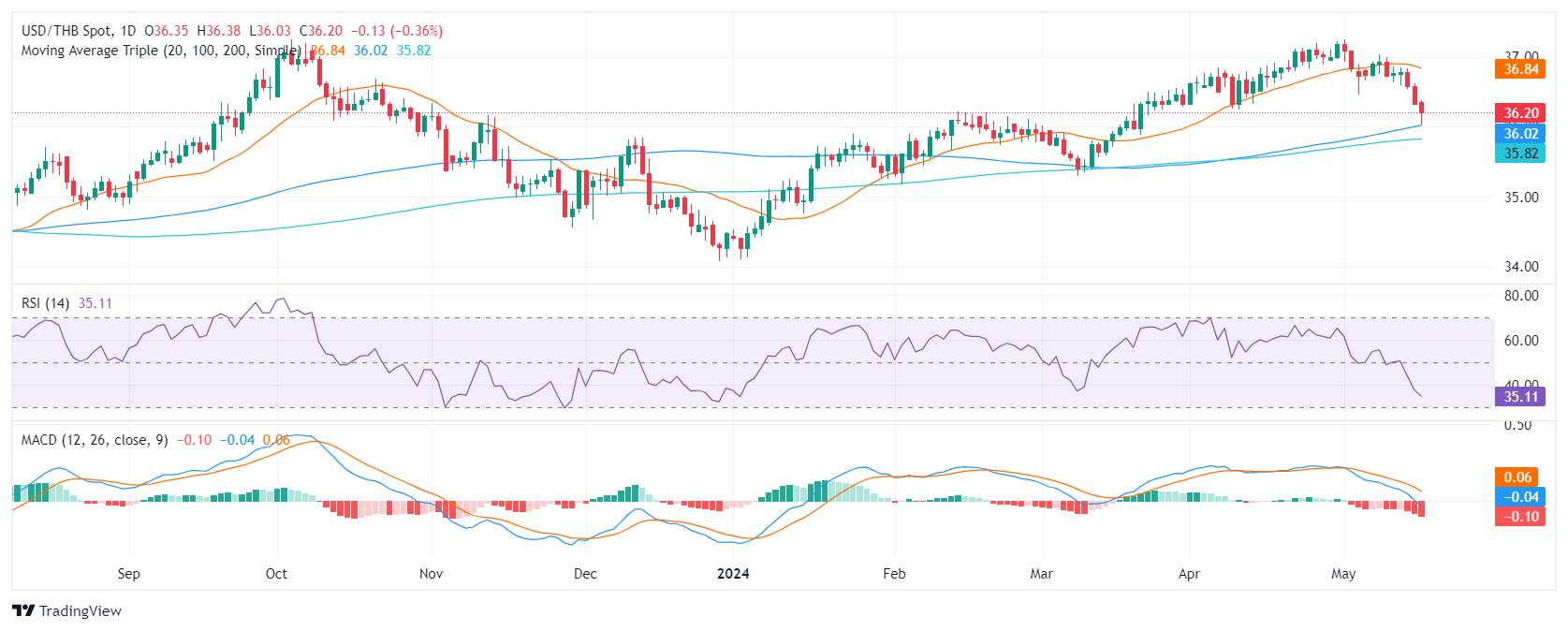
On the daily chart, the Relative Strength Index (RSI) shows a decrease from positive territory to negative in the last session, now nearing oversold conditions. This indicates that sellers currently dominate the market. Concurrently, the Moving Average Convergence Divergence (MACD) histogram details rising red bars, indicative of increasing negative momentum.

The USD/THB pair's position in relation to its Simple Moving Averages (SMAs), shows it positioned below the 20-day but above the 100 and 200-day averages. This suggests that while the short-term outlook is negative, the medium to longer outlook remains positive, as long as buyers defend these levels.

USD/THB daily chart
Author

Patricio Martín

Patricio is an economist from Argentina passionate about global finance and understanding the daily movements of the markets.


More from Patricio Martín
Share:

Editor's Picks

GBP/USD declines as market caution lifts US Dollar

GBP/USD extends its gains for the second successive day, trading around 1.3200 during the Asian hours on Wednesday. The currency pair depreciated as the US Dollar gained momentum, driven by a combination of robust domestic economic data and a complex, mixed geopolitical landscape.

EUR/USD weakens below 1.1400 as Fed hike bets lift US Dollar

The EUR/USD pair trades on a negative note near 1.1380 during the early Asian trading hours on Wednesday. The major pair extends the decline as traders continue to assess the developments surrounding the US-Iran peace deal.

Gold retains bearish bias near two-week low as Fed hike bets support USD

Gold recovers slightly from a fresh two-week low, near $4,080 touched during the Asian session on Wednesday, though it lacks follow-through. The US Dollar stands firm near its highest level since May 2025 amid firming expectations of a Fed rate hike, which, in turn, is seen undermining the non-yielding bullion. Furthermore, mixed US-Iran signals over Tehran's nuclear issues favor the USD bulls, suggesting that the path of least resistance for the commodity remains to the downside.

Australia CPI set to show inflation accelerated again in May

The Australian Bureau of Statistics will publish the high-impact Consumer Price Index for May on Wednesday at 01:30 GMT. Heading into the inflation test, the Australian Dollar is at its lowest level in two months against the US Dollar, having surrendered the 0.7000 psychological mark.

"Rearranging the deckchairs on the Titanic": UK's fiscal crisis outlasts another Prime Minister

Keir Starmer's resignation as the UK Prime Minister comes ten years after the Brexit referendum vote, a coincidence that financial markets have been quick to note. The British Pound trades around 1.3220 against the US Dollar on Thursday.

Regime change: Inside Kevin Warsh's first move to make the Fed unreadable on purpose

The rate did not move. That was the least interesting thing about Kevin Warsh's first meeting in charge of the Fed. The FOMC held its benchmark at 3.50%-3.75% for the fourth straight meeting, exactly as priced, and then the new chair used his first press conference to dismantle the machinery the market has leaned on for a decade.