|

USD/SEK loses further ground despite hawkish Fed and mixed Swedish economic outlook

  • The USD/SEK trades at 10.306, shedding 0.14% in Monday's trading session.
  • The SEK is resilient and undervalued despite subpar economic fundamentals in Sweden, outperforming its G10 peers.
  • Governor Per Jansson flagged the possibility of a rate cut in May or June before a surge in inflation to 5.4% YoY.

The USD/SEK pair experienced a slight dip, registering a 0.14% decline in Monday's session falling to 10.306. Datawise, the US trades weak, due to poor housing data reported earlier in the session, but all eyes seem to be on high-tier economic activity and inflation reports from the US set to be released later in the week.

The Swedish Krona (SEK) has recently gained significant ground against the US Dollar, despite presenting a mixed economic outlook. In addition, surging inflation for January in Sweden may push the Riksbank to hold delay cuts to June, somewhat aligning with the Federal Reserve’s (Fed) stance.

In case the Swedish monetary policy aligns with the American, the health of each economy will dictate the pace of the pair. For this week, the US will report revisions on the Gross Domestic Product (GDP) from Q4 and Personal Consumption Expenditures (PCE) figures from January, which may affect the expectations on the next decisions from the Fed and potentially fuelling volatility on the pair. As for now, the odds of a cut in March and May seem to have been disregarded by the markets and instead pushed to June.

USD/SEK technical analysis

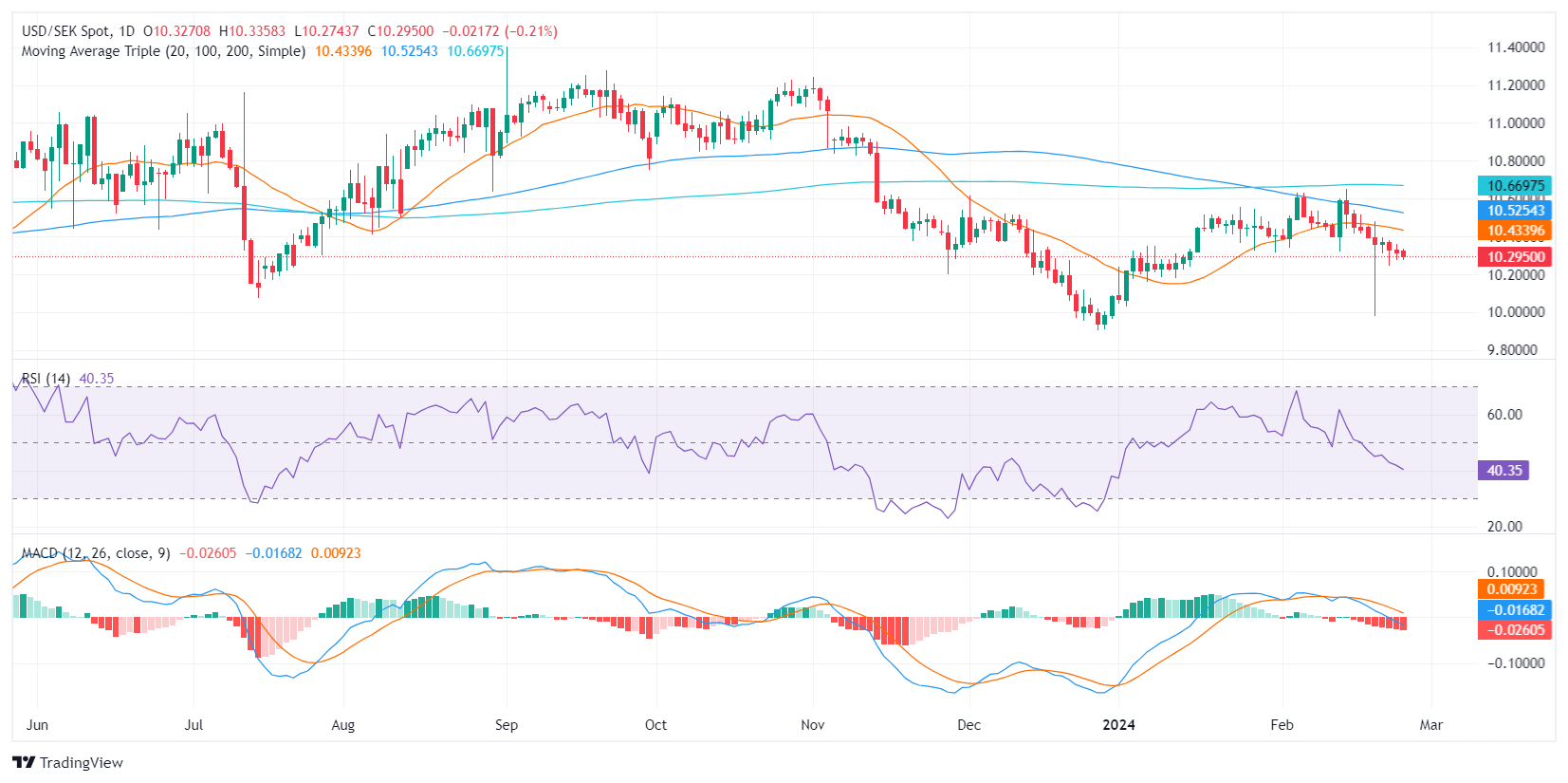
The daily Relative Strength Index (RSI) is currently positioned in the negative territory as it has been tracking lower than 50 while the Moving Average Convergence Divergence (MACD) histogram, with rising red bars, signifies a negative meaning that sellers are assuming control in the market, applying downward pressure to the pair.

In addition, the pair's underneath position relative to its 20, 100, and 200-day Simple Moving Averages (SMAs), reaffirms the bearish bias.

USD/SEK daily chart
Author

Patricio Martín

Patricio is an economist from Argentina passionate about global finance and understanding the daily movements of the markets.


More from Patricio Martín
Share:

Editor's Picks

GBP/USD declines as market caution lifts US Dollar

GBP/USD extends its gains for the second successive day, trading around 1.3200 during the Asian hours on Wednesday. The currency pair depreciated as the US Dollar gained momentum, driven by a combination of robust domestic economic data and a complex, mixed geopolitical landscape.

EUR/USD weakens below 1.1400 as Fed hike bets lift US Dollar

The EUR/USD pair trades on a negative note near 1.1380 during the early Asian trading hours on Wednesday. The major pair extends the decline as traders continue to assess the developments surrounding the US-Iran peace deal.

Gold nurses losses near $4,100 as Fed hike bets support USD

Gold recovers slightly from a fresh two-week low, near $4,070 touched during the Asian session on Wednesday, though it lacks follow-through. The US Dollar stands firm near its highest level since May 2025 amid firming expectations of a Fed rate hike, which, in turn, is seen undermining the non-yielding bullion. Furthermore, mixed US-Iran signals further favor the USD bulls.

Global strategy 3Q 2026
With the signing of a framework agreement and subsequent negotiations between the U.S. and Iran in June, the outlook for the third quarter is favorable. Oil prices have already fallen sharply, and futures are pricing in a further decline over the course of the year. This will ease the burden on consumers and reduce uncertainty among businesses, with positive effects on the economy.
"Rearranging the deckchairs on the Titanic": UK's fiscal crisis outlasts another Prime Minister

Keir Starmer's resignation as the UK Prime Minister comes ten years after the Brexit referendum vote, a coincidence that financial markets have been quick to note. The British Pound trades around 1.3220 against the US Dollar on Thursday.

Regime change: Inside Kevin Warsh's first move to make the Fed unreadable on purpose

The rate did not move. That was the least interesting thing about Kevin Warsh's first meeting in charge of the Fed. The FOMC held its benchmark at 3.50%-3.75% for the fourth straight meeting, exactly as priced, and then the new chair used his first press conference to dismantle the machinery the market has leaned on for a decade.