USD/MXN wavers amid risk aversion as investors’ focus shifts to US inflation data
- USD/MXN trades at 17.2607, with the dollar gaining 0.20% as risk-off sentiment prevails in the market.
- US inflation data due Wednesday could be a game-changer; CPI expected to rise from 3.2% to 3.6% YoY.
- Mexico’s 2024 economic package proposes fiscal deficit increase to 4.9% of GDP, the highest in 36 years.

The Mexican Peso (MXN) loses some ground vs. the US Dollar (USD) after strengthening to 17.2688, but the latter regains some composure as the North American session progresses. A scarce economic docket in the US and a risk-off impulse keep investors seeking safety ahead of US inflation data. The USD/MXN is trading at 17.2607.
Mexican Peso retraces slightly as investors await US CPI, digests Mexico’s 2024 economic package
Risk aversion is boosting the Greenback vs. the Mexican Peso, as US equities remain trading with losses, except for the Dow Jones. Market participants are bracing for the release of August’s inflation data in the US on Wednesday. The Consumer Price Index (CPI) is expected to rise from 3.2% to 3.6% YoY, while core CPI will drop from 4.7% to 4.3%.
Ahead of the data, the buck is printing gains of 0.20%, as shown by the US Dollar Index (DXY), which tracks the American Dollar’s performance against six counterparts. The DXY is at 104.74, underpinned by the advancement of the US 2-year Treasury note yield, peaking at 5.00%.
A risk-off impulse and firm US Treasury bond yields are backing the US Dollar (USD) ahead of the release of August inflation data in the United States. The US 10-year benchmark note sits at 4.292%, unchanged compared to yesterday, contrary to the American Dollar (USD), as shown by the US Dollar Index (DXY). The DXY tracks the buck’s performance against a basket of six peers and prints solid gains of 0.30% at 104.83 after dropping to a four-day low of 104.42.
On the US front, the US Bureau of Labor Statistics (BLS) will release August’s inflation data on Wednesday. The Consumer Price Index (CPI) is expected to jump from 3.2% to 3.6% YoY, while core CPI will drop from 4.7% to 4.3%. A higher-than-expected inflation reading would reignite speculations about another rate hike by the US Federal Reserve.
Across the border, the economic package in Mexico for 2024 proposes an increase in the fiscal deficit from 3.3% to 4.9% of GDP in 2023, the most significant negative balance in 36 years. The budget assumes the USD/MXN exchange rate would average 17.60 by the end of 2025 while considering the Mexican oil exports would be selling at around $56.7 per barrel next year.
Given the fundamental backdrop, the USD/MXN would likely continue to edge lower unless tomorrow’s CPI data rises above estimates and put another interest rate increase into the table. Otherwise, expect further Mexican Peso strength, which could drive the pair back towards the 17.0000 barrier.
USD/MXN Price Analysis: Technical outlook
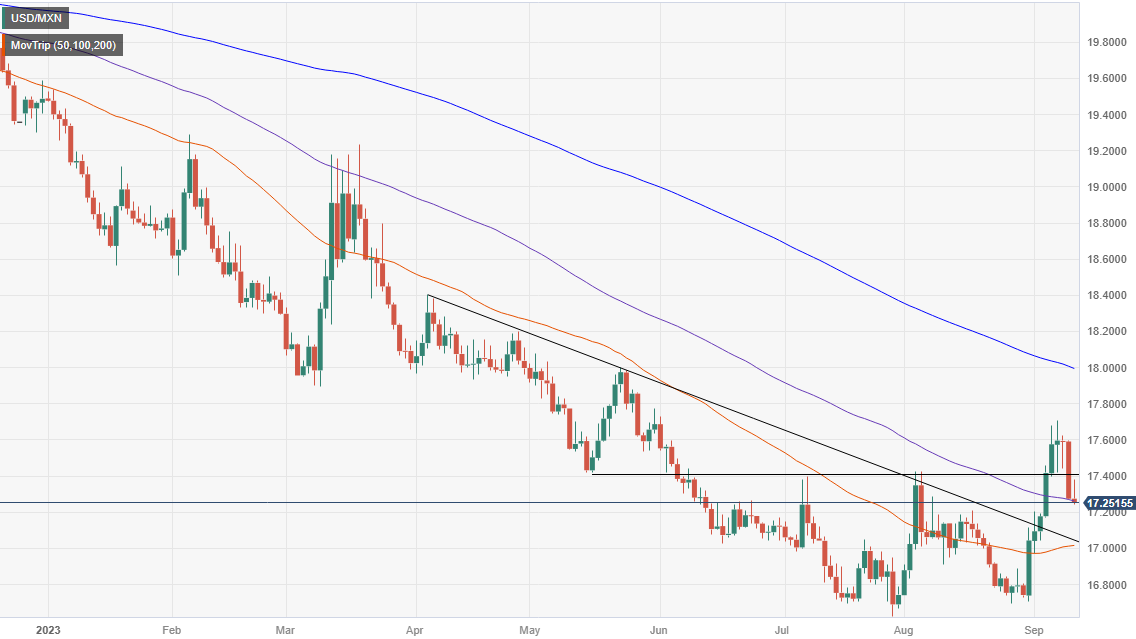
From a daily chart perspective, the pair is challenging technical support at the 100-day Moving Average (DMA) at 17.2558, which capped the USD/MXN drop. A daily close below the latter, and the pair could test the 20-DMA at 17.0929 before slumping toward the psychological 17.0000 price level. For an upward resumption, the exotic pair must reclaim the 17.5000 area before testing the September 11 high at 17.5927.
Author

Christian Borjon Valencia
FXStreet
Markets analyst, news editor, and trading instructor with over 14 years of experience across FX, commodities, US equity indices, and global macro markets.
















