|

USD/MXN sees uptick amid China’s economic concerns, ahead Powell’s Jackson Hole speech

  • Wall Street shows positive signs, but China’s rate cut and push for increased lending dampen global sentiment.
  • US Dollar remains steady with the DXY at 103.472 as market participants look forward to a packed US economic calendar.
  • Mexico’s upcoming inflation and Q2 GDP data could influence the USD/MXN trajectory, with potential appreciation if Mexico’s economy falters.

USDMXN registers minimal gains even though a risk-on impulse would usually underpin the emerging market currency. Monday’s light economic calendar would leave traders adrift to sentiment weighed by China’s woes and US Dollar (USD) dynamics. The USD/MXN exchanges hands at 17.0620, gaining 0.01%.

Emerging market currency feels the heat from China’s rate cut and US Dollar dynamics, while traders await key economic data and Powell’s speech

Wall Street trades positively, portraying investors’ mood improved ahead of the Jackson Hole Symposium, organized by the Kansas City Fed in Wyoming. US Treasury bond yields advance, slightly underpinning the greenback, which remains flat at 103.472, as shown by its US Dollar Index (DXY).

China’s woes weighed on investors’ sentiment after the People’s Bank of China (PboC) cut rates on its 1-year Loan Prime Rate from 3.55% to 3.45%, disappointing analysts. As reported by Bloomberg, it’s said that PboC’s officials and government regulators told lenders to boost loans to support recovery.

In the meantime, a National Association of Business Economics (NABE) poll showed economists are more confident that the Fed would pull a soft landing, as revealed by Bloomberg.

The upcoming United States (US) calendar will reveal Existing Home Sales, Fed speakers, New Home Sales, S&P Global PMIs, Jobless Claims, Durable Good Orders, and Fed Chair Jerome Powell’s speech on Friday.

Across the border, the Mexican economic docket would witness the release of inflation figures for the first half of August and the second quarter Gross Domestic Product (GDP) report on Friday.

Given the backdrop, if the Mexican economy weakens, expect the USD/MXN to appreciate further. Likewise, dovish signals by Fed officials and Jerome Powell’s speech would be repriced by traders, weakening the USD/MXN pair.

USD/MXN Price Analysis: Technical outlook

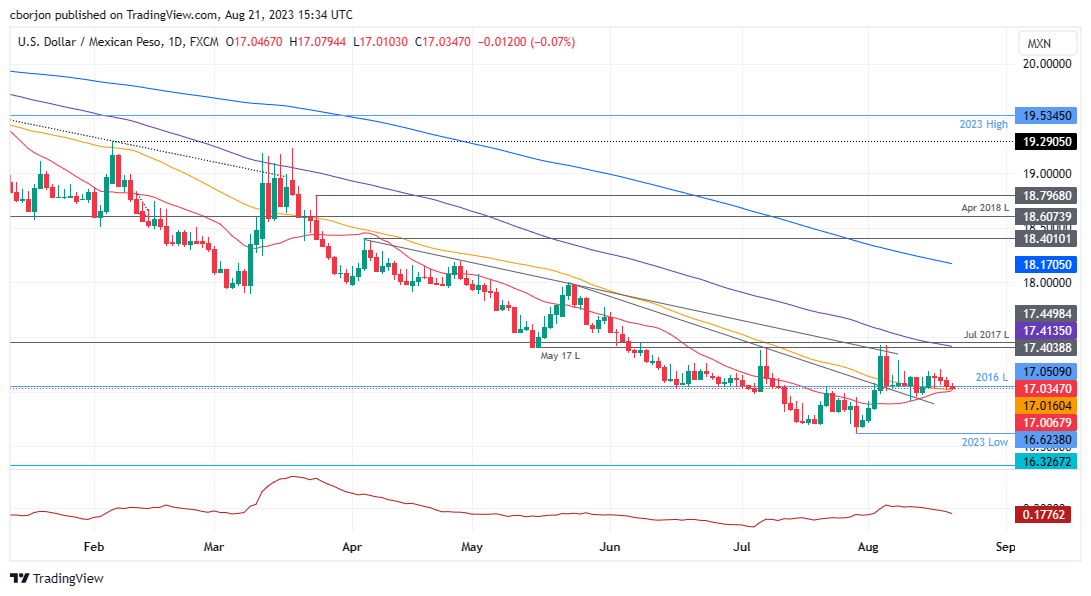
The USD/MXN remains subdued, unable to crack below/above support and resistance levels, each at 17.0000/17.1878. On the downside, the confluence of the 50 and 20-day Moving Averages (DMAs) at 17.0060/17.0160 emerged as a solid support level, which, if cleared, the USD/MXN could dip towards the year-to-date (YTD) low of 16.6238. Conversely, if USD/MXN breaks above 17.1878, the pair could rally towards the 100-DMA at 17.4135.

USD/MXN Daily Chart
USD/MXN

Overview
Today last price17.0412
Today Daily Change-0.0158
Today Daily Change %-0.09
Today daily open17.057
 
Trends
Daily SMA2017.0056
Daily SMA5017.0284
Daily SMA10017.4305
Daily SMA20018.1906
 
Levels
Previous Daily High17.1366
Previous Daily Low17.0167
Previous Weekly High17.2094
Previous Weekly Low16.9663
Previous Monthly High17.3957
Previous Monthly Low16.6258
Daily Fibonacci 38.2%17.0625
Daily Fibonacci 61.8%17.0908
Daily Pivot Point S117.0036
Daily Pivot Point S216.9502
Daily Pivot Point S316.8837
Daily Pivot Point R117.1235
Daily Pivot Point R217.19
Daily Pivot Point R317.2434

Author

Christian Borjon Valencia

Markets analyst, news editor, and trading instructor with over 14 years of experience across FX, commodities, US equity indices, and global macro markets.


More from Christian Borjon Valencia
Share:

Editor's Picks

AUD/USD remains depressed near 0.6950 after RBA minutes

AUD/USD attracts follow-through selling during Tuesday’s Asian session, looking to extend the overnight rejection slide from 0.7000, or a two-week top, following the release of RBA meeting Minutes. The US Dollar retains a bullish undertone near its highest level since April 2025 as energy-driven inflation risks keep December Fed rate hike bets firmly on the table. Adding to this, geopolitical risks further underpin the safe-haven USD.

USD/JPY extends retreat below 158.50 as intervention risks loom

USD/JPY is dropping below 158.50 in the Asian session on Tuesday, snapping a two-day winning streak and pulling back from an over two-week top touched the previous day, despite Japan's soft PPI inflation print. Bulls turn cautious amid speculation that authorities will step in to prop up the Japanese Yen, which, in turn, weighs on the pair.

Gold advances to $4,200 amid retreating USD; Fed hike bets to cap further gains

Gold builds on its modest intraday move up and hits a fresh daily high around the $4,200 neighborhood during the Asian session. The US Dollar retreats from its highest level since April 2025 amid some profit-taking, offering support to the commodity. However, the US Federal Reserve's hawkish stance and escalating Middle East conflicts could limit deeper losses for the safe-haven buck.

Cardano: Retail support wanes as ADA tests a make-or-break level

Cardano price is up nearly 2% at press time on Tuesday, holding above its 50-day Exponential Moving Average (EMA) at $0.2302 and a near-term rising support trendline at $0.2264. ADA is losing retail demand in the derivatives market as its futures Open Interest declines and funding rates flip negative.

Indian Rupee gains further on RBI’s fresh measures to lower US Dollar’s demand

The Indian Rupee extends the Monday’s advance against the US Dollar on Tuesday, driven by the announcement of fresh Reserve Bank of India’s US Dollar-related measures to shore up the domestic currency. In the opening session, the USD/INR pair tumbles 0.6% to near 95.00, the lowest level seen in over a month.

Has Bitcoin really escaped the macro forces it was built to fight?
Over 17 years ago, Satoshi Nakamoto designed Bitcoin (BTC) on the back of a global financial crisis as an alternative to the global monetary system outside the control of central banks, governments and traditional intermediaries. This raises a key question: has Bitcoin really become independent of the macroeconomic forces it was built to challenge?















