|

USD/MXN retreats from weekly highs drops below the 100, 20-DMAs

  • USD/MXN edges lower by 0.48% on positive market sentiment and a weakened US Dollar.
  • Despite hawkish remarks from Fed officials, the US Dollar remains under pressure, with the DXY marking minimal gains at 105.45.
  • Upcoming political developments and potential credit rating revisions in Mexico may affect the Peso's trajectory.

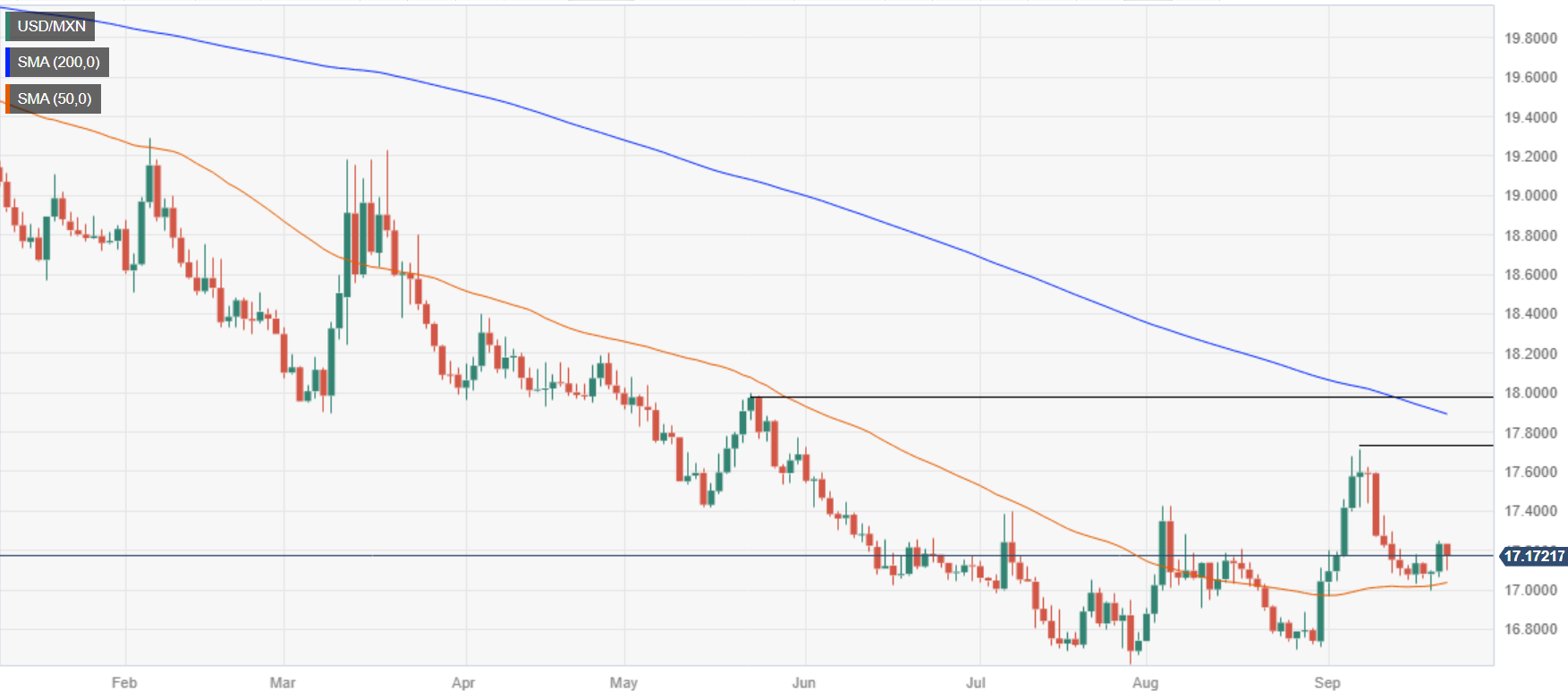
The emerging market currency the Mexican Peso (MXN) counterattacks the US Dollar (USD) after the exotic pair reached a weekly high of 17.2489, but it has trimmed those gains. At the time of writing, the USD/MXN changes hands at 17.1478, down 0.48%.

MXN strengthens to 17.1400ish on soft US Dollar due to a drop in US Treasury bond yields

Market sentiment remains positive, as shown by US equities trading with gains. Business activity in the United States (US) presented minuscule changes as revealed by S&P Global, with Manufacturing activity improving but standing in recessionary territory. Although expanded, the Services and Composite PMIs portrayed the country's economic slowdown.

Federal Reserve’s officials had been unleashed on the central bank space, led by the Boston Fed President Susan Collins. She suggested the possibility of further tightening while emphasizing the need for patience. Fed Governor Michell Bowman strongly determined that more rate hikes are necessary to control inflation.

Despite US central bank policymakers' hawkish rhetoric, the buck stands pressured. The US Dollar Index (DXY), which tracks the buck’s value vs. a basket of six currencies, prints minimal gains of 0.07%, at 10.45. Plunging US Treasury bond yields are a headwind for the USD/MXN, while also a tranche of upbeat Mexican data, supported the Peso.

Inflation in Mexico slowed down for the first half of September, hitting 4.44% YoY, down from 4.64% in August, below 4.46% forecasts. At the same time, the core Consumer Price Index rose 5.78%, above estimates of 5.76% YoY, but below August’s 6.21%. It should be said the Bank of Mexico (Banxico) held rates unchanged at 11.25% in the latest monetary policy meeting and emphasized the need to hold rates for a long period of time.

Given the backdrop, further USD/MXN downside is expected but capped around the 17.0000 figure.  Traders should know about political developments, as Mexico is headed for general elections. That, alongside the latest economic budget beginning to generate worries about a revision of the country’s credit rating, can weigh on the Mexican Peso.

USD/MXN Price Analysis: Technical outlook

Although the USD/MXN pair is set to finish the week with gains, price action has failed to achieve a new cycle high, with buyers eyeing the September 7 high at 17.7074. A breach of that level could open the door to test the 18.0000 figure, but it must reclaim the 100-day moving average (DMA) at 17.1888. On the downside, the pair’s fall is cushioned by the 50-DMA at 17.0302, before challenging 17.0000.
USD/MXN

Overview
Today last price17.181
Today Daily Change-0.0530
Today Daily Change %-0.31
Today daily open17.234
 
Trends
Daily SMA2017.1481
Daily SMA5017.0291
Daily SMA10017.2011
Daily SMA20017.9049
 
Levels
Previous Daily High17.2506
Previous Daily Low17.0639
Previous Weekly High17.5959
Previous Weekly Low17.0504
Previous Monthly High17.4274
Previous Monthly Low16.6945
Daily Fibonacci 38.2%17.1793
Daily Fibonacci 61.8%17.1352
Daily Pivot Point S117.115
Daily Pivot Point S216.9961
Daily Pivot Point S316.9283
Daily Pivot Point R117.3018
Daily Pivot Point R217.3696
Daily Pivot Point R317.4885

Author

Christian Borjon Valencia

Markets analyst, news editor, and trading instructor with over 14 years of experience across FX, commodities, US equity indices, and global macro markets.


More from Christian Borjon Valencia
Share:

Editor's Picks

AUD/USD languishes near two-month low amid renewed Iran tensions

AUD/USD holds above 0.7000 during the Asian session on Wednesday, though it remains close to a nearly two-month low set the previous day. Fresh US strikes on Iran temper hopes for a peace deal and benefit the safe-haven US Dollar. Furthermore, inflationary concerns continue to fuel hawkish Fed expectations, lending additional support to the buck ahead of the US CPI report. Adding to this, reduced bets on an RBA rate hike in June cap the currency pair.


USD/JPY sits near 160.50 intervention zone as bulls shrug off Japan's strong PPI

USD/JPY consolidates just below mid-160.00s, or its highest level since late April, as economic concerns stemming from the Middle East conflict continue to undermine the Japanese Yen (JPY). Furthermore, a fresh wave of US strikes on Iran benefits the safe-haven US Dollar and acts as a tailwind for the currency pair, countering Japan's hotter-than-expected PPI report. However, intervention fears cap the upside as traders seem hesitant ahead of the US consumer inflation figures later this Wednesday.

Gold flirts with $4,200, lowest since March 23 on hawkish Fed bets

Gold drops to a fresh low since March 23, around the $4,200 mark during the Asian session on Wednesday, as fresh US strikes on Iran fuel inflationary concerns and bolster bets for more hawkish central banks, including the US Fed. Meanwhile, US Dollar bulls are turning cautious ahead of the US CPI report, which could limit bullion losses. However, the recent breakdown below the 200-day SMA suggests that the path of least resistance for the XAU/USD is to the downside.

Bitcoin sell-off pushes over 50% of circulating supply into loss, hinting at market bottom

Bitcoin dropped near $61,000 on Tuesday, with the latest sell-off pushing long-term market indicators toward levels historically associated with bear-market bottoms, according to a report by K33 Research.

When the chips are down, the AI tape starts to shake

The market came into Tuesday trying to sell investors the comforting ”Turnaround Tuesday” idea that Friday’s AI fracture was just another pothole on the road higher. By the close, that story had lost its bid. Monday’s dead cat bounce had done what dead cat bounces always do.

The US economy defies the rules: 100 days into the Oil shock and the recession signal is still missing

More than three months after the start of the Iran war and the resulting disruption to global energy markets, the US economy continues to display remarkable resilience. The conflict has triggered a sharp rise in Oil prices, reignited inflationary pressures and fueled widespread concerns about a potential economic slowdown.












