Breaking: US private sector payrolls rise 41,000 in December vs 47,000 forecast

Private sector employment in the US rose by 41,000 in December and annual pay was up 4.4%, the Automatic Data Processing (ADP) Research Institute reported on Wednesday. This reading followed the 29,000 decrease (revised from -32,000) reported in November and came in slightly weaker than the market expectation of 47,000.
Assessing the report's findings, "small establishments recovered from November job losses with positive end-of-year hiring, even as large employers pulled back,” said Dr. Nela Richardson, chief economist, ADP.
Market reaction to ADP Employment Change data
This report failed to trigger a noticeable market reaction. At the time of press, the US Dollar (USD) Index was virtually unchanged on the day at 98.60.
US Dollar Price This week
The table below shows the percentage change of US Dollar (USD) against listed major currencies this week. US Dollar was the strongest against the Swiss Franc.
| USD | EUR | GBP | JPY | CAD | AUD | NZD | CHF | |
|---|---|---|---|---|---|---|---|---|
| USD | 0.32% | -0.18% | -0.25% | 0.43% | -0.81% | -0.46% | 0.47% | |
| EUR | -0.32% | -0.50% | -0.51% | 0.10% | -1.13% | -0.78% | 0.14% | |
| GBP | 0.18% | 0.50% | -0.11% | 0.62% | -0.63% | -0.28% | 0.65% | |
| JPY | 0.25% | 0.51% | 0.11% | 0.66% | -0.59% | -0.23% | 0.75% | |
| CAD | -0.43% | -0.10% | -0.62% | -0.66% | -1.08% | -0.89% | 0.04% | |
| AUD | 0.81% | 1.13% | 0.63% | 0.59% | 1.08% | 0.35% | 1.31% | |
| NZD | 0.46% | 0.78% | 0.28% | 0.23% | 0.89% | -0.35% | 0.93% | |
| CHF | -0.47% | -0.14% | -0.65% | -0.75% | -0.04% | -1.31% | -0.93% |
The heat map shows percentage changes of major currencies against each other. The base currency is picked from the left column, while the quote currency is picked from the top row. For example, if you pick the US Dollar from the left column and move along the horizontal line to the Japanese Yen, the percentage change displayed in the box will represent USD (base)/JPY (quote).
Developing story, please refresh the page for updates.
This section below was published as a preview of the US ADP Employment Change data at 05:00 GMT.
- The ADP Employment Change report is expected to show a moderate improvement in December.
- Investors await the ADP report and further US labour data for a better insight into the Fed rate path.
- The US Dollar is showing a frail recovery attempt after hitting three-month lows.
The Automatic Data Processing (ADP) Research Institute will release its monthly Employment Change Report for December on Wednesday. The ADP report is expected to show that the United States (US) economy created 47,000 jobs in the last month of 2025, to offset the 32.000 net employment loss seen in November.
The ADP report tends to attract interest because it precedes the key Nonfarm Payrolls report, released by the US Bureau of Labor Statistics (BLS), usually two days later. The correlation between these indicators is mostly poor, but deviations in the final reading of the ADP Employment Change normally have a significant impact on US Dollar crosses.
ADP Jobs Report: The US labour market and the Federal Reserve
December’s ADP report comes amid growing concerns about US labour market’s momentum and wide divergence among Federal Reserve (Fed) policymakers about the depth of the central bank’s monetary easing cycle.
The Fed cut its benchmark interest rate by a quarter point in December, but the minutes of the meeting revealed a deeply divided monetary policy committee. The weakening labour market revealed by the latest US employment releases, combined with a stubbornly high inflation, poses a serious challenge to the bank’s monetary policy-setting activity.
In this context, the bank’s interest rate projections, the so-called dot-plot, anticipate a unique rate cut in 2026. Futures markets, however, see at least two quarter-point cuts in the next 12 months, according to data released by the CME Group’s Fedwatch tool, and this week’s labour figures might be key to tipping the scales in one way or the other.
Minneapolis Fed President Neel Kashkari underscored this dilemma earlier this week. Kashkari assessed that monetary policy is close to neutral now, but warned that higher unemployment might force the Fed to lower borrowing costs deeper than forecast.
With most of the major central banks already at the end of their easing cycles, a weak US ADP in this scenario would deepen the monetary policy divergence with the Fed, and, highly likely, crush the US Dollar’s incipient recovery. A strong employment report, on the other hand, would ease concerns about the labour market and leave inflation as the Fed’s prevailing target. This outcome would have a positive impact on the US Dollar.
When will the ADP Report be released, and how could it affect the USD Index?
ADP will release the US Employment Change report on Wednesday at 13:15 GMT, and it is expected to show that the private sector added 47,000 new positions in December.
The US Dollar Index, which measures the value of the Greenback against a basket of majors, has opened the 2026 year on a strong note, but it remains near three-week lows after a 2.5% depreciation in December
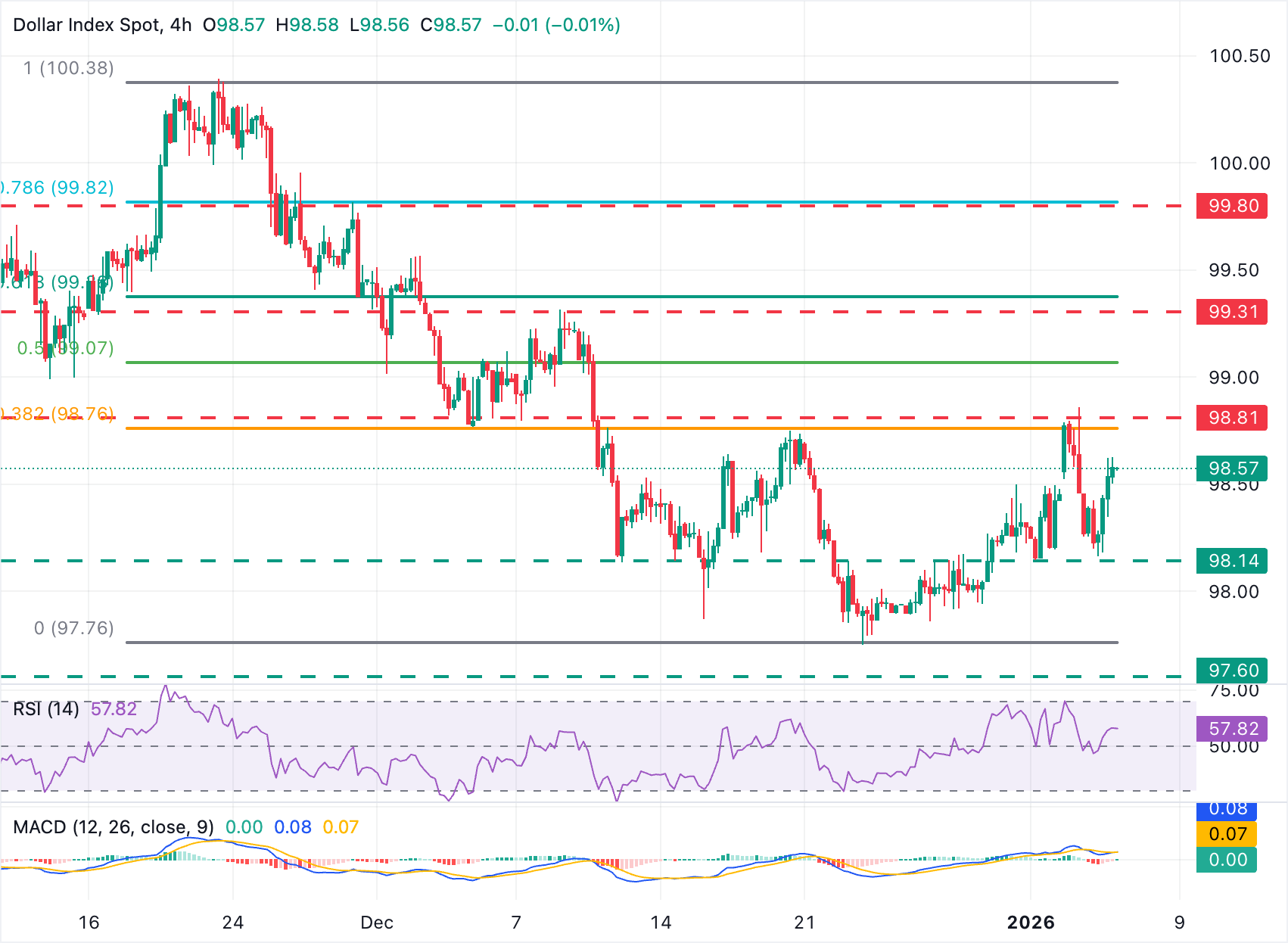
From a technical perspective, Guillermo Alcala, Analyst at FXStreet, highlights the resistance area at 98.75 as a key level to confirm a trend shift: “The US Dollar Index is showing signs of a weakening bearish trend but the pair must break and hold above the December 19 low at 98.75 to aim to the early December and late November highs at the 99.30 and 99.80 areas respectively.”
“The US Dollar, however, is not out of the woods yet. Upside momentum remains frail, and weak US macroeconomic data might resurface investors’ concerns and push the pair below December’s bottom, at 97.75. In that case, the October 1 low, at 97.46, emerges as the next target”, says Alcala.
Employment FAQs
Labor market conditions are a key element to assess the health of an economy and thus a key driver for currency valuation. High employment, or low unemployment, has positive implications for consumer spending and thus economic growth, boosting the value of the local currency. Moreover, a very tight labor market – a situation in which there is a shortage of workers to fill open positions – can also have implications on inflation levels and thus monetary policy as low labor supply and high demand leads to higher wages.
The pace at which salaries are growing in an economy is key for policymakers. High wage growth means that households have more money to spend, usually leading to price increases in consumer goods. In contrast to more volatile sources of inflation such as energy prices, wage growth is seen as a key component of underlying and persisting inflation as salary increases are unlikely to be undone. Central banks around the world pay close attention to wage growth data when deciding on monetary policy.
The weight that each central bank assigns to labor market conditions depends on its objectives. Some central banks explicitly have mandates related to the labor market beyond controlling inflation levels. The US Federal Reserve (Fed), for example, has the dual mandate of promoting maximum employment and stable prices. Meanwhile, the European Central Bank’s (ECB) sole mandate is to keep inflation under control. Still, and despite whatever mandates they have, labor market conditions are an important factor for policymakers given its significance as a gauge of the health of the economy and their direct relationship to inflation.
Author

FXStreet Team
FXStreet
Composed of a group of economic journalists and FX experts, the FXStreet content team produces and oversees all content published on FXStreet. It provides a purely journalistic approach to the Forex market.