USD/MXN extends gains after Banxico’s slash currency hedge program, back above 17.1500
- Banxico’s decision to reduce its currency hedging program sends the pair higher.
- US Nonfarm Payrolls beat expectations but rising Unemployment Rate stalls USD rally.
- Cleveland’s Fed President Loretta Mester remains hawkish on US interest rates.

The Mexican Peso (MXN) prolonged its losses by more than 0.50% versus the US Dollar (USD) after the Bank of Mexico (Banxico) decided to slash its hedging program due to stabilizing the USD/MXN exchange rate amid geopolitical and Covid-19 uncertainty. Hence, the pair trades at 17.1792 after hitting a daily low of 17.0430.
Mexican Peso weakens further after the Bank of Mexico’s decision to cut hedging, despite mixed US employment figures
Last week’s news that Banxico would reduce its currency hedging program sent the USD/MXN pair into a tailspin, as the program was designed to tame volatility, seen by traders as an exit signal from its long positions. On August 31, the USD/MXN posted more than 1.70% gains after Banxico’s decision.
On Friday, the latest US employment figures revealed the US Nonfarm Payrolls (NFP) rose to 187K in August versus 170K expected and 157K prior (revised). Nevertheless, the Unemployment Rate rising to 3.8% from the 3.5% market forecasts and previous readings stalled the Greenback rally, as the data was seen as a justification for the Fed to keep interest rates unchanged at the September meeting.
Other data The US ISM Manufacturing PMI also impressed the US Dollar buyers with the 47.6 figures versus analysts’ estimation of 47.0 versus 46.4 previous readings.
In the central bank action, Cleveland’s Fed President Loretta Mester states that the Unemployment Rate remains low, and she still sees the jobs market as quite strong. However, the policymaker remains hawkish and has seen higher rates for longer.
On the Mexican front, Banxico’s Governor Victoria Rodriguez Ceja took off from the table rate cuts, as she added, “The outlook ahead continues to be complex and uncertain. It’s important to remember that disinflation periods are not linear.”
Upcoming data will see the release of Mexican inflation figures for August, and the US ISM Non-Manufacturing PMI will give direction to the USD/MXN pair. Nevertheless, expect further Mexican Peso weakness after Banxico’s hedge cuts.
USD/MXN Price Analysis: Technical outlook
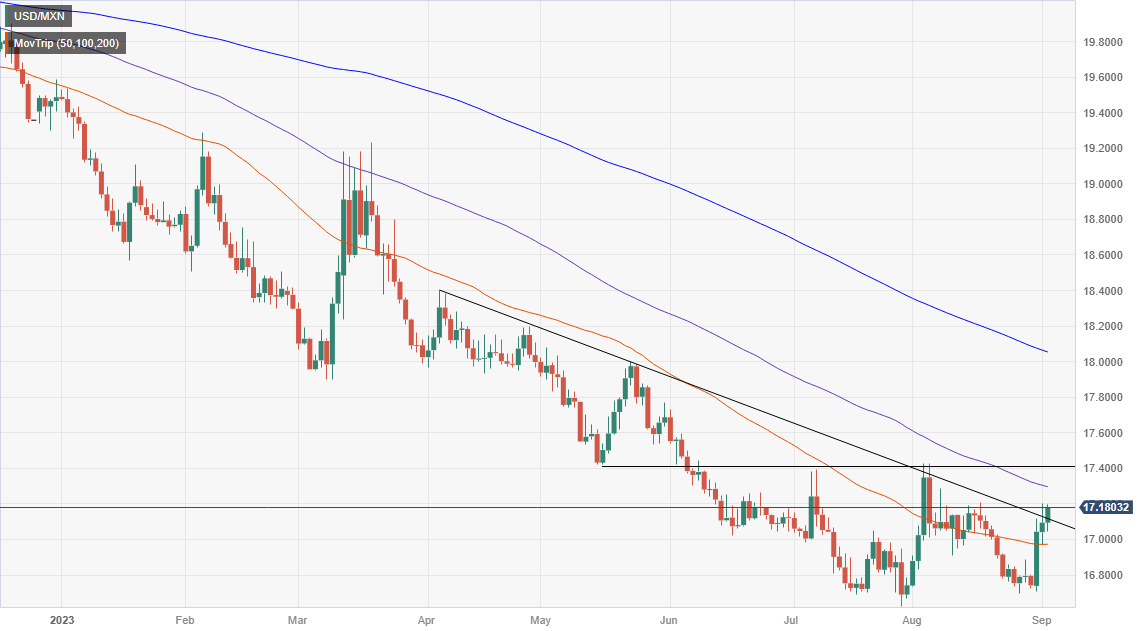
The USD/MXN is consolidating, with the pair unable to crack to new year-to-date (YTD) lows while reversing its course, threatening to edge higher if it reclaims a mult-month downslope resistance trendline and the 50-day Moving Average (DMA) at around 17.20/17.2900. If that area is reclaimed, look for buyers to test the May 17 daily low turned resistance at 17.4038, seen as a crucial level to overcome, before testing the confluence of the 200-DMA and the psychological 18.0000 figure. On the downside, risks emerge below the confluence of the 20 and 50-DMA at around 16.98/96.
Author

Christian Borjon Valencia
FXStreet
Markets analyst, news editor, and trading instructor with over 14 years of experience across FX, commodities, US equity indices, and global macro markets.