USD/JPY soars to 10-month high amid risk-aversion, rising US bond yields
- USD/JPY pair reaches a 10-month high of 147.70, driven by risk aversion and a surge in US 10-year Treasury bond yields to 4.261%.
- Despite positive business activity data from Japan, the Yen remains weak as China’s lower-than-expected Caixin Services PMI fuels global economic concerns.
- Upcoming US ISM Non-Manufacturing PMI and S&P Global Services PMI could pressure the Greenback.

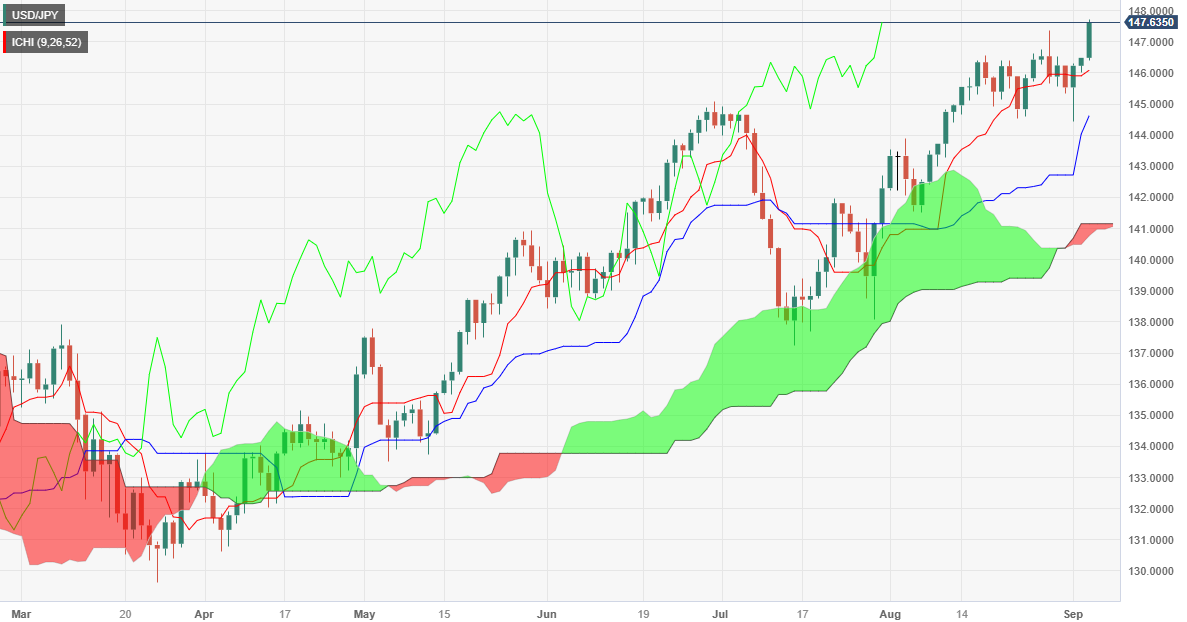
The Japanese Yen (JPY) fell to a 10-month low against the US Dollar (USD), spurred by risk aversion and a jump in US Treasury bond yields, mainly the 10-year as business activity decelerates worldwide, as revealed by S&P Global. Hence, the USD/JPY is trading at 147.65 after hitting a yearly high of 147.70.
Japanese Yen hits yearly low as investors flock to Greenback; upcoming PMI data could influence Fed’s next move
Market sentiment remains downbeat, as China revealed its Caixin Services PMI expanding at a lower rate than estimates of 53.6 at 51.8, and also below the previous month’s reading of 54.1. That triggered fears globally, and investors seeking safety went towards the Greenback and US Treasury bond yields.
Even though Japan reported that business activity for August improved, as revealed by the Jibun Bank Services PMI at 54.3, as expected and above July’s 53.8, it failed to underpin the battered JPY.
On the United States (US) front, after a Labor Day holiday, the docket revealed that Factory Orders for August showed a slight improvement despite plummeting to -2.1%, above estimates of -2.5%. Data from the US Department of Commerce ended a four-month streak of gains.
On the central bank space, the US Federal Reserve board member Christopher Waller stated that recent data gives the US central bank space to decide its next interest rate decision. As of late, Cleveland’s Fed President Loretta Mester said the Fed would not continue to tighten monetary policy until inflation hits 2%, nor wait until it gets there, to lower rates.
In the meantime, US Treasury bond yields continue to trend higher, with the 10-year Treasury bond yield advancing six basis points at 4.261%, a tailwind for the USD/JPY pair. The US Dollar Index (DXY), a measurement of the buck’s performance against six currencies, posted solid gains of 0.61%, at 104.794, its highest level since March 13, 2023.
Upcoming events, like the release of the US ISM Non-Manufacturing PMI for August, is expected to slightly decelerate from 52.7 to 52.5, while the S&P Global Services PMI would likely follow suit, with estimates at 51 from July’s 52.3. If both readings come as expected, the Greenback could be under pressure, as it could reassure the Fed’s pause in September while denting the odds for another interest rate increase in November.
USD/JPY Price Analysis: Technical outlook
From a daily chart perspective, the USD/JPY remains upward biased as it pushes towards new year-to-date (YTD) highs at around the session. The next stop would be the 148.00 psychological level, followed by last November’s high at 148.82, before challenging 149.00. Conversely, if sellers stepped in, downside risks emerged at the Tenkan-Sen line at 146.09, followed by Senkou Span A at 145.35. A breach of the latter will expose the Kijun-Sen at 144.62 and then the 144.00 mark.
Author

Christian Borjon Valencia
FXStreet
Markets analyst, news editor, and trading instructor with over 14 years of experience across FX, commodities, US equity indices, and global macro markets.