USD/JPY drops below 142.00 as US Nonfarm Payrolls miss estimates
- USD/JPY dipped below 142, down 0.47%, after the US jobs data showed easing in the labor market and BoJ’s tweaks to its YCC.
- US Nonfarm Payrolls missed estimates, but wages are increasing, putting pressure on the Fed.
- US Treasury Bond Yield fall, a headwind for USD/JPY.
- Looking Ahead: Investors will be eyeing key economic indicators next week, including July’s US inflation report, Balance of Trade, and Fed speakers in the US.

USD/JPY prolonged its losses to two consecutive days, as jobs data from the United States (US) indeed showed the labor market is easing, while the Bank of Japan’s (BoJ) recent tweak to its Yield Curve Control (YCC) boosted the Japanese Yen (JPY) against the US Dollar (USD). Hence, the USD/JPY is trading at 141.82 after hitting a daily high of 142.92, down 0.47%.
Despite a rise in Average Hourly Earnings, disappointing jobs data from the US, and the BoJ’s recent yield curve control tweaks pressures the USD/JPY pair downwards
Wall Street opened on a higher note after the US Bureau of Labor Statistics (BLS) revealed July’s Nonfarm Payroll figures which missed estimates of 200K, decelerating to 187K. Although the data could encourage the Federal Reserve (Fed) to skip a rate hike in September, Average Hourly Earnings rose by 4.4% YoYs, exceeding estimates of 4.2%, while the Unemployment Rate climbed by 3.6%, a tick up from 3.5%.
Consequently, the US Treasury bond yield, mainly the 10-year benchmark note, has erased seven basis points of gain compared to yesterday’s, stands at 4.119%, a headwind for the USD/JPY pair, which correlates positively to US bond yield, as traders take advantage of the carry trade.
Nevertheless, the BoJ’s decision to give flexibility to its YCC, within the 0.50%-1%, keeps speculators guessing, which would be the peak for the BoJ, as the bank has continued to exercise unscheduled bond-buying operations in the market.
In the meantime, the US Dollar Index (DXY), which tracks the buck’s performance against a basket of peers, sheds more than 0.50%, exchanging hands at 101.944, forming an evening-star three-candle pattern, warranting further downside expected.
Ahead into the next week, the US economic agenda will feature July’s inflation report, the Balance of Trade, and Fed speakers as the main highlight. On the Japanese front, the BoJ Summary of Opinions and Japan’s Current Account
USD/JPY Price Analysis: Technical outlook
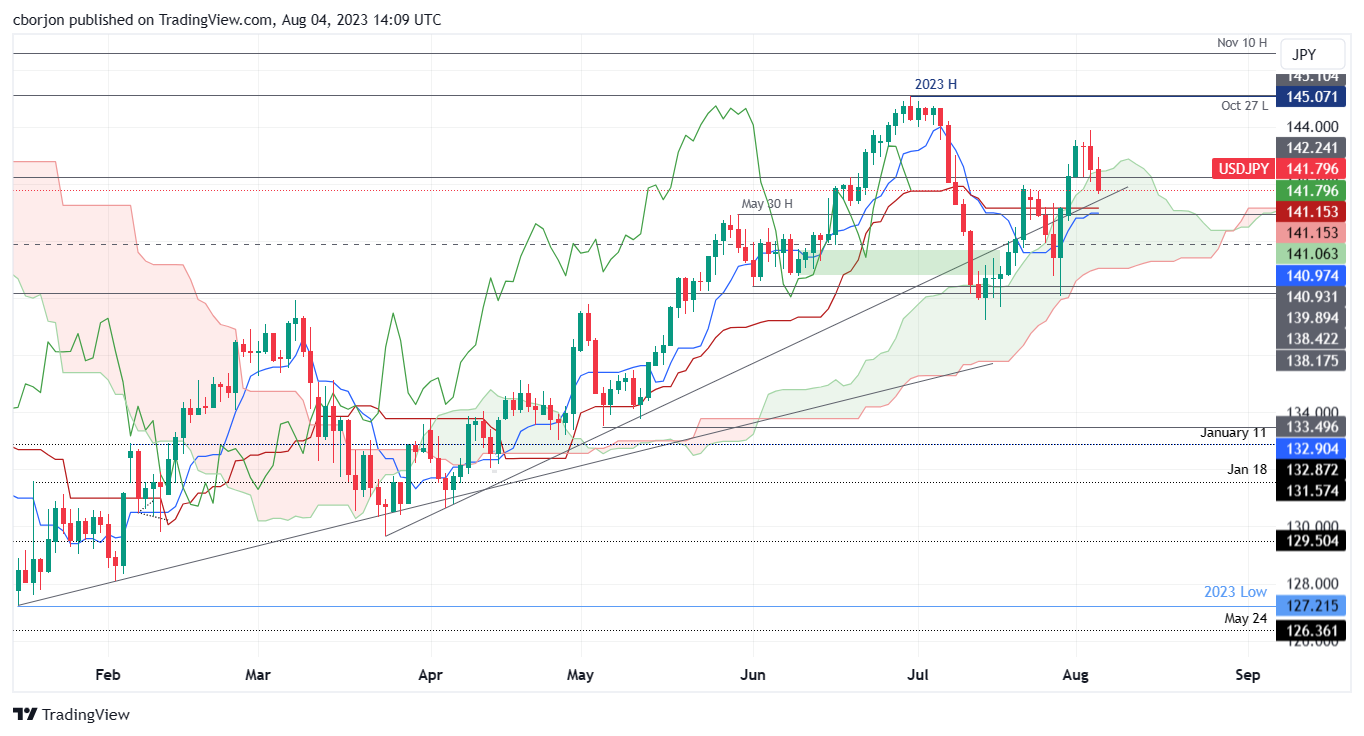
From a daily chart perspective, the USD/JPY has dived inside the Ichimoku Cloud (Kumo), opening the door for further losses, which could be capped by the Kijun and Tenkan-Sen levels, at 141.15 and 140.97, respectively. A break below will send the pair sliding towards the bottom of the Kumo at 139.05, ahead of plunging to July 28 low of 138.05. Hence, if buyers do not enter the market, the USD/JPY could erase almost 2.39% of its hard-earned gains. Contrarily, USD/JPY buyers must reclaim the 142.00 figure to have a chance of regaining control. Up next would be the 143.00 figure.
Author

Christian Borjon Valencia
FXStreet
Markets analyst, news editor, and trading instructor with over 14 years of experience across FX, commodities, US equity indices, and global macro markets.

















