USD/INR sees more upside as India’s retail inflation growth cools down to 0.25%
- The Indian Rupee remains against the US Dollar as the US-India trade deal has not yet been announced.
- India's retail CPI grew at a moderate pace of 0.25% in October.
- Weak US job trend has prompted Fed dovish speculation.

The Indian Rupee (INR) is exposed to more downside against its major peers as India's retail Consumer Price Index (CPI) growth has cooled further. During late trading hours in India, the Ministry of Statistics and Programme Implementation reported that inflationary pressures decelerated to 0.25% on an annualized basis in October.
Inflation in the Indian economy was expected to cool down due to a sustained fall in food prices. However, the pace of decline came in higher than projected. Economists expected India’s retail inflation to have grown 0.48% on an annualized basis, slower than the 1.54% growth seen in September.
Signs of price pressures cooling would boost expectations of further monetary policy easing by the Reserve Bank of India (RBI) this year. So far this year, the RBI has already reduced its Repo Rate by 100 basis points (bps) to 5.5%.
At the time of writing, the USD/INR pair trades 0.2% higher to near 88.80.
Meanwhile, the continuous outflow of foreign funds from the Indian stock market due to an absence of a United States (US)-India trade deal announcement has already been keeping the Indian Rupee on its back foot. On Tuesday, Foreign Institutional Investors (FIIs) turned out to be net sellers again and sold shares worth Rs. 803.22 crore.
The table below shows the percentage change of Indian Rupee (INR) against listed major currencies today. Indian Rupee was the weakest against the Australian Dollar.
| USD | EUR | GBP | JPY | CAD | AUD | INR | CHF | |
|---|---|---|---|---|---|---|---|---|
| USD | 0.04% | 0.22% | 0.34% | 0.00% | -0.04% | 0.18% | 0.04% | |
| EUR | -0.04% | 0.18% | 0.30% | -0.04% | -0.08% | 0.13% | 0.00% | |
| GBP | -0.22% | -0.18% | 0.14% | -0.21% | -0.25% | -0.03% | -0.17% | |
| JPY | -0.34% | -0.30% | -0.14% | -0.34% | -0.39% | -0.17% | -0.31% | |
| CAD | -0.00% | 0.04% | 0.21% | 0.34% | -0.04% | 0.18% | 0.04% | |
| AUD | 0.04% | 0.08% | 0.25% | 0.39% | 0.04% | 0.23% | 0.09% | |
| INR | -0.18% | -0.13% | 0.03% | 0.17% | -0.18% | -0.23% | -0.14% | |
| CHF | -0.04% | -0.00% | 0.17% | 0.31% | -0.04% | -0.09% | 0.14% |
The heat map shows percentage changes of major currencies against each other. The base currency is picked from the left column, while the quote currency is picked from the top row. For example, if you pick the Indian Rupee from the left column and move along the horizontal line to the US Dollar, the percentage change displayed in the box will represent INR (base)/USD (quote).
Daily digest market movers: Fed dovish bets increase after weak US job data
- The Indian Rupee trades lower against the US Dollar, even as the latter trades cautiously due to intensifying market expectations of an interest rate cut by the Federal Reserve (Fed) in the December policy meeting.
- According to the CME FedWatch tool, the probability of the Fed cutting interest rates by 25 basis points (bps) to 3.50%-3.75% in the December meeting has increased to 68% from 62.4% seen on Monday.
- At the press time, the US Dollar Index (DXY), which tracks the Greenback’s value against six major currencies, trades marginally higher to near 99.55. On Tuesday, the USD Index fell sharply after the release of the soft ADP Employment Change four-week average data, which prompted Fed dovish expectations.
- Private payroll processor ADP reported that employers laid off 11.25K workers each week through late October, demonstrating a weak job trend. "The labor market struggled to produce jobs consistently during the second half of the month," said Nela Richardson, ADP’s chief economist.
- The impact of the job data has been significant on the Fed’s interest rate projections lately as officials have warned of downside labor market risks.
- Going forward, investors will focus on a slew of US economic releases, which were halted due to the government shutdown. On Tuesday, the US Senate advanced the federal funding bill to the Republican-controlled House of Representatives, which is expected to be passed on Wednesday.
Technical Analysis: USD/INR aims to revisit all-time high above 89.00
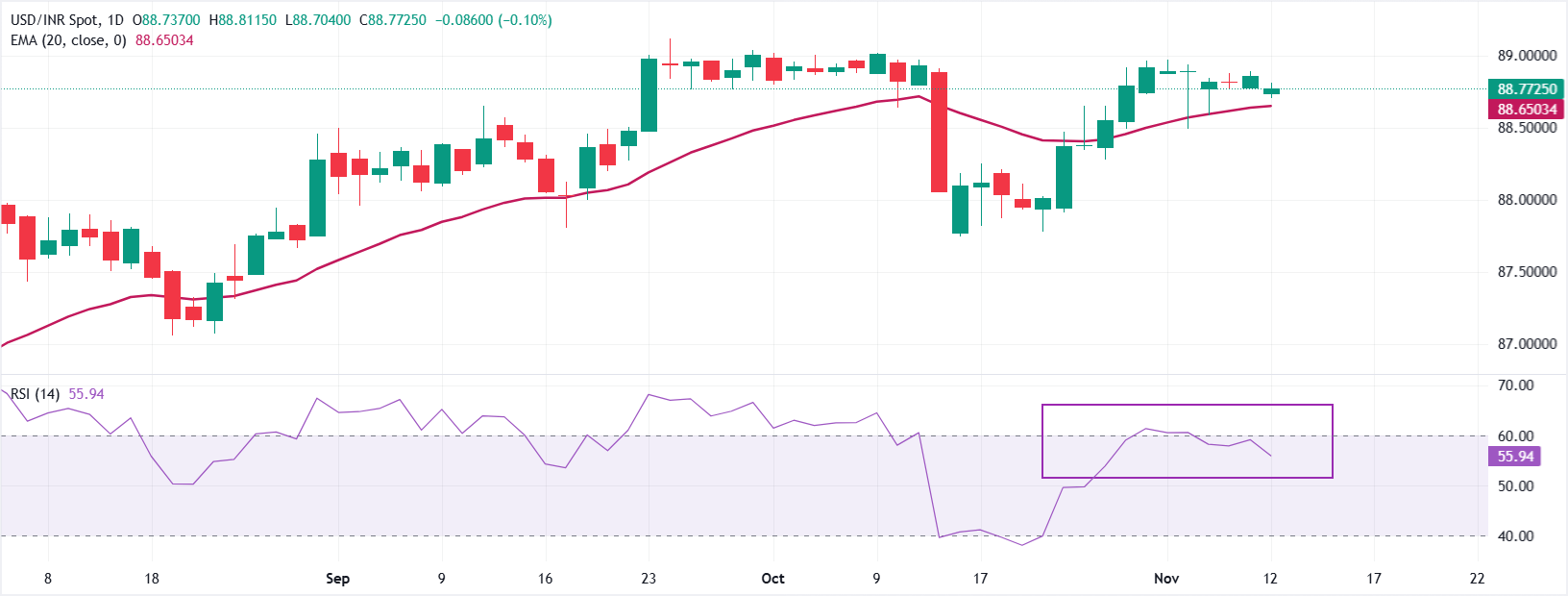
USD/INR rises to near 88.80 at open on Wednesday. The near-term trend of the pair remains bullish as it stays above the 20-day Exponential Moving Average (EMA), which trades around 88.65.
The 14-day Relative Strength Index (RSI) strives to return above 60.00. A fresh bullish momentum would emerge if the RSI (14) manages to do so.
Looking down, the August 21 low of 87.07 will act as key support for the pair. On the upside, the all-time high of 89.12 will be a key barrier.
Inflation FAQs
Inflation measures the rise in the price of a representative basket of goods and services. Headline inflation is usually expressed as a percentage change on a month-on-month (MoM) and year-on-year (YoY) basis. Core inflation excludes more volatile elements such as food and fuel which can fluctuate because of geopolitical and seasonal factors. Core inflation is the figure economists focus on and is the level targeted by central banks, which are mandated to keep inflation at a manageable level, usually around 2%.
The Consumer Price Index (CPI) measures the change in prices of a basket of goods and services over a period of time. It is usually expressed as a percentage change on a month-on-month (MoM) and year-on-year (YoY) basis. Core CPI is the figure targeted by central banks as it excludes volatile food and fuel inputs. When Core CPI rises above 2% it usually results in higher interest rates and vice versa when it falls below 2%. Since higher interest rates are positive for a currency, higher inflation usually results in a stronger currency. The opposite is true when inflation falls.
Although it may seem counter-intuitive, high inflation in a country pushes up the value of its currency and vice versa for lower inflation. This is because the central bank will normally raise interest rates to combat the higher inflation, which attract more global capital inflows from investors looking for a lucrative place to park their money.
Formerly, Gold was the asset investors turned to in times of high inflation because it preserved its value, and whilst investors will often still buy Gold for its safe-haven properties in times of extreme market turmoil, this is not the case most of the time. This is because when inflation is high, central banks will put up interest rates to combat it. Higher interest rates are negative for Gold because they increase the opportunity-cost of holding Gold vis-a-vis an interest-bearing asset or placing the money in a cash deposit account. On the flipside, lower inflation tends to be positive for Gold as it brings interest rates down, making the bright metal a more viable investment alternative.
Author

Sagar Dua
FXStreet
Sagar Dua is associated with the financial markets from his college days. Along with pursuing post-graduation in Commerce in 2014, he started his markets training with chart analysis.














