How much can one month of soft inflation change the Fed’s mind?


One month of softer inflation data is rarely enough to shift Federal Reserve policy on its own, but in a market highly sensitive to every data point, even a single reading can reshape expectations. November’s inflation report offered a welcome sign of cooling price pressures. But what about questions around data quality, looming cost drivers, and the broader policy backdrop? Let’s take a closer look:
A soft November reading amidst fears of a 2026 price surge
The Bureau of Labor Statistics reported that inflation rose 2.7% year-over-year in November, marking a deceleration from September’s 3% reading. Core inflation, which excludes volatile food and energy categories, registered at 2.6%—the lowest level observed since early 2021, before pandemic-related price pressures sent inflation soaring above 9%.

However, financial analysts are approaching these figures with skepticism. The data collection process faced unprecedented disruptions due to a prolonged government shutdown that extended until November 12, preventing officials from gathering price information in the field during October. As a result, the Labor Department’s report omitted month-over-month breakdowns for October and November across most categories, creating significant blind spots.
Beyond the procedural complications, economists have also raised concerns about a potential technical adjustment that may have artificially suppressed the November figure. This combination of factors has left market participants questioning whether the apparent cooling in price pressures reflects genuine economic trends or merely statistical artifacts.
The timing of these data gaps could be problematic as inflation dynamics might be poised for change. Historically, the beginning of the calendar year represents a key window when businesses implement pricing adjustments or adopt new pricing strategies for the year. Companies that have been monitoring the impact of new trade policies may use this natural reset period to pass costs through to consumers, potentially reversing the downward trajectory captured in November’s report.
Trade policy has emerged as a wildcard for future inflation. A 10% baseline tariff on global imports took effect in April, followed by substantially higher rates on goods from major trading partners and critical materials including steel and aluminum over subsequent months. Some corporations have already incorporated these additional costs into consumer prices, while others have adopted a wait-and-see approach to avoid alienating customers prematurely.
The inflationary pressures extending beyond manufactured goods into the services sector represent an additional concern for policymakers. Tighter immigration enforcement has reduced the labor supply for roles such as home healthcare and other service positions traditionally filled by immigrant workers. This labor constraint could push service prices higher, broadening the inflation challenge beyond tradeable goods.
Perhaps most troubling is the risk of inflation expectations becoming unanchored. If consumers and businesses anticipate sustained price increases, this psychological shift can become self-reinforcing. Companies discovering they can raise prices without losing significant market share may continue testing their pricing power, creating momentum that proves difficult to reverse through monetary policy alone.
What could be the implications of the November inflation reading for the Federal Reserve?
Some analysts interpret the combination of moderating inflation and rising unemployment as building a case for additional rate cuts. If subsequent data releases confirm the November trend, the central bank could potentially deliver not just one but two rate cuts during the first quarter of 2026 to tackle the deteriorating job market.
However, Goldman Sachs has cautioned against overweighting the November reading in policy forecasts. The absence of October data eliminates crucial month-over-month comparisons, while the compressed data collection timeline may have introduced systematic measurement biases. From this perspective, the December CPI release scheduled for mid-January will serve as a more reliable indicator of underlying inflation dynamics.
Fed officials demonstrated their cautious outlook in their latest projections. They now expect the Personal Consumption Expenditures price index to average 2.9% in 2025 and 2.4% in 2026, representing modest downward revisions from September’s forecasts of 3% and 2.6% respectively. For 2027 and 2028, policymakers project inflation settling at 2.1% and 2%, approaching their target range.
Core PCE projections were similarly adjusted to 3% for 2025 and 2.5% for 2026, with convergence to headline rates expected by 2027. While these estimates suggest gradual progress toward price stability, they also acknowledge that inflation will remain above the Fed’s 2% target well into next year.
The main debate about inflation in monetary policy deliberations is likely to be on whether inflation has genuinely entered a sustainable downward trajectory or merely paused in its persistence. Hawks on the Federal Open Market Committee worry that premature rate cuts could reignite price pressures if inflation proves more entrenched than a single month’s data suggests.
According to Atlanta Federal Reserve President Raphael Bostic, "Moving monetary policy near or into accommodative territory, which further federal funds rate cuts will do, risks exacerbating already elevated inflation and untethering the inflation expectations of businesses and consumers."
The upcoming December CPI report should help resolve this debate.
How did the market respond to the November inflation report?
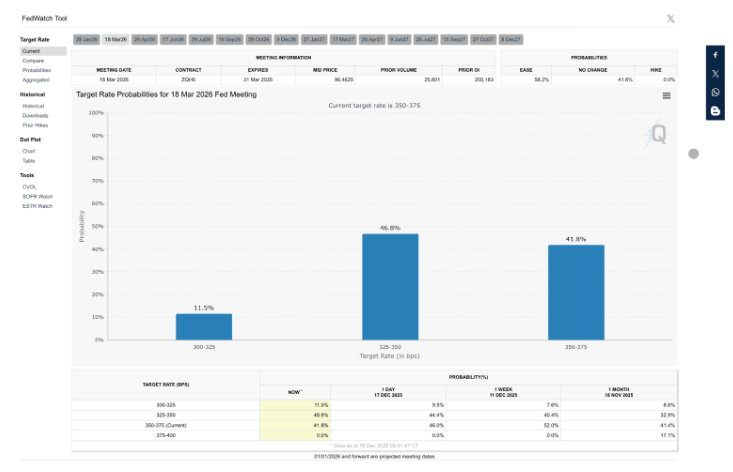
Financial markets interpreted the softer-than-expected November inflation data as supportive for risk assets and fixed income securities. Major equity indices posted gains as investors recalibrated their expectations for the Fed’s policy stance, though skepticism remains about near-term rate cuts. Market pricing currently assigns low probability to a rate reduction at the Fed’s January meeting, but expectations have strengthened for potential easing at the March gathering.
At the time of writing, the Dow Jones is up more than 0.80%, the Nasdaq is up more than 1.70% and the S&P500 is up more than 1.12% according to ActivTrades’ trading data. Treasury yields declined across the curve following the inflation release. The benchmark 10-year Treasury yield dropped around 3 basis points to 4.12%, while the 2-year yield and the 5-year fell by a similar magnitude to 3.45% and 3.653% respectively. The long end of the curve also participated in the rally, with 30-year bond yields sliding to 4.797%.
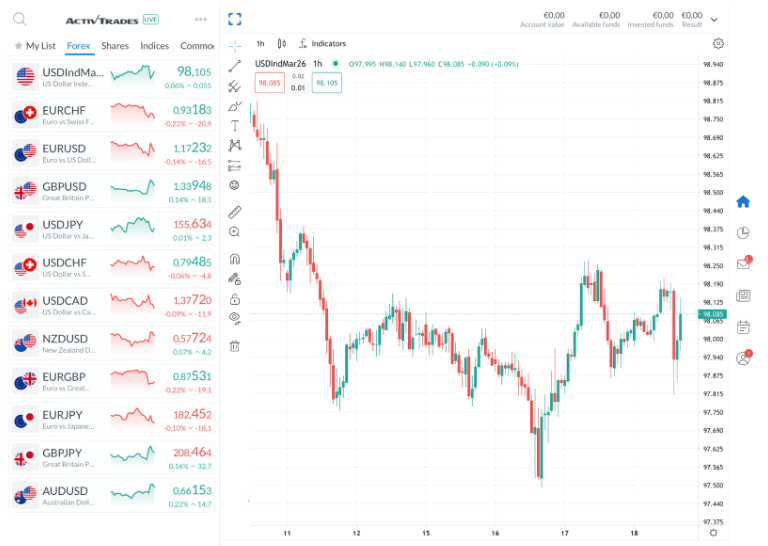
The U.S. Dollar retreated against its peers as soft inflation figures boosted bets on 2026 rate cuts, which tend to dampen demand for the Dollar as shown in the following hourly Dollar Index chart.
Stay up to date with what's moving and shaking on the world's markets and never miss another important headline again! Check ActivTrades daily news and analyses here.
Author
Carolane de Palmas
ActivTrades
Carolane graduated with a Masters in Corporate Finance & Financial Markets and got the AMF Certification (Financial Markets Regulator in France). Afterward, she became an independent trader, investing mostly in European and American stocks/indices.