Gold consolidates near $4,350 amid firm US Dollar
- Gold trades sideways after failing to sustain a post-CPI rally.
- Expectations for Fed rate cuts offer support, but a resilient US Dollar keeps Gold confined to a narrow range.
- Technically, XAU/USD continues to consolidate below $4,350, with short-term moving averages providing near-term support.

Gold (XAU/USD) Gold (XAU/USD) regains ground on Friday, edging modestly higher after earlier weakness, even as a resilient US Dollar (USD) caps upside momentum. At the time of writing, XAU/USD trades around $4,345, recovering from a daily low near $4,309.
The precious metal briefly surged toward record highs on Thursday after US inflation data undershot expectations. However, gains quickly faded as softer inflation lifted risk appetite across equity markets and pushed Gold back within the range established earlier this week.
That said, the downside appears limited, as a dovish Federal Reserve (Fed) outlook and persistent geopolitical risks continue to provide a steady tailwind for prices, keeping the metal on track to end the week with modest gains.
Attention now turns to upcoming US economic releases later on Friday, including Existing Home Sales and the University of Michigan Consumer Sentiment and Consumer Expectations surveys, along with one-year and five-year inflation expectations.
Market movers: Fed outlook and geopolitics steer markets
- US data released on Friday painted a mixed picture. Existing Home Sales rose 0.5% MoM in November, slowing from October’s 1.5% increase. The University of Michigan’s final December survey showed softer consumer sentiment, with the Consumer Expectations Index revised down to 54.6 from 55.0 and the headline Consumer Sentiment Index finalised at 52.9. On the inflation front, one-year consumer inflation expectations edged up to 4.2%, while the five-year outlook remained unchanged at 3.2%.
- New York Fed President John Williams said on Friday that recent labour market data show no sign of a sharp deterioration, adding that the rise in the Unemployment Rate may reflect temporary distortions rather than a fundamental weakening. Speaking in a CNBC interview, Williams said policy remains mildly restrictive and still has room to move toward neutral, which he sees as slightly below 1% in real terms, while stressing that he sees no urgency to change the current policy stance and that recent data have not altered his outlook.
- The US Dollar Index (DXY), which tracks the Greenback's value against a basket of six major currencies, is trading around 98.70, its highest level since December 11, extending its rebound after briefly dipping below 98.00 on Tuesday, the weakest level in over two months.
- Data released by the US Bureau of Labor Statistics on Thursday showed that the Consumer Price Index (CPI) rose 2.7% YoY in November, falling short of market expectations of 3.1% and easing from 3.0% in September. Core CPI, which excludes food and energy, also slowed to 2.6% YoY from 3.0%.
- Delayed US Nonfarm Payrolls (NFP) data released earlier this week showed the Unemployment Rate rising to 4.6% in November, its highest level since 2021, indicating a softening labor market. Combined with cooling inflation, the data have strengthened expectations that the Federal Reserve (Fed) may deliver further interest rate cuts sooner than previously expected into 2026.
- Markets are pricing in around 62 basis points of rate cuts in 2026. Even so, the Fed is still widely expected to keep rates unchanged at its January meeting, with the CME FedWatch Tool showing only a 24% probability of a 25-basis-point cut, rising to around 45% for March.
- Geopolitical risks are back in focus, with tentative optimism around progress in US-led Russia-Ukraine peace talks offset by rising tensions between the United States and Venezuela. US President Donald Trump said on Friday that Washington would carry out additional seizures of oil tankers near Venezuela. Trump added that the possibility of a war with Venezuela remains on the table, according to an NBC News interview.
Technical analysis: XAU/USD consolidates below $4,350
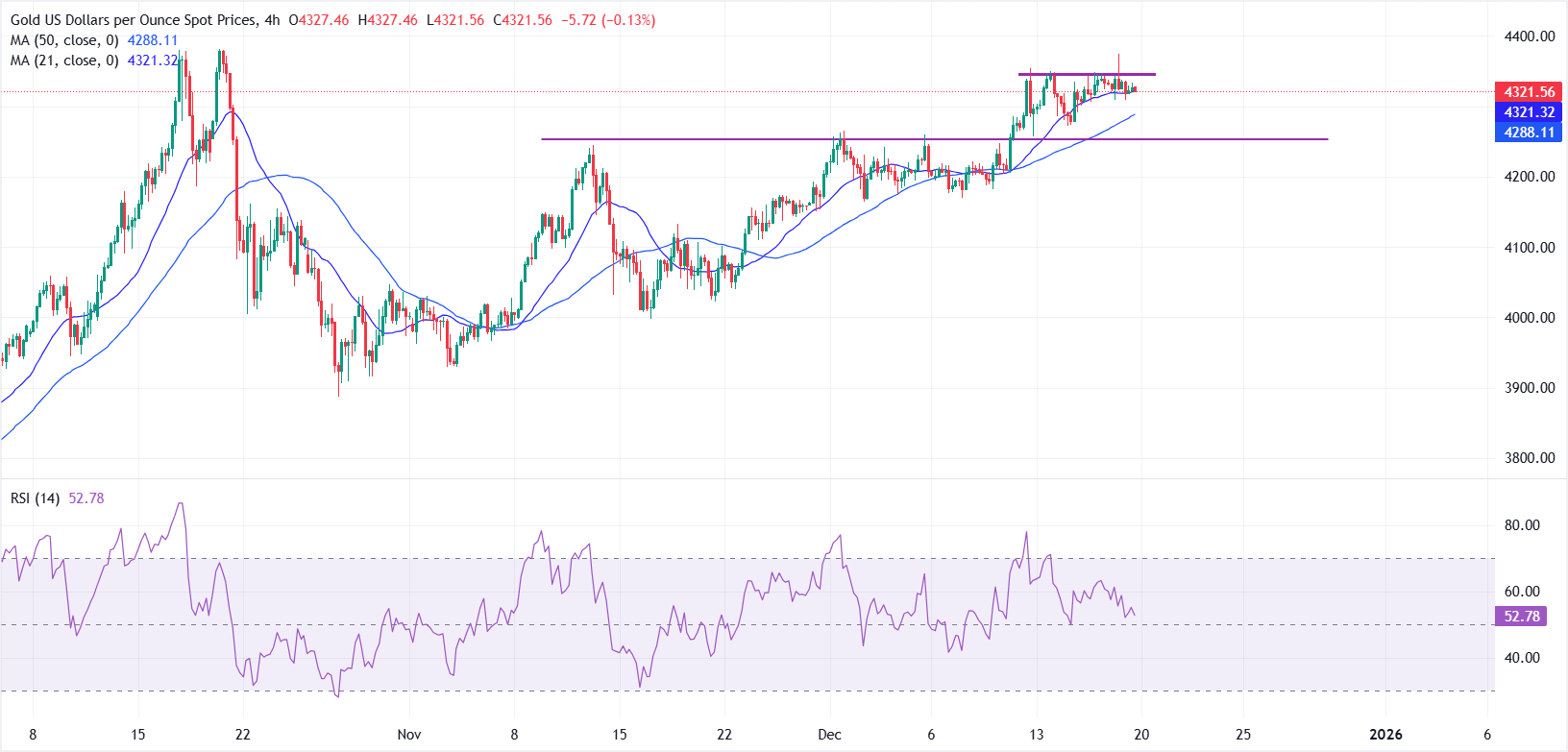
Gold remains range-bound below the $4,350 level, with the 4-hour chart showing prices stabilising just above the 21-period Simple Moving Average (SMA), which is helping to limit immediate downside pressure.
A sustained break below the 21-SMA could expose the 50-period SMA near $4,320, with a deeper pullback opening the door toward the $4,250 region, a key short-term support zone.
On the upside, a decisive move above $4,350 would bring Thursday’s high near $4,374 into focus, followed by the all-time high around $4,381. Momentum indicators remain neutral, with the Relative Strength Index (RSI) hovering near the mid-50s, suggesting room for either direction.
Gold FAQs
Gold has played a key role in human’s history as it has been widely used as a store of value and medium of exchange. Currently, apart from its shine and usage for jewelry, the precious metal is widely seen as a safe-haven asset, meaning that it is considered a good investment during turbulent times. Gold is also widely seen as a hedge against inflation and against depreciating currencies as it doesn’t rely on any specific issuer or government.
Central banks are the biggest Gold holders. In their aim to support their currencies in turbulent times, central banks tend to diversify their reserves and buy Gold to improve the perceived strength of the economy and the currency. High Gold reserves can be a source of trust for a country’s solvency. Central banks added 1,136 tonnes of Gold worth around $70 billion to their reserves in 2022, according to data from the World Gold Council. This is the highest yearly purchase since records began. Central banks from emerging economies such as China, India and Turkey are quickly increasing their Gold reserves.
Gold has an inverse correlation with the US Dollar and US Treasuries, which are both major reserve and safe-haven assets. When the Dollar depreciates, Gold tends to rise, enabling investors and central banks to diversify their assets in turbulent times. Gold is also inversely correlated with risk assets. A rally in the stock market tends to weaken Gold price, while sell-offs in riskier markets tend to favor the precious metal.
The price can move due to a wide range of factors. Geopolitical instability or fears of a deep recession can quickly make Gold price escalate due to its safe-haven status. As a yield-less asset, Gold tends to rise with lower interest rates, while higher cost of money usually weighs down on the yellow metal. Still, most moves depend on how the US Dollar (USD) behaves as the asset is priced in dollars (XAU/USD). A strong Dollar tends to keep the price of Gold controlled, whereas a weaker Dollar is likely to push Gold prices up.
Author

Vishal Chaturvedi
FXStreet
I am a macro-focused research analyst with over four years of experience covering forex and commodities market. I enjoy breaking down complex economic trends and turning them into clear, actionable insights that help traders stay ahead of the curve.
















