USD/INR falls on RBI intervention, ignores Warsh's nomination supported US Dollar
- The Indian Rupee rises against the US Dollar at the open after the RBI’s intervention.
- The Indian equity market fell sharply on Sunday after the government announced the FY 2026-27 fiscal budget.
- Warsh’s selection as the Fed’s new Chairman has strengthened the US Dollar.

The Indian Rupee (INR) gains against the US Dollar (USD) on Monday, following the Indian government's announcement of the fiscal budget for the Financial Year (FY) 2026-27 on Sunday. The USD/INR pair declines to near 91.60 as the Reserve Bank of India (RBI) intervenes in the spot and Non-Deliverable Forward (NDF) markets to cushion the Indian Rupee near its lifetime lows against the US Dollar.
According to a report from Reuters, traders say that the Indian central bank likely intervened before the local spot market opened on Monday to help the currency stave off a fall to near record low levels.
Meanwhile, Indian stock markets recovered sharply on Monday, following a crash the previous day. Indian bourses fell like a house of cards on Sunday after the annual budget announcement in which the government surprisingly raised Securities Transaction Tax (STT) on trading in the Futures and Options (F&O) segment in the derivative market to extend its grip on curbing speculative activities.
Other major highlights of the fiscal budget were 22% increase in the defence budget to modernize defence equipment, 9% rise in capital expenditure to ₹12.2 lakh crore, tax holidays for global companies to produce data centers in India till 2047, an increase in outlay of Rs. 40,000 Crore to boost the manufacturing of electronic components, and the launch of the Semiconductor Mission 2.0.
Going forward, the major trigger for the Indian Rupee will be the monetary policy announcement by the RBI on Friday. In the December policy meeting, the Indian central bank slashed the Repo Rate by 25 basis points (bps) to 5.25%, and announced a fresh liquidity infusion of ₹1.5 lakh crore to boost credit flow.
The table below shows the percentage change of Indian Rupee (INR) against listed major currencies today. Indian Rupee was the strongest against the Australian Dollar.
| USD | EUR | GBP | JPY | CAD | AUD | INR | CHF | |
|---|---|---|---|---|---|---|---|---|
| USD | -0.05% | 0.00% | -0.06% | 0.27% | 0.47% | -0.20% | -0.07% | |
| EUR | 0.05% | 0.06% | -0.02% | 0.33% | 0.52% | -0.12% | -0.02% | |
| GBP | -0.01% | -0.06% | -0.06% | 0.27% | 0.46% | -0.21% | -0.07% | |
| JPY | 0.06% | 0.02% | 0.06% | 0.34% | 0.53% | -0.10% | -0.01% | |
| CAD | -0.27% | -0.33% | -0.27% | -0.34% | 0.19% | -0.47% | -0.35% | |
| AUD | -0.47% | -0.52% | -0.46% | -0.53% | -0.19% | -0.66% | -0.54% | |
| INR | 0.20% | 0.12% | 0.21% | 0.10% | 0.47% | 0.66% | 0.10% | |
| CHF | 0.07% | 0.02% | 0.07% | 0.00% | 0.35% | 0.54% | -0.10% |
The heat map shows percentage changes of major currencies against each other. The base currency is picked from the left column, while the quote currency is picked from the top row. For example, if you pick the Indian Rupee from the left column and move along the horizontal line to the US Dollar, the percentage change displayed in the box will represent INR (base)/USD (quote).
Daily Digest Market Movers: Investors shift focus to US NFP data
- RBI’s surprise intervention has supported the Indian Rupee to counter the firm US Dollar. As of writing, the US Dollar Index (DXY), which tracks the Greenback’s value against six major currencies, holds onto Friday’s gains near 97.33.
- The US Dollar gained sharply on Friday after the White House nominated former Federal Reserve (Fed) Governor Kevin Warsh as the successor of current Chairman Jerome Powell. Investors took Warsh’s appointment as favorable for the US Dollar, given his historical preference for a strong US Dollar in his prior term at the Fed.
- While investors think Warsh will be inclined to cut rates as United States (US) President Donald Trump already said that the *new Chairman will support bigger cuts, they expect him to rein in the Fed’s balance sheet, which is typically supportive for the dollar as it reduces the money supply in the market, Reuters reported.
- A higher US Dollar has resulted in a sharp decline in the appeal of precious metals, which had rallied significantly in recent months on expectations that Trump’s new candidate will dampen the Fed’s autonomous character.
- For near-term cues on the Fed’s monetary policy outlook, investors await a slew of employment-related economic data, especially the Nonfarm Payrolls (NFP) report for January, which will be released on Friday.
- In Monday’s session, investors will focus on the ISM Manufacturing Purchasing Managers’ Index (PMI) data for January, which will be published at 15:00 GMT. Economists expect the manufacturing sector activity to have contracted again, but at a moderate pace. A figure below 50.0 is considered a contraction in the business activity. The ISM Manufacturing PMI is seen higher at 48.3 from 47.9 in December.
Technical Analysis: USD/INR sees immediate support at 20-day EMA
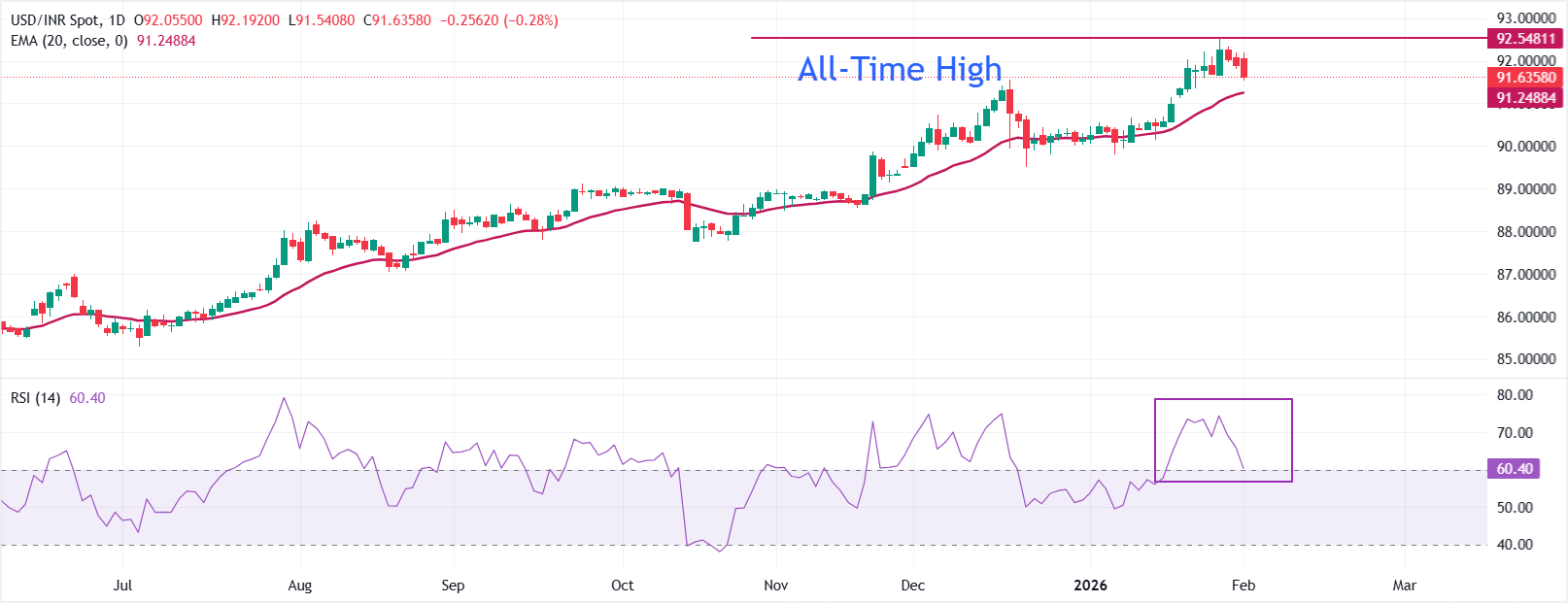
USD/INR trades lower at around 91.60 at the time of writing. The pair holds firm above the rising 20-day EMA at 91.24, keeping the short-term uptrend intact. The average continues to ascend, pointing to sustained buying pressure and favoring dips to be bought.
RSI at 60 (positive) has cooled from recent overbought readings, yet remains above the midline to validate bullish momentum. Continuation could see the advance extend, while pullbacks would find initial support at the rising average. A daily close beneath it would open room for a deeper correction.
(The technical analysis of this story was written with the help of an AI tool.)
Indian economy FAQs
The Indian economy has averaged a growth rate of 6.13% between 2006 and 2023, which makes it one of the fastest growing in the world. India’s high growth has attracted a lot of foreign investment. This includes Foreign Direct Investment (FDI) into physical projects and Foreign Indirect Investment (FII) by foreign funds into Indian financial markets. The greater the level of investment, the higher the demand for the Rupee (INR). Fluctuations in Dollar-demand from Indian importers also impact INR.
India has to import a great deal of its Oil and gasoline so the price of Oil can have a direct impact on the Rupee. Oil is mostly traded in US Dollars (USD) on international markets so if the price of Oil rises, aggregate demand for USD increases and Indian importers have to sell more Rupees to meet that demand, which is depreciative for the Rupee.
Inflation has a complex effect on the Rupee. Ultimately it indicates an increase in money supply which reduces the Rupee’s overall value. Yet if it rises above the Reserve Bank of India’s (RBI) 4% target, the RBI will raise interest rates to bring it down by reducing credit. Higher interest rates, especially real rates (the difference between interest rates and inflation) strengthen the Rupee. They make India a more profitable place for international investors to park their money. A fall in inflation can be supportive of the Rupee. At the same time lower interest rates can have a depreciatory effect on the Rupee.
India has run a trade deficit for most of its recent history, indicating its imports outweigh its exports. Since the majority of international trade takes place in US Dollars, there are times – due to seasonal demand or order glut – where the high volume of imports leads to significant US Dollar- demand. During these periods the Rupee can weaken as it is heavily sold to meet the demand for Dollars. When markets experience increased volatility, the demand for US Dollars can also shoot up with a similarly negative effect on the Rupee.
Author

Sagar Dua
FXStreet
Sagar Dua is associated with the financial markets from his college days. Along with pursuing post-graduation in Commerce in 2014, he started his markets training with chart analysis.














