USD/INR gains as intensifying dovish RBI bets weigh on Indian Rupee
- The Indian Rupee faces pressure against the US Dollar as the RBI is expected to cut interest rates in December.
- FIIs have turned out to be net sellers on all trading days so far this week.
- Fed’s Collins supports no adjustment in current interest rates.

The Indian Rupee (INR) is under pressure against the US Dollar (USD) on Thursday. The USD/INR pair rises to near 88.85 as the Indian Rupee is expected to face significant pressure due to growing expectations that the Reserve Bank of India (RBI) could loosen monetary policy conditions in the December policy meeting.
RBI dovish speculation has intensified following the release of the retail Consumer Price Index (CPI) data for October, released on Wednesday. The report showed that retail inflation decelerated at a faster-than-expected pace to 0.25% on an annualized basis, driven by soft food prices and tax cuts in consumer goods announced in the third quarter of the year. This is the second straight month when the inflation data has come below the RBI’s tolerance range of 2%-6%.
"To prevent the economy from slipping into sluggish and weak economic growth, the RBI may go for a 25-50 basis points cut in repo rate in its December 2025 monetary policy," said Devendra Pant, chief economist at India Ratings and Research, Reuters reported.
Lower interest rates by the RBI bode poorly for the Indian Rupee.
Meanwhile, the continuous outflow of foreign funds from the Indian stock market is also keeping the Indian Rupee under pressure. Foreign Institutional Investors (FIIs) have turned out to be net sellers in all three trading days so far this week. On Wednesday, FIIs pared stake worth Rs. 1,750.03 crore.
Going forward, investors will focus on the Wholesale Price Index (WPI) Inflation data for October, which will be released on Friday.
On the domestic front, Moody's Rating has predicted that the Indian economy will grow by 6.5% through 2027. The agency has stated that strong economic growth projections are backed by robust infrastructure spending, although it remained cautious over private sector business capital spending.
The table below shows the percentage change of Indian Rupee (INR) against listed major currencies today. Indian Rupee was the weakest against the Australian Dollar.
| USD | EUR | GBP | JPY | CAD | AUD | INR | CHF | |
|---|---|---|---|---|---|---|---|---|
| USD | 0.06% | 0.09% | 0.12% | 0.06% | -0.26% | 0.13% | 0.16% | |
| EUR | -0.06% | 0.02% | 0.07% | -0.00% | -0.32% | 0.08% | 0.10% | |
| GBP | -0.09% | -0.02% | 0.04% | -0.03% | -0.34% | 0.06% | 0.08% | |
| JPY | -0.12% | -0.07% | -0.04% | -0.09% | -0.38% | 0.01% | 0.03% | |
| CAD | -0.06% | 0.00% | 0.03% | 0.09% | -0.30% | 0.10% | 0.11% | |
| AUD | 0.26% | 0.32% | 0.34% | 0.38% | 0.30% | 0.38% | 0.43% | |
| INR | -0.13% | -0.08% | -0.06% | -0.01% | -0.10% | -0.38% | 0.02% | |
| CHF | -0.16% | -0.10% | -0.08% | -0.03% | -0.11% | -0.43% | -0.02% |
The heat map shows percentage changes of major currencies against each other. The base currency is picked from the left column, while the quote currency is picked from the top row. For example, if you pick the Indian Rupee from the left column and move along the horizontal line to the US Dollar, the percentage change displayed in the box will represent INR (base)/USD (quote).
Daily digest market movers: US government reopens after 43-day-long shutdown
- The Indian Rupee weakens against the US Dollar, even as the latter trades cautiously against its major currency peers. At the time of writing, the US Dollar Index (DXY), which tracks the Greenback’s value against six major currencies, falls to near 99.20.
- The Greenback has been under pressure, and traders seem confident that the Federal Reserve (Fed) will cut interest rates again in the policy meeting in December. According to the CME FedWatch tool, the probability of the Fed cutting interest rates by 25 basis points (bps) to 3.50%-3.75% in the December meeting has increased to 67% from 62% seen a week ago.
- Fed dovish bets have slightly accelerated following the release of ADP Employment Change four-week average data, which showed that private employers laid off 11.25K workers each week through late October.
- Contrary to market expectations, a few Federal Open Market Committee (FOMC) members have been arguing in favor of holding interest rates at their current levels for some time. On Wednesday, Boston Federal Reserve President Susan Collins stated that recent interest rate cuts have raised the bar of further monetary policy easing very high, citing upside inflation risks.
- "It will likely be appropriate to keep policy rates at the current level for some time to balance the inflation and employment risks in this highly uncertain environment," Collins said at the Greater Boston Chamber of Commerce, Reuters reported.
- Meanwhile, the reopening of the US government, following the historically longest shutdown, has been ordered as President Donald Trump has signed the federal funding bill. The US government reopening will be followed by key economic releases, which were halted due to the shutdown.
Technical Analysis: USD/INR stays above 20-day EMA
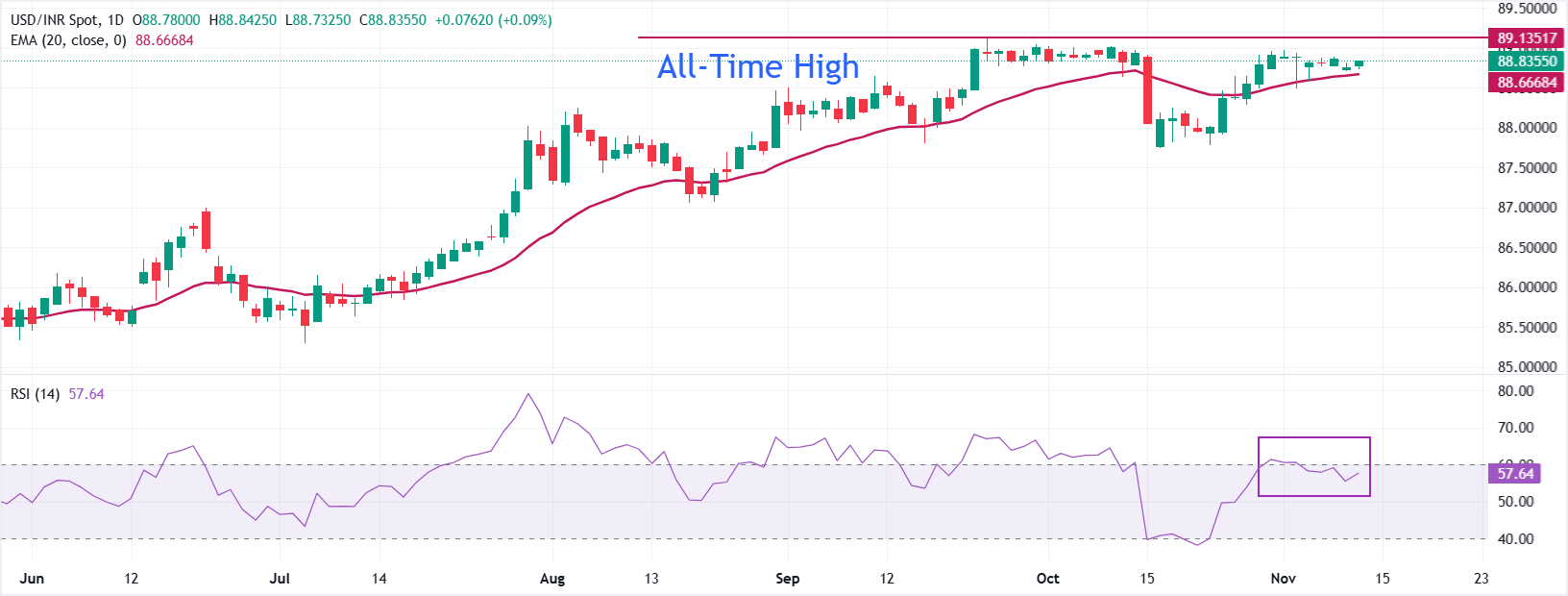
USD/INR rises to near 88.85 at open on Thursday. The near-term trend of the pair remains bullish as it stays above the 20-day Exponential Moving Average (EMA), which trades around 88.66.
The 14-day Relative Strength Index (RSI) strives to return above 60.00. A fresh bullish momentum would emerge if the RSI (14) manages to do so.
Looking down, the August 21 low of 87.07 will act as key support for the pair. On the upside, the all-time high of 89.12 will be a key barrier.
Economic Indicator
WPI Inflation
The WPI Inflation released by the Ministry of Commerce and Industry is a measure of price movements similar to the Consumer Price Indices (CPI). Generally, a high reading is seen as positive (or bullish) for the Rupee, while a low reading is seen as negative (or bearish).
Read more.Next release: Fri Nov 14, 2025 06:30
Frequency: Monthly
Consensus: -0.6%
Previous: 0.13%
Author

Sagar Dua
FXStreet
Sagar Dua is associated with the financial markets from his college days. Along with pursuing post-graduation in Commerce in 2014, he started his markets training with chart analysis.














