USD/CHF Price Forecast: Gathers strength to near 0.8000, bearish outlook prevails
- USD/CHF gains ground to around 0.7990 in Thursday’s early European session.
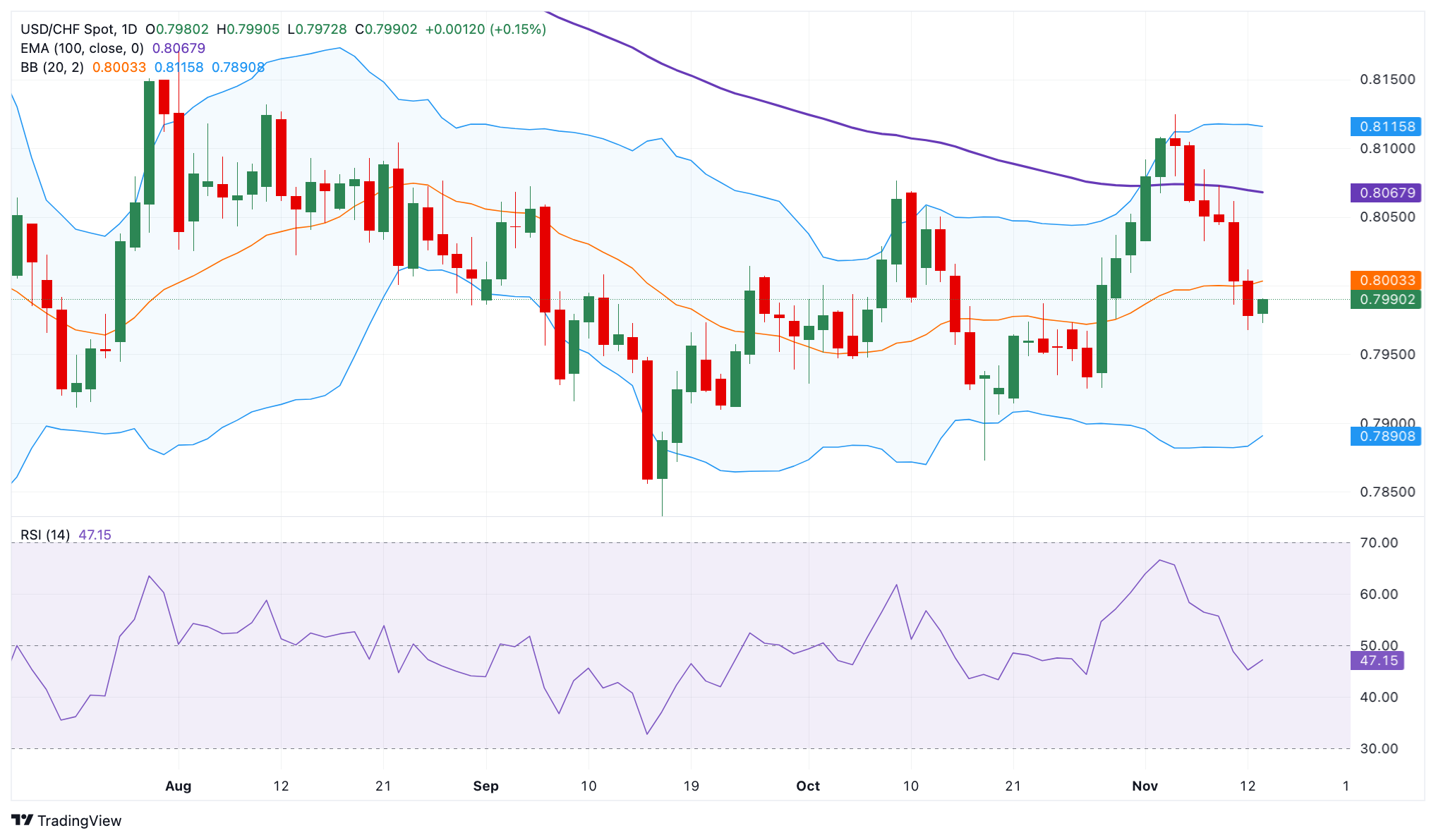
- The negative outlook of the pair remains in play below the 100-day EMA, with the bearish RSI indicator.
- The initial support level to watch is 0.7946; immediate upside target is seen at 0.8007.

The USD/CHF pair gathers strength to near 0.7990 during the early European session on Thursday. The US Dollar (USD) strengthens against the Swiss Franc (CHF) after a record-long US government shutdown ends as US President Donald Trump signs a funding bill. Traders will take more cues about future monetary policy from the Fedspeak later in the day. Fed policymakers Neel Kashkari, Alberto Musalem and Beth Hammack are set to speak.
According to the daily chart, the bearish outlook of the pair remains intact, with the price holding below the key 100-day Exponential Moving Average (EMA). Further downside looks favorable as the 14-day Relative Strength Index (RSI) stands below the midline near 46.65. This suggests the bearish momentum in the near term.
The first support level for USD/CHF is located at 0.7946, the low of October 6. Any follow-through selling below this level could see a drop to 0.7909, the low of September 23. Sustained trading below the mentioned level could expose the lower limit of the Bollinger Band of 0.7890.
On the other hand, the key resistance level for the pair emerges at 0.8007, the high of September 26. A decisive break above this level could pave the way to 0.8065, the 100-day EMA. The next upside barrier is seen at 0.8115, the upper boundary of the Bollinger Band.
USD/CHF daily chart
Swiss Franc FAQs
The Swiss Franc (CHF) is Switzerland’s official currency. It is among the top ten most traded currencies globally, reaching volumes that well exceed the size of the Swiss economy. Its value is determined by the broad market sentiment, the country’s economic health or action taken by the Swiss National Bank (SNB), among other factors. Between 2011 and 2015, the Swiss Franc was pegged to the Euro (EUR). The peg was abruptly removed, resulting in a more than 20% increase in the Franc’s value, causing a turmoil in markets. Even though the peg isn’t in force anymore, CHF fortunes tend to be highly correlated with the Euro ones due to the high dependency of the Swiss economy on the neighboring Eurozone.
The Swiss Franc (CHF) is considered a safe-haven asset, or a currency that investors tend to buy in times of market stress. This is due to the perceived status of Switzerland in the world: a stable economy, a strong export sector, big central bank reserves or a longstanding political stance towards neutrality in global conflicts make the country’s currency a good choice for investors fleeing from risks. Turbulent times are likely to strengthen CHF value against other currencies that are seen as more risky to invest in.
The Swiss National Bank (SNB) meets four times a year – once every quarter, less than other major central banks – to decide on monetary policy. The bank aims for an annual inflation rate of less than 2%. When inflation is above target or forecasted to be above target in the foreseeable future, the bank will attempt to tame price growth by raising its policy rate. Higher interest rates are generally positive for the Swiss Franc (CHF) as they lead to higher yields, making the country a more attractive place for investors. On the contrary, lower interest rates tend to weaken CHF.
Macroeconomic data releases in Switzerland are key to assessing the state of the economy and can impact the Swiss Franc’s (CHF) valuation. The Swiss economy is broadly stable, but any sudden change in economic growth, inflation, current account or the central bank’s currency reserves have the potential to trigger moves in CHF. Generally, high economic growth, low unemployment and high confidence are good for CHF. Conversely, if economic data points to weakening momentum, CHF is likely to depreciate.
As a small and open economy, Switzerland is heavily dependent on the health of the neighboring Eurozone economies. The broader European Union is Switzerland’s main economic partner and a key political ally, so macroeconomic and monetary policy stability in the Eurozone is essential for Switzerland and, thus, for the Swiss Franc (CHF). With such dependency, some models suggest that the correlation between the fortunes of the Euro (EUR) and the CHF is more than 90%, or close to perfect.
Author

Lallalit Srijandorn
FXStreet
Lallalit Srijandorn is a Parisian at heart. She has lived in France since 2019 and now becomes a digital entrepreneur based in Paris and Bangkok.