GBP/USD rebounds as US Dollar retreats, but weekly losses persist
- GBP/USD climbs 0.60% as US Dollar weakens, despite lingering pressure from BoE’s dovish stance.
- BoE Governor Bailey reinforces easing bias as disinflation advances and private-sector growth stays weak.
- Soft US labor data boosts Fed cut expectations ahead of delayed NFP and CPI data.

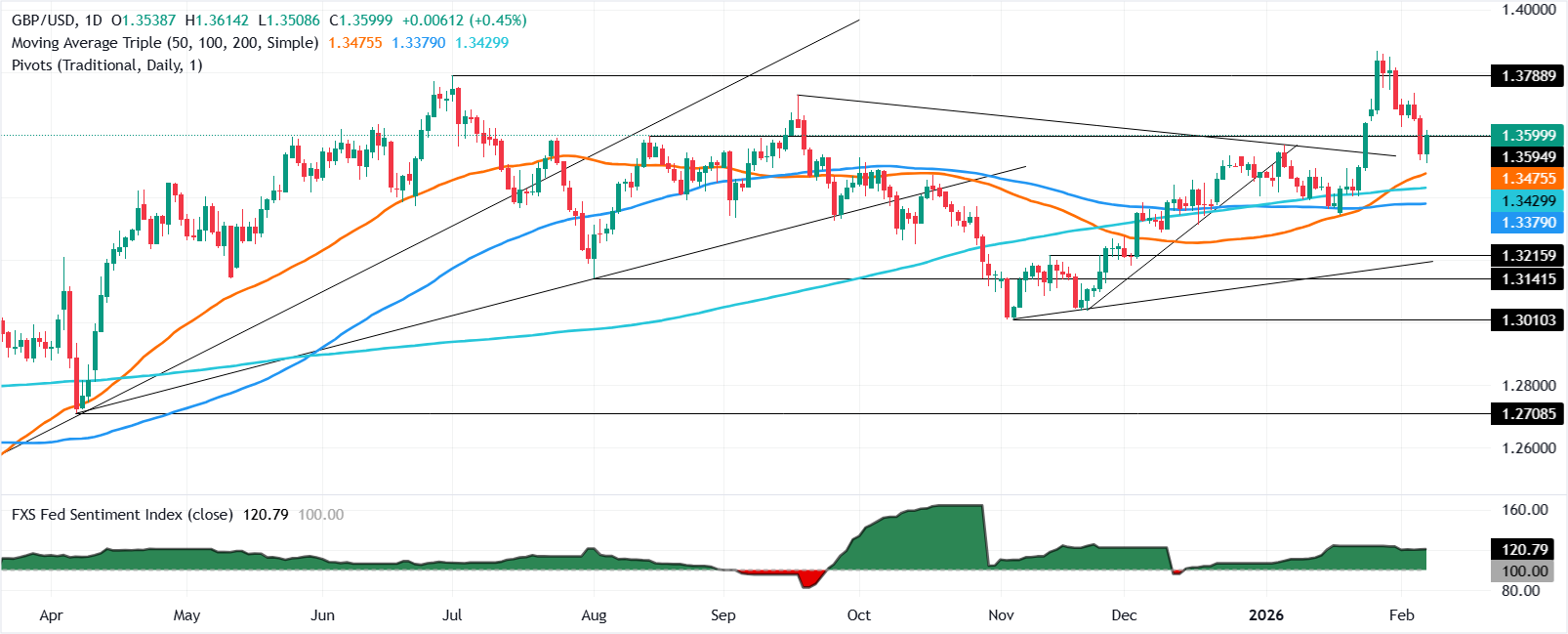
The Pound Sterling (GBP) recovers on Friday, up by 0.60% as the US Dollar (USD) makes a U-turn, erasing Thursday’s losses amid a risk-on mood. At the time of writing, GBP/USD trades at 1.3604, yet is poised to finish the week with a 0.56% loss.
Sterling rises amid risk-on flows and softer Dollar tone, though dovish BoE signals cap upside
The US Dollar Index (DXY), which tracks the performance of six currencies versus the American Dollar, edges down 0.37% at 97.59, after reaching a two-week high of 98.03 earlier in the day.
On Thursday, the Bank of England (BoE) left rates unchanged, though it signaled that if the disinflation process met the criteria, it would cut rates. Nevertheless, BoE Governor Andrew Bailey sounded dovish, adding that the Bank Rate is expected to be reduced further.
Recently, the BoE Chief Economist Huw Pill said that it is good news that inflation is falling to target and acknowledged that private sector growth is subdued but positive.
In the US, softer US jobs data on Thursday led to a delayed reaction in the FX markets, as the Greenback posted gains on Thursday but pared those gains on Friday. Job openings falling, an increase in layoffs according to the Challenger’s report, and a jump in Jobless Claims ramped up expectations that the Fed will cut rates in 2026.
Recently, the University of Michigan (UoM) revealed that Consumer Sentiment improved in February, from 56.4 to 57.3, exceeding estimates of 55. Inflation expectations for one-year dipped from 4% to 3.5%, while they ticked up for a five-year period from 3.3% to 3.4%.
Ahead next week, traders will eye US data, Nonfarm Payrolls and the Consumer Price Index (CPI), both delayed by the short government shutdown. Also, Retail Sales and a flurry of Fed officials will cross the wires.
In the UK, Gross Domestic Product (GDP) figures on Thursday and a speech by BoE’s Governor Andrew Bailey could move the needle, if not for the ongoing domestic political turmoil surrounding the PM Keir Starmer.
GBP/USD Price Analysis: Technical outlook
The GBP/USD pair seems poised for a recovery, yet bulls are not out of the woods. They must end the session above 1.3600 to remain hopeful of testing the February 5 high at 1.3662 ahead of 1.3700. Conversely, a drop below 1.3600 could motivate sellers to drive the exchange rate to the current week’s low of 1.3508 ahead of 1.3500. On further weakness, the 50-day SMS is up next at 1.3463.
Pound Sterling Price This week
The table below shows the percentage change of British Pound (GBP) against listed major currencies this week. British Pound was the strongest against the Japanese Yen.
| USD | EUR | GBP | JPY | CAD | AUD | NZD | CHF | |
|---|---|---|---|---|---|---|---|---|
| USD | 0.35% | 0.71% | 1.37% | 0.28% | -0.74% | 0.09% | 0.60% | |
| EUR | -0.35% | 0.31% | 1.04% | -0.07% | -1.07% | -0.25% | 0.24% | |
| GBP | -0.71% | -0.31% | 0.60% | -0.38% | -1.38% | -0.57% | -0.07% | |
| JPY | -1.37% | -1.04% | -0.60% | -1.06% | -2.09% | -1.23% | -1.03% | |
| CAD | -0.28% | 0.07% | 0.38% | 1.06% | -0.99% | -0.18% | 0.31% | |
| AUD | 0.74% | 1.07% | 1.38% | 2.09% | 0.99% | 0.83% | 1.33% | |
| NZD | -0.09% | 0.25% | 0.57% | 1.23% | 0.18% | -0.83% | 0.50% | |
| CHF | -0.60% | -0.24% | 0.07% | 1.03% | -0.31% | -1.33% | -0.50% |
The heat map shows percentage changes of major currencies against each other. The base currency is picked from the left column, while the quote currency is picked from the top row. For example, if you pick the British Pound from the left column and move along the horizontal line to the US Dollar, the percentage change displayed in the box will represent GBP (base)/USD (quote).
Author

Christian Borjon Valencia
FXStreet
Markets analyst, news editor, and trading instructor with over 14 years of experience across FX, commodities, US equity indices, and global macro markets.