USD/CAD edges higher as Fed cautions against hasty rate cuts, Oil holds the line
- USD/CAD pushes higher on USD strength after Fed officials advocate caution in cutting interest rates.
- Oil remains bid despite higher inventories as official government figures moderate previous data.
- BoC could turn dovish at the next meeting on lower inflation and negative growth outlook.

USD/CAD continues channeling higher, up by almost a tenth of a percent and trading above 1.3600 on Thursday. The pair is benefiting from a general appreciation in the US Dollar (USD) on the back of expectations the Federal Reserve (Fed) will delay cutting interest rates, a key driver of FX markets.
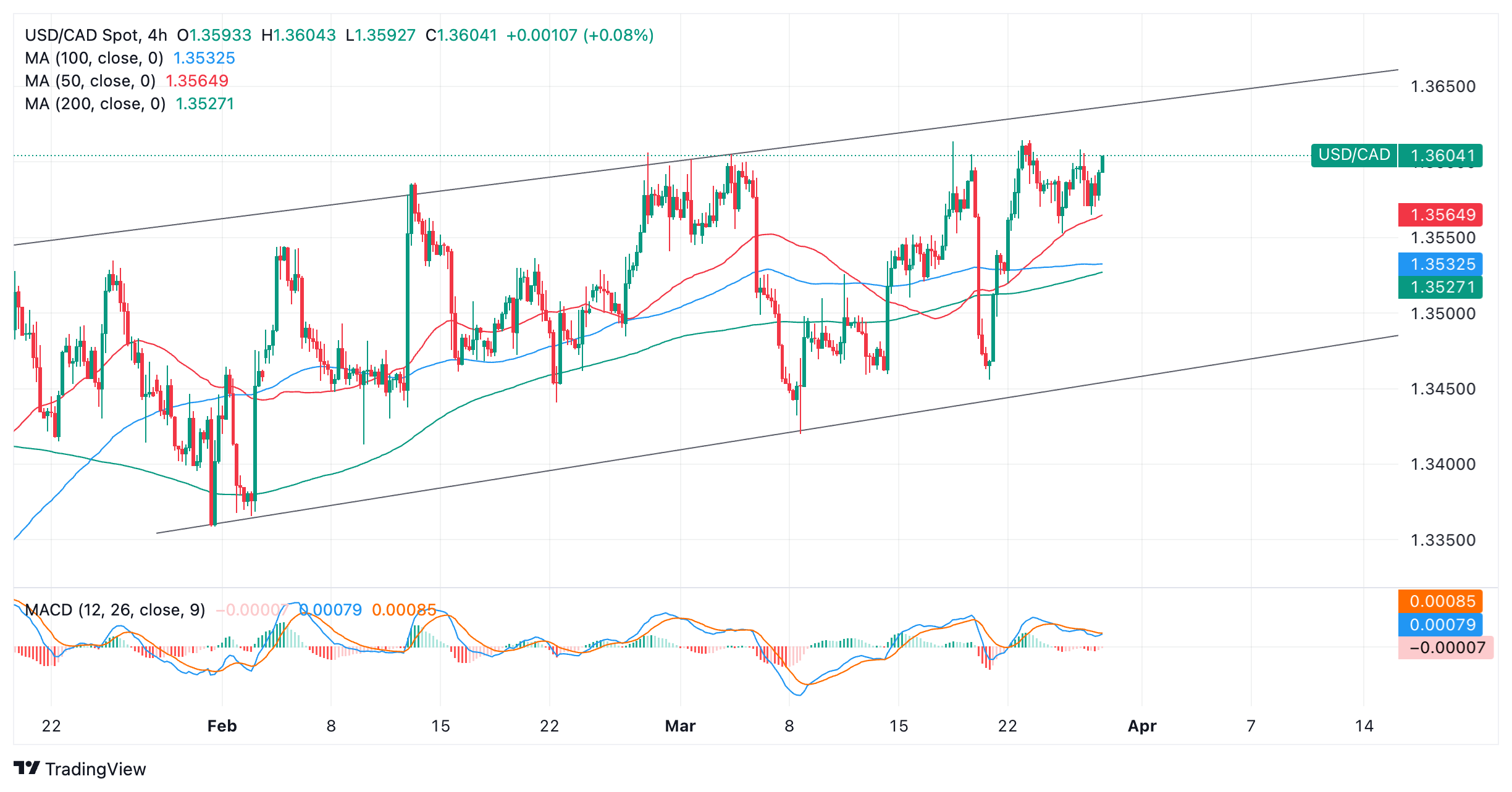
US Dollar versus Canadian Dollar: 4-hour chart
The outlook for Canada’s largest export Crude Oil, has hampered the Canadian Dollar (CAD) meanwhile, after a surprise rise in US stockpile data denoted flagging demand. Although WTI Oil is rising on Thursday – due to a more official source of stockpile data from the Energy Information Administration (EIA) moderating the initial data – Crude’s outlook remains uncertain.
Fed officials caution against hasty rate cuts
Overall stronger growth data and stickier-than-expected inflation in the US have led a series of Fed speakers to question whether the conditions are right for a rate cut in June. With interest rates now expected to remain higher for longer, the US Dollar (USD) has gained a boost, since higher interest rates tend to attract greater inflows of foreign capital.
Policymakers in Canada have been less vocal about cutting interest rates and at the last Bank of Canada (BoC) meeting BoC Governor Tiff Macklem said it was still too early to consider cutting interest rates as more time was needed to ensure inflation had come down to the BoC’s 2.0% target.
BoC may change tone
The divergence in policy stances between the two central banks would normally be expected to favor the Canadian Dollar over the US Dollar (bearish for USD/CAD), however, since Maclem spoke, Canadian inflation data for February has shown a fairly steep drop.
The core Consumer Price Index, which is the metric most central banks favor for targeting price stability, fell to 2.1% YoY in February, from 2.4% in January, placing it just a tenth of a percent above the BoC’s target, according to data from Statistics Canada.
Headline inflation also slowed to 2.8% from 2.9% and undershot expectations of 3.1%. The cooling inflation data suggests the BoC could shift their stance from its current “mute” setting at the next policy meeting on April 10.
Apart from disinflation there may be other reasons why the BoC may feel a need to start cutting interest rates. Canada’s economy is in comparatively worse shape than the US’s and it could do with the panacea of lower interest rates to help stimulate activity.
Canada’s GDP growth rate is slower, it has higher unemployment and – in the words of BoC Assistant Deputy Governor Carolyn Rogers – suffers from “low productivity” and “poor levels of investment”.
In addition, the BoC’s policy rate is lower at 5.0% than the fed funds rate of 5.25%-5.50%, a differential which mildly favors the US Dollar over the CAD.
Author
Joaquin Monfort
FXStreet
Joaquin Monfort is a financial writer and analyst with over 10 years experience writing about financial markets and alt data. He holds a degree in Anthropology from London University and a Diploma in Technical analysis.