US Treasury yields climb amid central bank policymakers speeches
- Futures market adjusts expectations, reducing bets on quick Fed rate cuts, leading to a rise in US Treasury yields across various maturities.
- Atlanta Fed President Bostic and Fed Governor Waller emphasize a measured approach to rate cuts, citing risks of inflation and policy calibration.
- Inversion in US Treasury yield curve deepens, signaling potential recession concerns, while key US economic data and Fed speeches loom this week.

US Treasury yields rose across the board as interest rate traders in the futures market trimmed their bets that the US Federal Reserve (Fed) would cut rates as quickly as expected. Global bond yields are climbing as central bankers from the Federal Reserve (Fed) push back against market participants' projections that they would relax monetary policy even though the risks of overtightening have emerged.
US bond yields rise as Fed officials signal slower rate cuts
Over the weekend, the Atlanta Fed president Raphael Bostic warned that a “second wave” of inflation could emerge should the central banks cut rates too soon and warned that getting inflation towards the Fed’s 2% target would take some time, according to the Financial Times.
Bostic added that he expects inflation progress to slow down, adding that there were “some risks that inflation may stall out altogether.”
Recently, Fed Governor Christopher Waller commented the Fed is in no rush to easy policy as inflation is “within striking distance.” Although he supports the idea of cutting rates, he warned that until any risks of inflation resurging have subsided, policy changes should “be carefully calibrated and not rushed.”
Following the Fed’s Waller speech, Fed funds futures traders expect a 65% chance of 25 basis points, lower than the 76.9% expected yesterday.
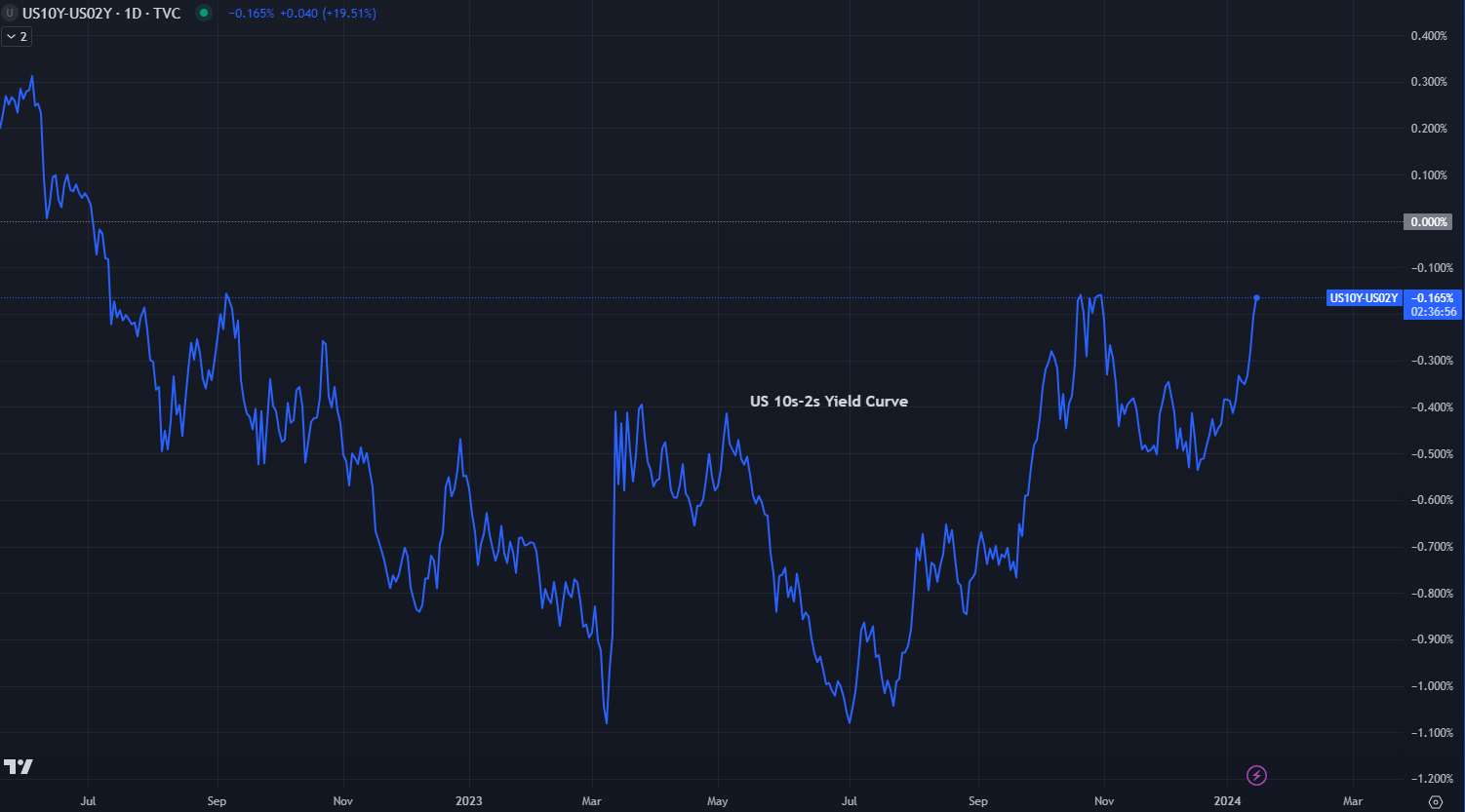
The US 10-year Treasury note climbed 12 basis points, up to 4.07%, while the 2-year note rose 9 basis points at 4.24%. Even though the short and the mid-term of the curve are rising, the US 10s-2s yield curve disinsertion continued, as the spread hit its highest level since October of 2023, at -0.163%. When inverted, that part of the US Treasury yield curve Is usually seen as a warning sign of an upcoming recession.
Ahead of the week, the US economic docket will feature US Retail Sales and Industrial Production housing data and Fed speeches on Wednesday. On Thursday, Initial Jobless Claims and further Fed speakers would cross the wires, followed by Friday’s University of Michigan (UoM) Consumer Sentiment.
US 10s-2s Yield spread chart
Interest rates FAQs
What are interest rates?
Interest rates are charged by financial institutions on loans to borrowers and are paid as interest to savers and depositors. They are influenced by base lending rates, which are set by central banks in response to changes in the economy. Central banks normally have a mandate to ensure price stability, which in most cases means targeting a core inflation rate of around 2%.
If inflation falls below target the central bank may cut base lending rates, with a view to stimulating lending and boosting the economy. If inflation rises substantially above 2% it normally results in the central bank raising base lending rates in an attempt to lower inflation.
How do interest rates impact currencies?
Higher interest rates generally help strengthen a country’s currency as they make it a more attractive place for global investors to park their money.
How do interest rates influence the price of Gold?
Higher interest rates overall weigh on the price of Gold because they increase the opportunity cost of holding Gold instead of investing in an interest-bearing asset or placing cash in the bank.
If interest rates are high that usually pushes up the price of the US Dollar (USD), and since Gold is priced in Dollars, this has the effect of lowering the price of Gold.
What is the Fed Funds rate?
The Fed funds rate is the overnight rate at which US banks lend to each other. It is the oft-quoted headline rate set by the Federal Reserve at its FOMC meetings. It is set as a range, for example 4.75%-5.00%, though the upper limit (in that case 5.00%) is the quoted figure.
Market expectations for future Fed funds rate are tracked by the CME FedWatch tool, which shapes how many financial markets behave in anticipation of future Federal Reserve monetary policy decisions.
Author

Christian Borjon Valencia
FXStreet
Markets analyst, news editor, and trading instructor with over 14 years of experience across FX, commodities, US equity indices, and global macro markets.
















