United Kingdom FX Today: British Pound awaits next labour market test

The British Pound (GBP) retreated slightly against the US Dollar (USD) on Friday, with the GBP/USD pair trading around 1.3555, down 0.1% on the day, correcting after the previous day's rebound.
The GBP remains under pressure in the forex market, however, held back by persistent concerns over the health of the UK labour market ahead of next Tuesday's release of key employment statistics.
Forex investors are awaiting this data with caution as the Bank of England (BoE), which holds its monetary policy meeting next week, could adjust its rate-cutting cycle in line with developments in the labour market.
Against this backdrop, GBP/USD volatility could increase if the employment figures confirm a sharper-than-expected weakening in the British economy.
A gradually cooling labour market
The UK's employment dynamic has clearly changed course since the spring. As reported by the UK Office for National Statistics (ONS), the number of employees on the payroll fell by 164,000 YoY and by 8,000 between June and July 2025, reaching 30.3 million.
This is the tenth month of decline in the last 12, mainly in the hotel & catering and retail sectors.
The Unemployment Rate stood at 4.7% for the April-June period, compared with 4.6% the previous quarter. However, this apparent stabilization masks a more worrying reality.
According to the Resolution Foundation, the Unemployment Rate could quickly reach 5%, its highest level since 2021. As Gregory Thwaites, the think tank's Director of Research, puts it, "the easing of the labour market is taking the form of a hiring freeze rather than a wave of layoffs, which remains bad news for jobseekers".
Falling job vacancies, youth employment at risk
Job vacancies fell by 5.8% in the May-July quarter to 718,000, their lowest level since April 2021, according to ONS.
This is the 37th consecutive quarterly decline in the number of vacancies. This general decline in recruitment reflects a reluctance on the part of companies, particularly against a backdrop of rising wage costs: increase in the National Living Wage (from £11.44 to £12.21), rise in the employer's national insurance contribution rate (from 13.5% to 15%), and lowering of the tax threshold.
As Stephen Evans, Chief Executive of the Learning and Work Institute, points out: "The job market continues to cool, with a marked loss of jobs in retail and hospitality. This is the combined result of a fragile economy, an increase in the minimum wage and higher labour costs.
British youth are particularly vulnerable. Unemployment among 16-24 year-olds reached 14.1% between April and June, and the number of young people neither in employment nor in training (NEET) stands at 1.22 million.
As Chief Economist Helen Gray points out, "Long-term unemployment among young people is on the rise, and can have a lasting effect on their career prospects.”
Wage growth high but under pressure
Despite the slowdown in the job market, wage growth remains robust. ONS data shows a 5.0% annual rise in wages excluding bonuses between April and June.
However, this growth is beginning to show signs of slowing, particularly in the private sector, where the increase was only 4.8%, compared with 5.7% in the public sector.
In real terms, wages are still rising by 0.9%, which could give the BoE some room to cut rates.
But as Monica George Michail, Associate Economist at the National Institute of Economic and Social Research, notes, "the decline in job vacancies is likely to slow wage growth in the future".
This would be a welcome slowdown for the BoE, engaged in a difficult trade-off between sluggish growth and inflation still above its 2% target (4.1% in June).
Technical analysis of GBP/USD: The Cable is still below solid resistance
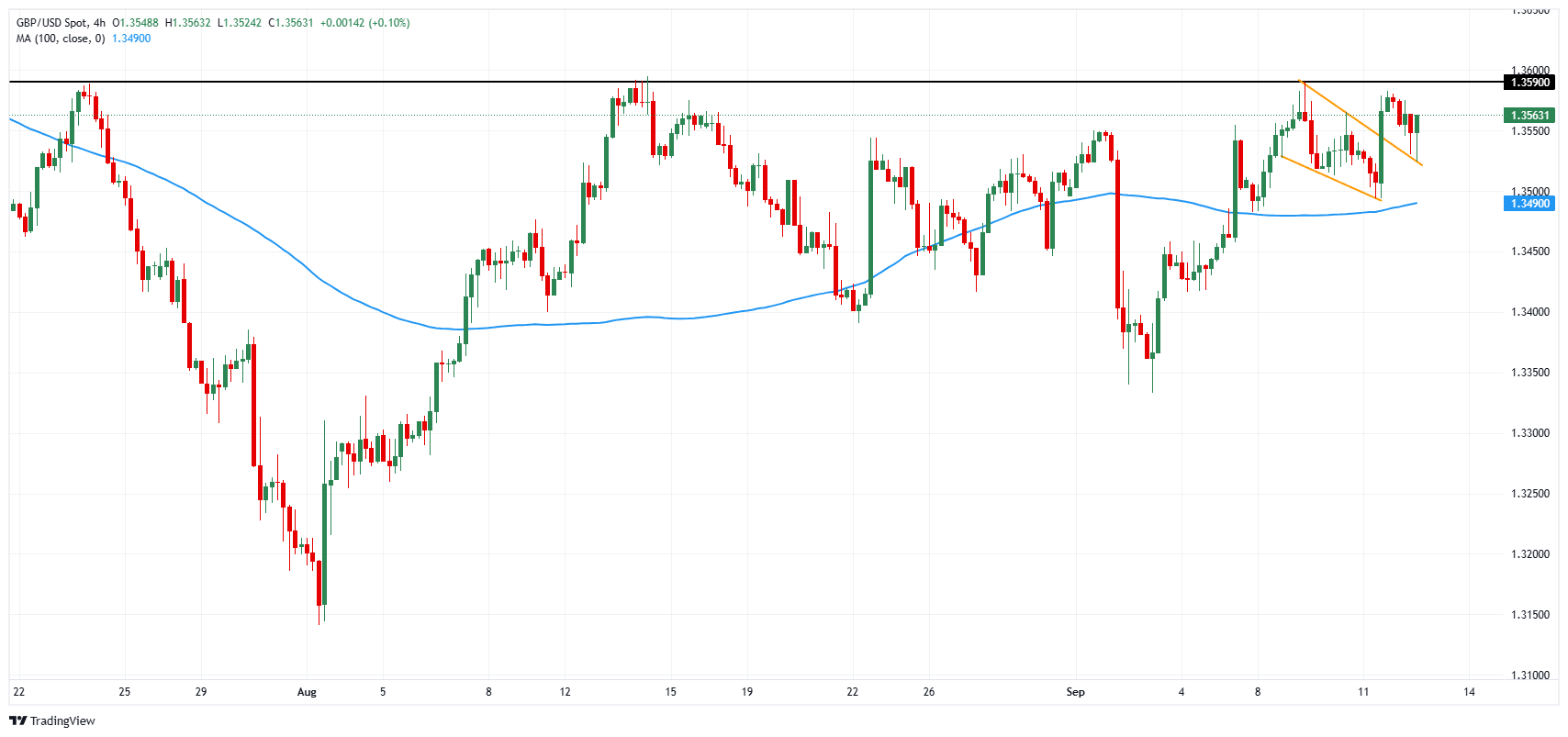
GBP/USD 4-hour chart. Source FXStreet
The GBP/USD pair rebounds after hitting a short-term trendline at 1.3525, confirming the bullish breakout from the flag on Thursday.
However, the Cable is not far from an important resistance around 1.3590, a level which has blocked any bullish attempt since July. A break of this level is, therefore, necessary before any upward acceleration can be envisaged.
On the downside, a reintegration of the flag below 1.3525 could encourage a stronger pullback toward the 100 Simple Moving Average (SMA) on the 4-hour chart, currently at 1.3490.
Pound Sterling Price Today
The table below shows the percentage change of British Pound (GBP) against listed major currencies today. British Pound was the strongest against the New Zealand Dollar.
| USD | EUR | GBP | JPY | CAD | AUD | NZD | CHF | |
|---|---|---|---|---|---|---|---|---|
| USD | 0.09% | 0.12% | 0.31% | 0.11% | 0.24% | 0.40% | 0.10% | |
| EUR | -0.09% | 0.03% | 0.19% | 0.04% | 0.17% | 0.29% | 0.02% | |
| GBP | -0.12% | -0.03% | 0.16% | 0.00% | 0.11% | 0.29% | -0.00% | |
| JPY | -0.31% | -0.19% | -0.16% | -0.19% | -0.07% | 0.05% | -0.23% | |
| CAD | -0.11% | -0.04% | -0.00% | 0.19% | 0.16% | 0.29% | -0.00% | |
| AUD | -0.24% | -0.17% | -0.11% | 0.07% | -0.16% | 0.18% | -0.14% | |
| NZD | -0.40% | -0.29% | -0.29% | -0.05% | -0.29% | -0.18% | -0.29% | |
| CHF | -0.10% | -0.02% | 0.00% | 0.23% | 0.00% | 0.14% | 0.29% |
The heat map shows percentage changes of major currencies against each other. The base currency is picked from the left column, while the quote currency is picked from the top row. For example, if you pick the British Pound from the left column and move along the horizontal line to the US Dollar, the percentage change displayed in the box will represent GBP (base)/USD (quote).
Author

Ghiles Guezout
FXStreet
Ghiles Guezout is a Market Analyst with a strong background in stock market investments, trading, and cryptocurrencies. He combines fundamental and technical analysis skills to identify market opportunities.
















