Pound Sterling trades calm at the start of thin volume year-end week
- The Pound Sterling trades broadly stable against its major peers towards the start of 2026.
- Investors expect the BoE to follow a moderate monetary easing cycle next year.
- Investors await the release of the FOMC minutes for fresh cues on the Fed's monetary policy outlook.

The Pound Sterling (GBP) trades calmly against its major peers at the start of the last week of 2025, holding steady around 1.3500 against the US Dollar (USD). The British currency remains broadly firm as investors expect the Bank of England (BoE) to follow a moderate monetary easing cycle in 2026.
The BoE is unlikely to cut interest rates aggressively next year as inflation in the United Kingdom (UK) is still well above the central bank’s 2% target, despite slowing down in the past few months. Inflation decelerated to 3.2% YoY in November after peaking at 3.8% in the July-September period.
In the monetary policy announcement this month, the BoE reiterated that the monetary policy will remain on a gradual downward path.
The Pound Sterling is expected to trade flat in the following days, with markets poised to be illiquid amid the holiday on January 1 due to New Year celebrations.
Pound Sterling Price Today
The table below shows the percentage change of British Pound (GBP) against listed major currencies today. British Pound was the strongest against the New Zealand Dollar.
| USD | EUR | GBP | JPY | CAD | AUD | NZD | CHF | |
|---|---|---|---|---|---|---|---|---|
| USD | -0.02% | 0.10% | -0.13% | 0.13% | 0.21% | 0.44% | -0.10% | |
| EUR | 0.02% | 0.10% | -0.07% | 0.17% | 0.22% | 0.45% | -0.08% | |
| GBP | -0.10% | -0.10% | -0.19% | 0.04% | 0.12% | 0.35% | -0.19% | |
| JPY | 0.13% | 0.07% | 0.19% | 0.26% | 0.33% | 0.54% | -0.04% | |
| CAD | -0.13% | -0.17% | -0.04% | -0.26% | 0.08% | 0.31% | -0.23% | |
| AUD | -0.21% | -0.22% | -0.12% | -0.33% | -0.08% | 0.23% | -0.30% | |
| NZD | -0.44% | -0.45% | -0.35% | -0.54% | -0.31% | -0.23% | -0.53% | |
| CHF | 0.10% | 0.08% | 0.19% | 0.04% | 0.23% | 0.30% | 0.53% |
The heat map shows percentage changes of major currencies against each other. The base currency is picked from the left column, while the quote currency is picked from the top row. For example, if you pick the British Pound from the left column and move along the horizontal line to the US Dollar, the percentage change displayed in the box will represent GBP (base)/USD (quote).
Daily Digest Market Movers: The Fed sees at least 50 bps reduction in interest rates in 2026
- The Pound Sterling steadies around 1.3500 against the US Dollar during Monday’s European session. The GBP/USD pair consolidates broadly within a range between 1.3477 and 1.3534, with the US Dollar Index trading cautiously around 98.00, close to its 12-week low of 97.75.
- The US Dollar is broadly under pressure as investors expect the Federal Reserve (Fed) to maintain a quicker monetary-easing cycle in 2026 compared to that of 2025. According to the CME FedWatch tool, there is a 73.3% chance that the Fed will reduce interest rates by at least 50 bps in 2026.
- This is contrary to what Fed officials signaled in the last dot plot, which showed that policymakers collectively see the Federal Funds Rate heading to 3.4% by the end of 2026. This means there will be only one interest rate cut next year from the current range of 3.50%-3.75%.
- Fed dovish speculation has been intensified due to expectations that Chairman Jerome Powell’s successor will favor more interest rate cuts. Last week, United States (US) President Donald Trump stated that he wants the new Fed Chairman to "lower interest rates even if the market is doing well".
- For fresh cues on the near-term monetary outlook, investors await Federal Open Market Committee (FOMC) Minutes, which are scheduled for Tuesday.
Technical Analysis: GBP/USD stays firmly above 20-day EMA
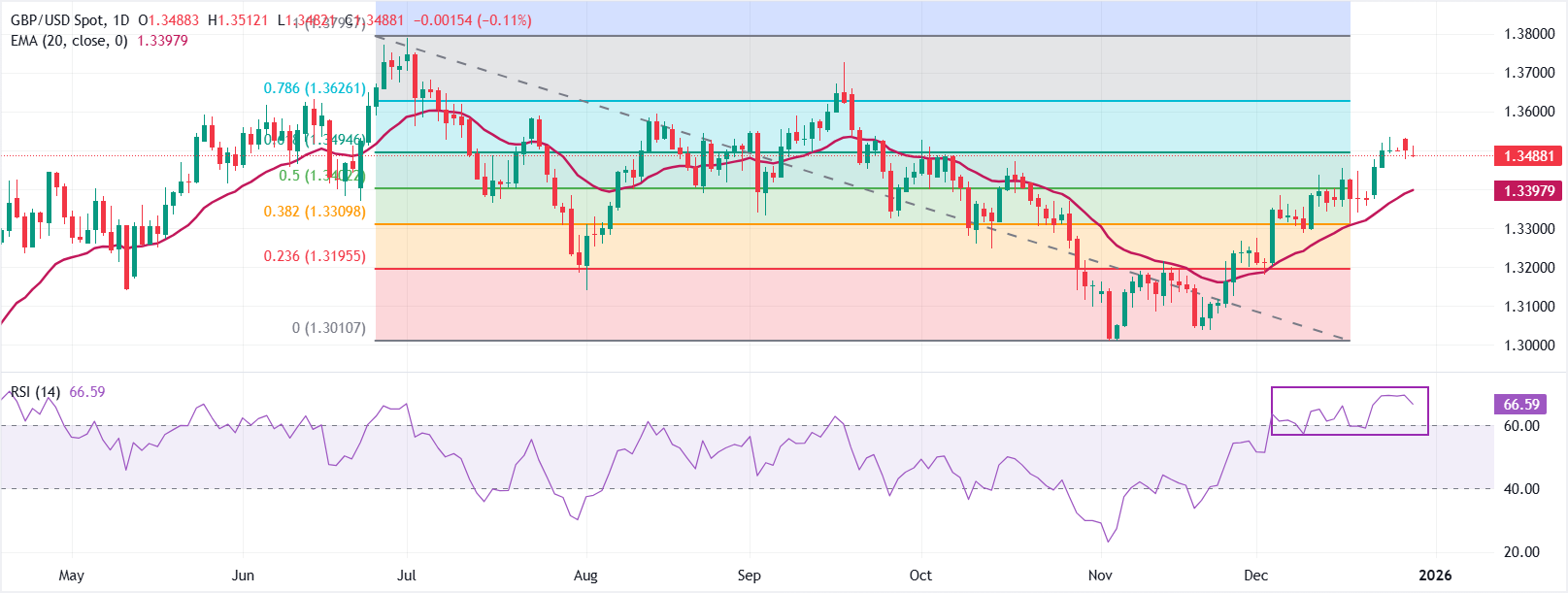
In the daily chart, GBP/USD trades broadly stable at 1.3488. The 20-day Exponential Moving Average (EMA) at 1.3398 ascends, and the price holds above it, reinforcing an upward bias. The recent steepening of this EMA reflects steady buying pressure.
The 14-day Relative Strength Index (RSI) at 66 is bullish without overbought conditions.
Measured from the 1.3794 high to the 1.3011 low, the 61.8% retracement at 1.3495 acts as resistance. A break above it could trigger a move toward the 78.6% retracement at 1.3626.
(The technical analysis of this story was written with the help of an AI tool.)
Author

Sagar Dua
FXStreet
Sagar Dua is associated with the financial markets from his college days. Along with pursuing post-graduation in Commerce in 2014, he started his markets training with chart analysis.