EUR/USD drifts lower on thin trading and a cautious sentiment
- EUR/USD retreats from its highs seen before Christmas in a thin trading session on Monday.
- Hopes of a peace deal in Ukraine are providing some support to the Euro.
- ECB-Fed monetary policy divergence is weighing on a significant USD recovery.

EUR/USD is trading lower for the fourth consecutive day on Monday, changing hands near 1.1760 after having peaked at levels right above 1.1800 last week. The US Dollar firms up as investors ponder the real scope of the Trump-Zelenskyy meeting, while tensions between China and Taiwan escalate.
US President Trump showed confidence that the peace deal in Ukraine is "a lot closer" after he met his Ukrainian counterpart, Volodymyr Zelenskyy, on Sunday, although thorny issues, namely the official status of the Donbas region remain unresolved, and likely to hinder any significant advance towards a sustainable agreement.
The highlight this week will be the release of the minutes of the Federal Reserve's (Fed) December meeting, in which the central bank decided to cut its benchmark rate by 25 basis points and signal another rate cut in 2026. Investors remain confident that the soft labour market will force the Fed to cut rates at least two times next year.
Daily Digest Market Movers: Euro corrects lower in thin trading
- The Euro (EUR) is pulling lower, but remains close to the three-month highs hit last week. Monetary policy divergence between a relatively hawkish European Central Bank and the Fed, which is expected to lower borrowing costs further next year, is acting as a headwind for a significant US Dollar recovery.
- China has announced “major” military exercises around Taiwan on Monday, and Taipei affirmed that several Chinese vessels have been seen near Taiwan’s territorial waters. Chinese drills are a further escalation of tensions in an already sensitive area and are highly likely to support the safe-haven US Dollar.
- On Monday, the most relevant event in the calendar will be the US Pending Home Sales figures for November, which are expected to have risen by 1%, following a 1.9% increase in the previous month.
- US data released last week revealed that the country's Gross Domestic Product grew at a faster-than-expected 4.3% annualised pace in the third quarter, from 3.8% in the second. Still, the US Dollar failed to draw any relevant support from the figures.
- Futures markets are still pricing between two and three Fed interest rate hikes in 2026, practically unchanged from previous weeks, according to data released by the CME Group's FedWatch Tool.
Technical Analysis: EUR/USD approaches trendline support at 1.1755
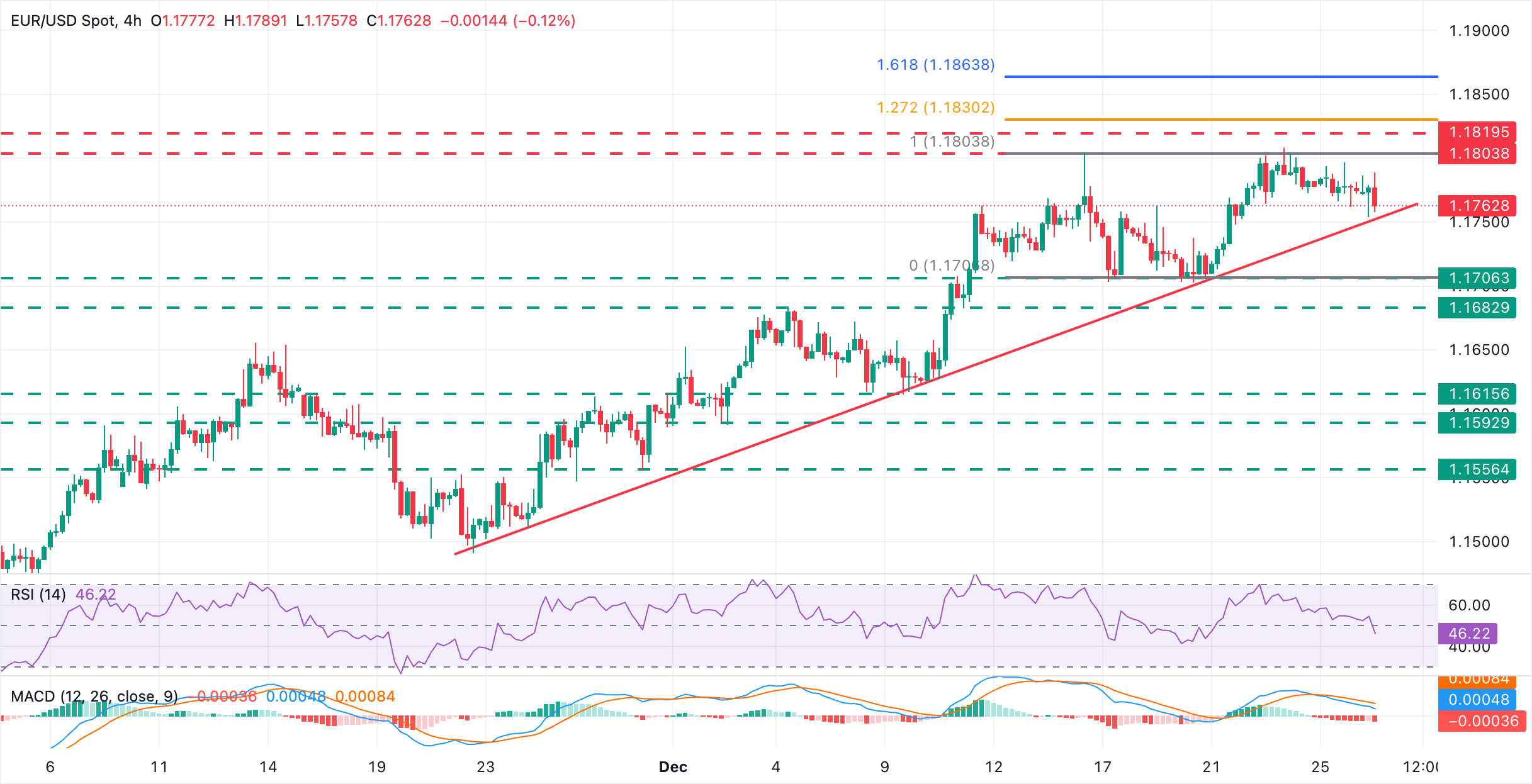
The EUR/USD pair retreats from last week's highs at 1.1800, with technical indicators highlighting a growing bearish momentum. The 4-hour Relative Strength Index (RSI) has retreated below the 50 level, and the Moving Average Convergence Divergence (MACD) indicator is printing red bars after crossing below the signal line.
Bears, however, are likely to find support at the ascending trendline from mid-December lows, now around 1.1755. A confirmation below this level will put the broader bullish trend into question and increase pressure towards the December 17 and 19 lows, near 1.1700.
To the upside, the 1.1805 area, where the pair was capped on December 16 and 24, is likely to challenge bulls ahead of the September 23 and 24 highs near 1.1820. Beyond here, the 161.80% Fibonacci extension of the December 19-24 rally is at 1.1863.
Euro FAQs
The Euro is the currency for the 20 European Union countries that belong to the Eurozone. It is the second most heavily traded currency in the world behind the US Dollar. In 2022, it accounted for 31% of all foreign exchange transactions, with an average daily turnover of over $2.2 trillion a day. EUR/USD is the most heavily traded currency pair in the world, accounting for an estimated 30% off all transactions, followed by EUR/JPY (4%), EUR/GBP (3%) and EUR/AUD (2%).
The European Central Bank (ECB) in Frankfurt, Germany, is the reserve bank for the Eurozone. The ECB sets interest rates and manages monetary policy. The ECB’s primary mandate is to maintain price stability, which means either controlling inflation or stimulating growth. Its primary tool is the raising or lowering of interest rates. Relatively high interest rates – or the expectation of higher rates – will usually benefit the Euro and vice versa. The ECB Governing Council makes monetary policy decisions at meetings held eight times a year. Decisions are made by heads of the Eurozone national banks and six permanent members, including the President of the ECB, Christine Lagarde.
Eurozone inflation data, measured by the Harmonized Index of Consumer Prices (HICP), is an important econometric for the Euro. If inflation rises more than expected, especially if above the ECB’s 2% target, it obliges the ECB to raise interest rates to bring it back under control. Relatively high interest rates compared to its counterparts will usually benefit the Euro, as it makes the region more attractive as a place for global investors to park their money.
Data releases gauge the health of the economy and can impact on the Euro. Indicators such as GDP, Manufacturing and Services PMIs, employment, and consumer sentiment surveys can all influence the direction of the single currency. A strong economy is good for the Euro. Not only does it attract more foreign investment but it may encourage the ECB to put up interest rates, which will directly strengthen the Euro. Otherwise, if economic data is weak, the Euro is likely to fall. Economic data for the four largest economies in the euro area (Germany, France, Italy and Spain) are especially significant, as they account for 75% of the Eurozone’s economy.
Another significant data release for the Euro is the Trade Balance. This indicator measures the difference between what a country earns from its exports and what it spends on imports over a given period. If a country produces highly sought after exports then its currency will gain in value purely from the extra demand created from foreign buyers seeking to purchase these goods. Therefore, a positive net Trade Balance strengthens a currency and vice versa for a negative balance.
Author

Guillermo Alcala
FXStreet
Graduated in Communication Sciences at the Universidad del Pais Vasco and Universiteit van Amsterdam, Guillermo has been working as financial news editor and copywriter in diverse Forex-related firms, like FXStreet and Kantox.