|

TSLA Stock Forecast: Tesla Inc extends streak to seven as Berlin opens doors for Europe

  • NASDAQ:TSLA gained 0.52% during Wednesday’s trading session.
  • Tesla opens the doors to European growth through its Berlin GigaFactory.
  • LG is opening a new battery plant in Arizona to supply Tesla.

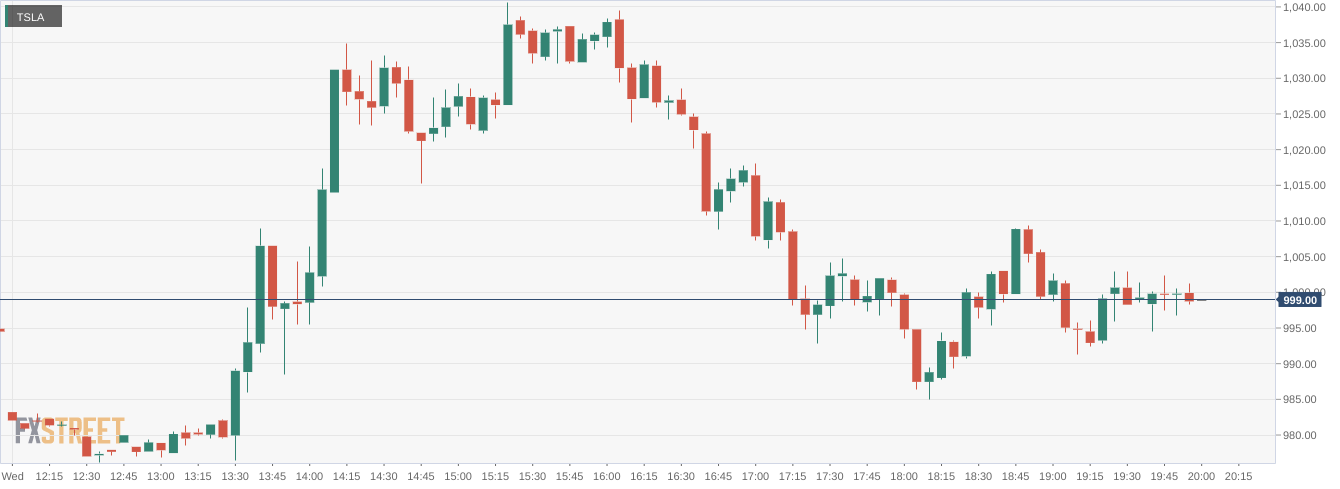
NASDAQ:TSLA surged past the $1,000 plateau Wednesday morning, but market weakness in the afternoon saw the stock close below the mark. Shares of TSLA gained 0.52% and closed the trading day at $999.11. The stock touched as high as $1,040 out of the gate this morning, but rising oil prices and a spike in the ten-year treasury bond yield sent the equities lower into the close. All three major indices closed the session lower, as the Dow Jones dropped by 448 basis points, while the S&P 500 and NASDAQ fell by 1.23% and 1.32% respectively during the session.


Stay up to speed with hot stocks' news!


On Tuesday, CEO Elon Musk officially opened the Berlin GigaFactory to much celebration from Tesla fans and shareholders alike. The factory gives Tesla a firm foothold in Europe and will reduce the costs of shipping vehicles from the US and Shanghai. Berlin’s capacity is expected to reach upwards of 500,000 vehicles on an annual basis, which will definitely give domestic brands like BMW and Volskwagen stiff competition. Some analysts are also expecting Tesla to build vehicles in Berlin that will be suited more for the European consumer, something it has already done in the US and China.

TSLA Stock

Korean tech giant, LG, is building a new factory in Arizona to build batteries that will supply Tesla and other companies. The news comes on the heels of Japanese electronics company Panasonic announcing that it will build its own battery plant in either Oklahoma or Kansas in the next couple of years, also to supply Tesla. As the EV industry grows in the US, so too does the infrastructure needed to supply EV makers with critical parts and supplies.

Author

More from Stocks Reporter
Share:

Editor's Picks

GBP/USD flirts with weekly highs in the Fed's aftermath

GBP/USD reversed early losses following the Federal Reserve decision to keep rates on hold and neared the 1.3360 level before shedding some ground. Focus shifts to Governor Kevin Warsh's speech, while the Bank of England will announce its monetary policy decision on Thursday.

EUR/USD extends rally pass 1.1450 on Fed's Warsh

EUR/USD trades at fresh weekly highs above 1.1450, following the Federal Reserve monetary policy decision to keep interest rates on hold. The statement showed policymakers remain confident in economic progress while blaming inflation on energy prices. The divided vote among officials put in doubt a September hike, leading to sharp US Dollar losses.

Gold  hovers around $4,100 as Fed decision hits the USD

Gold surged following the Federal Reserve's decision to keep the benchmark interest rate unchanged at 3.50%-3.75%. Policymakers noted that inflation remains elevated and that economic activity is expanding at a solid pace despite elevated uncertainty, spurring doubts about a rate hike in September. XAU/USD peaked above $4,100, now battling to retain the level.

No soft target: Warsh vows to return inflation to 2%
The Fed left interest rates unchanged at 3.50%-3.75%, but the decision carried a distinctly hawkish edge as three officials voted for an immediate 25-basis-point increase. Chair Kevin Warsh reinforced that message, insisting there was no tolerance for a softer inflation target and warning that the Fed would not hesitate to act.
How the CLARITY Act unlocks Wall Street’s tokenization pipeline
The United States (US) Digital Asset Market Clarity Act (CLARITY Act), awaiting a full Senate floor vote, promises to unlock Wall Street’s potential to tokenize financial assets, including equities, US Treasuries, private credit, real estate and commodities at a scale that could supercharge the real-world asset (RWA) market from the current $17 billion level to $5.5 trillion by 2030, according to
US Dollar mid-year outlook: Exceptional currency, exceptional risks?
The US Dollar enters the second half of 2026 in a markedly different position from a year ago. The King currency has recovered, reflecting persistent US inflation, changing expectations for Fed policy, geopolitical tensions and renewed demand for defensive assets.