|

The VIX remains elevated in historical terms but there could be more downise to come

  • The CBOE Volatility Index (VIX) is 7.57% lower as stock markets start the week off higher.
  • In terms of "normal levels" the index is far from its usual range.

VIX daily chart

The VIX is usually there to measure volatility and is calculated using a formula to derive expected volatility by averaging the weighted prices of out-of-the-money puts and calls. These are bearish (Puts) and Bullish (Calls) options based on the S&P 500.

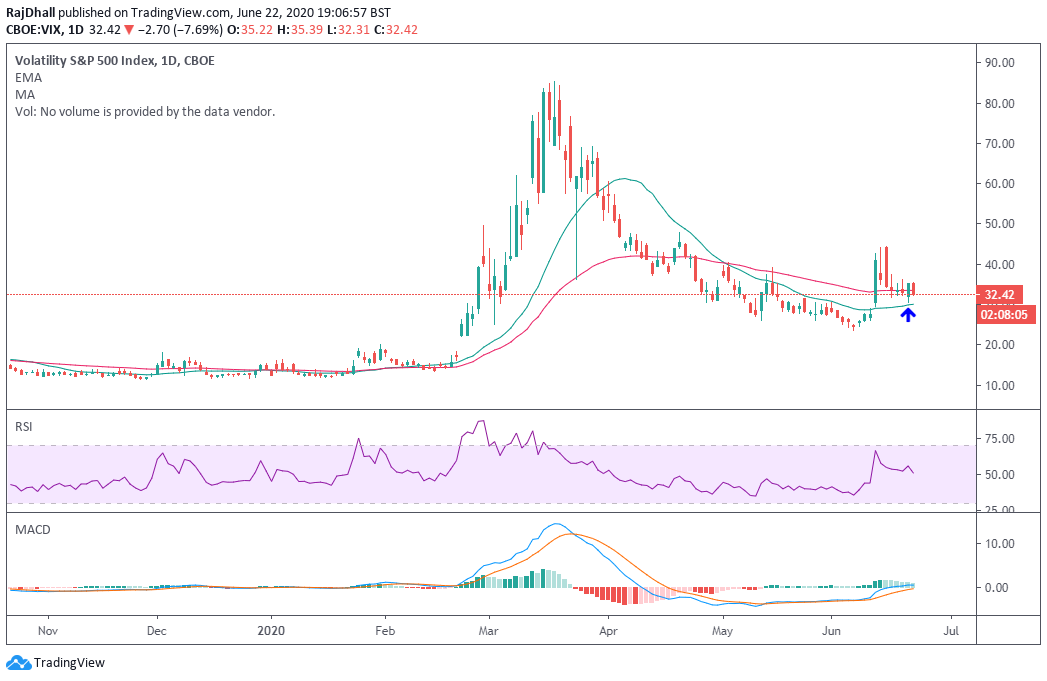
On Monday you can see from the chart below that the index has fallen by over 7%. This usually happens when the stock markets rally and the risk appetite in the market is positive. 

The price is currently trading above the 55 Exponential Moving Average and 200 Simple Moving Average. The moving averages are a good gauge in the VIX as when the price is underneath it usually represents a bull market. In this case, the VIX has used the 200 Simple Moving Average as a support zone and bounced back to the upside. In the future this support could be broken.

The US administration has recently indicated that even if there is a second wave of the COVID-19 pandemic, there will not be another lockdown or period of store closures. This could be bearish for the VIX and during the week if not next week the price may move back below the moving averages. There also seems to be another round of fiscal stimulus on the way, in which US residents could receive another cheque.

If the stock markets continue to trend higher then the VIX could eventually return to more normal levels between 11 and 20. At the moment the price is around 32 and in March was close to hitting 85.50 a far cry from where the market landscape is today.
VIX Stock Market Volatility

Author

Rajan Dhall, MSTA

Rajan Dhall is an experienced market analyst, who has been trading professionally since 2007 managing various funds producing exceptional returns.


More from Rajan Dhall, MSTA
Share:

Editor's Picks

EUR/USD shifts its attention to 1.1900 and above

EUR/USD has shaken off Tuesday’s dip, pushing back beyond the 1.1800 mark amid decent gains as  Wednesday’s session draws to a close. The rebound is largely driven by a modest pullback in the US Dollar, as markets digest the aftermath of President Trump’s SOTU speech and continue to monitor trade-related headlines and signals from the White House.
 

GBP/USD challenges multi-day highs near 1.3530

GBP/USD leaves behind the previous day’s decline and regains fresh upside traction on Wednesday, surpassing the 1.3500 barrier in a context of a modest decline in the Greenback and a generalised improved mood in the risk-linked space. Meanwhile, the US tariff narrative continues to dictate the mood among market participants after Presidet Trump’s SOTU speech failed to surprise markets.

Gold remains bid and close to $5,200

Gold buyers are returning to the fold on Wednesday, targeting the $5,200 area and possibly beyond, after Tuesday’s corrective dip from monthly highs. The rebound in the precious metal comes as the US Dollar loses traction, with Trump’s SOTU speech offering little fresh direction and AI-related nerves continuing to ease.

UK financial watchdog advances stablecoin oversight as four firms pilot issuance

The Financial Conduct Authority (FCA) in the United Kingdom (UK) is advancing toward the final stablecoin regulatory framework with a pilot program involving four companies, including Monee, Financial Technologies ReStabilise, Revolut and VVTX.

Nvidia earnings to influence AI trade and broader market sentiment

For the last three years, Nvidia has been the engine of the AI boom, and now Wall Street is watching to see whether that momentum can keep going. High-growth stocks have been struggling to maintain their bullish trend in 2026.

Cosmos Hub Price Forecast: ATOM rebounds slightly, bearish outlook remains intact

Cosmos Hub (ATOM) price rebounds, trading above $2.05 at the time of writing on Wednesday, after undergoing a sharp correction since last week. Weakening on-chain and derivatives data support a bearish outlook, while technical analysis remains unfavorable.