Tesla set to skid after missing on revenues and profits

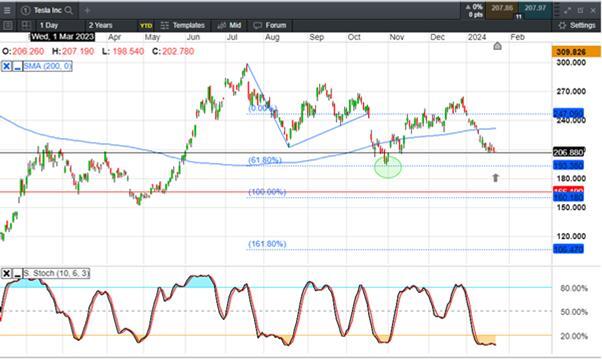
Having found itself caught up in the big Nasdaq 100 sell off in 2022 as its share price fell from peaks of $400 to as low as $102 in 2022 the Tesla share price managed to rebound to just shy of $300 in the summer of 2023, before establishing a short-term base just above $190 a share in October last year.
Since posting those lows in the wake of its Q3 numbers back in October the Tesla share price has chopped sideways as investors mull the prospect of whether we’ve seen peak Tesla when it comes to EV growth and profitability.
Tesla one-year chart
Source: CMC Markets
Wherever you look there are signs of EV fatigue as Tesla’s first mover advantage starts to wane, and the costs of owning an electric vehicle start to become apparent to all but the most affluent buyers.
Rising insurance costs relative to ICE cars, as well as higher repair costs mean that while running costs might be cheaper on a day-to-day basis, the financial barriers to owning an electric car are still high, while the same concerns about range anxiety remain.
While Musk is acutely aware of this given that he has indicated that he wants to look at producing a cheaper model at the company’s Austin factory, the market is also aware that the days of big margins on EV sales are very much in the rear-view mirror.
A year ago, when Tesla CEO Elon Musk outlined his sales target for the whole of 2023 the ambition was to push total sales to as many as 2m vehicles, which at the time seemed eminently feasible.
Increasing competition along with supply chain disruptions made that task harder and while it should meet that target in the upcoming fiscal year, having sold 1.8m in 2023 the days of big margins appear to be long gone.
We still saw total revenues rise to a record $25.17bn in Q4, a 3% increase year on year, however this was short of forecasts of $25.9bn, with annual revenues coming in at $96.7bn.
Profits were also below expectations coming in at 71c a share, pushing the shares sharply lower in afterhours trading, towards the lows we saw back in October.
The problem for Tesla is any significant attempt to boost sales and revenues from here on in will probably need to be achieved at the cost of further falls in operating margin, due to having to compete with BYD in China, one of its biggest markets, as well as increased competition elsewhere.
We’ve already seen the evidence for this over the past few months which has seen Tesla cut prices sharply across all its markets dragging operating margins down from 16% a year ago to 8.2%, while operating expenses have also gone by 27% to $2.37bn.
On an annual basis operating expenses rose to $8.77bn from $7.2bn while automotive gross margin fell from 28.5% to 18.2%.
Total automotive revenues rose 15% in 2023, however the main growth area came from Tesla’s energy generation business which saw revenues rise 54% to $6bn, while services grew 37% to $8.32bn.
Energy generation will be a key area of revenue growth as electric vehicles become more mainstream with pay per use supercharging points likely to help drive profits going forward, with the company looking to ramp up its charging infrastructure.
Deliveries of the first batch of the Cybertruck also began during Q4 from its Austin facility in Texas, with the initial aim of 125,000 capacity.
As we look ahead to the upcoming quarter and the new fiscal year Musk came across as particularly downbeat, declining to offer any specific full year targets, although Tesla did project that automotive volume growth was likely to be lower than 2023, and that the outlook for revenue in energy storage is expected to be better.
Author

Michael Hewson MSTA CFTe
Independent Analyst
Award winning technical analyst, trader and market commentator. In my many years in the business I’ve been passionate about delivering education to retail traders, as well as other financial professionals. Visit my Substack here.















